StoryHarness: AI Novel Writing & Multi-Agent Story Generator Source Code
StoryHarness turns a one-sentence idea into a story bible, an outline and a full novel written chapter by chapter. Separate AI agents outline, write, evaluate, revise and validate while sharing one memory of characters and world, with an ontology graph, quota-based plans and TXT export. Python + FastAPI.
Screenshots
About this product
Long-form fiction is where general-purpose AI chat tools fall apart. They can write a good scene, but by chapter 40 a character has a different personality, a foreshadowed clue has been forgotten, and the writer is spending more time re-explaining the story than writing it. Serial web-fiction authors who publish daily, scriptwriters working to a multi-act structure and brand writers turning source material into a narrative all hit the same wall: the model has no lasting memory of the book.
StoryHarness is an AI novel writing application built around a multi-agent pipeline and a story bible first approach. From a one-sentence idea it generates a story bible and an outline, then writes the work chapter by chapter. Separate agents handle outlining, the story bible, chapter generation, evaluation, revision and validation, and they share characters, worldbuilding and chapter state through a shared memory store so the book stays consistent. The seller describes the target as a publication-grade, full-length novel, with the writer keeping control of the story and the decisions.
Features
From one sentence to a full outline
- Start a project from a single-sentence idea; StoryHarness generates the story bible and a chapter-by-chapter outline
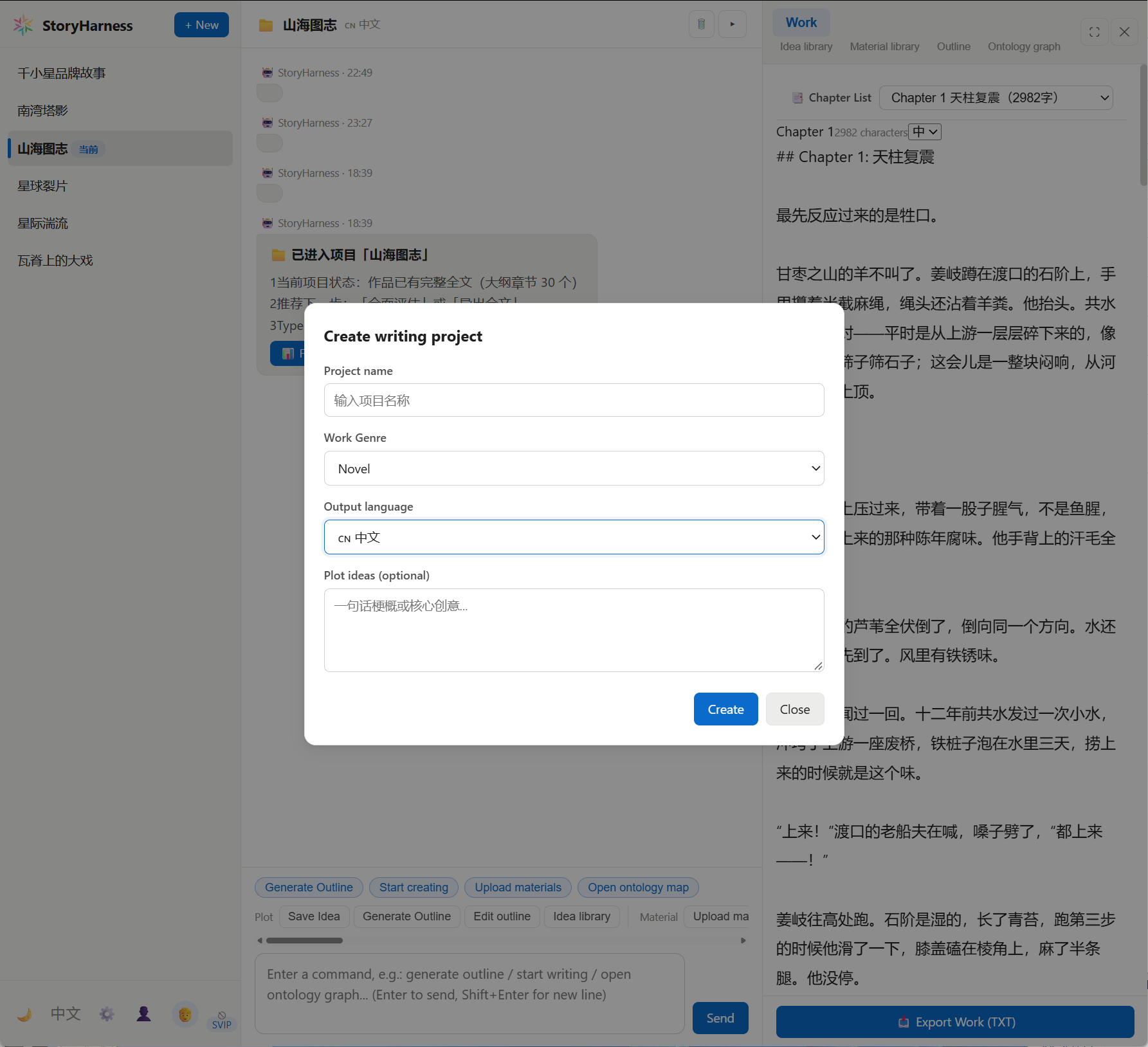
- Create writing project dialog with project name, work genre (e.g. Novel), output language (Chinese is shown) and optional plot ideas
- Edit the outline, save ideas to an Idea library and upload source materials to a Material library
Character and story consistency
- Character profiles are kept for the whole book, so traits hold across long works (the seller cites consistency across a million words)
- Foreshadowing is logged and later resolved, according to the seller
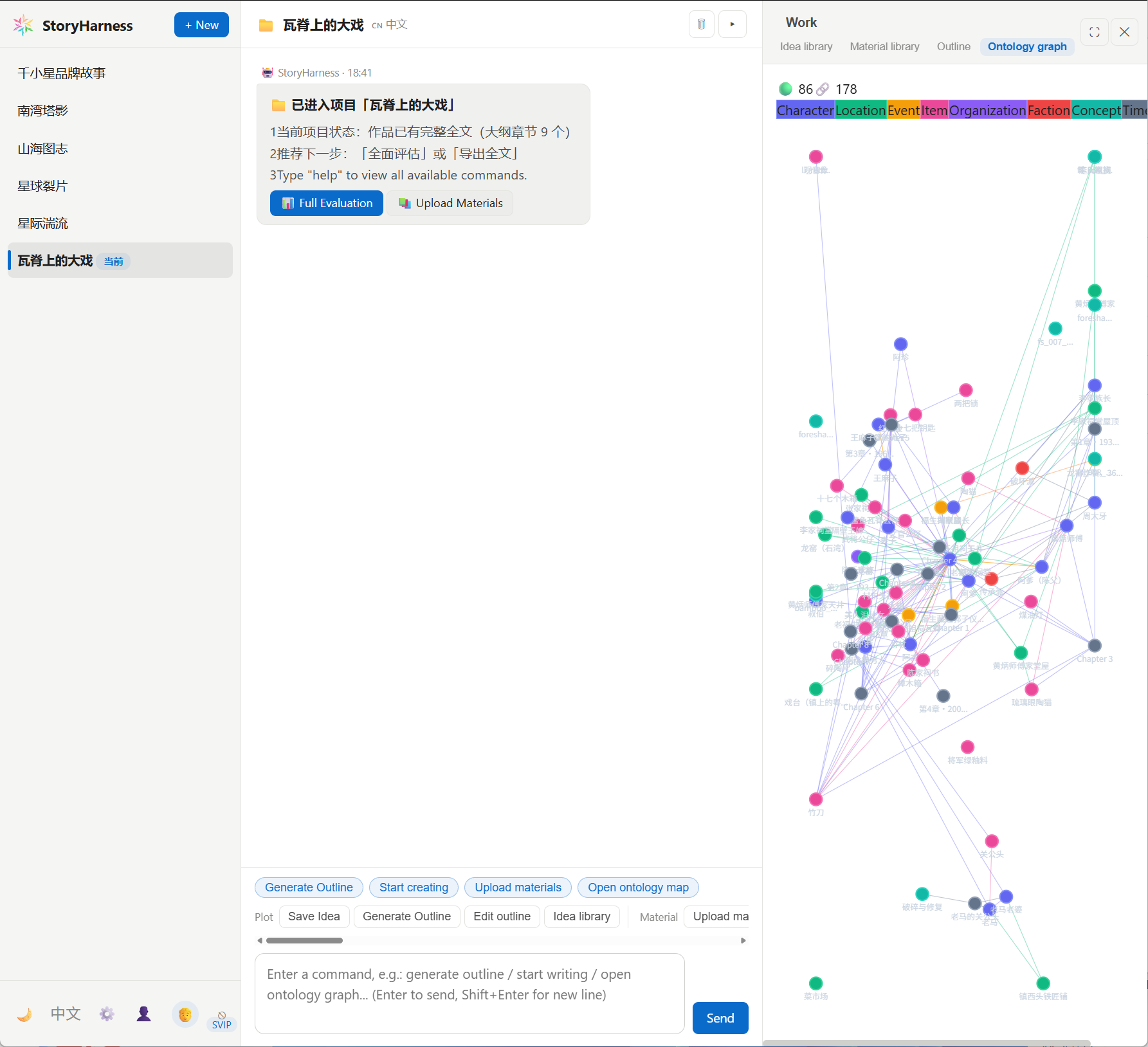
- An Ontology graph maps the story world as nodes and links typed as Character, Location, Event, Item, Organization, Faction, Concept and Time (one sample project shows 86 nodes and 178 links)
Generate, evaluate, revise, validate
- A QA agent plus programmatic rules score each work for structure, character, language and consistency
- A revision orchestrator distributes suggestions and an independent validator checks the result
- Quality-anchor rollback stops revisions from making the text progressively worse
- One-click Full Evaluation from the project panel
Writing workspace
- Three-pane workspace: project list, command chat and a Work panel with Chapter List, Outline and character counts per chapter
- Chat-style command box (e.g. "generate outline", "start writing", "open ontology graph", "help") plus quick-action buttons
- Export Work (TXT), dark mode and a Chinese/English interface toggle
Accounts, quotas and plans
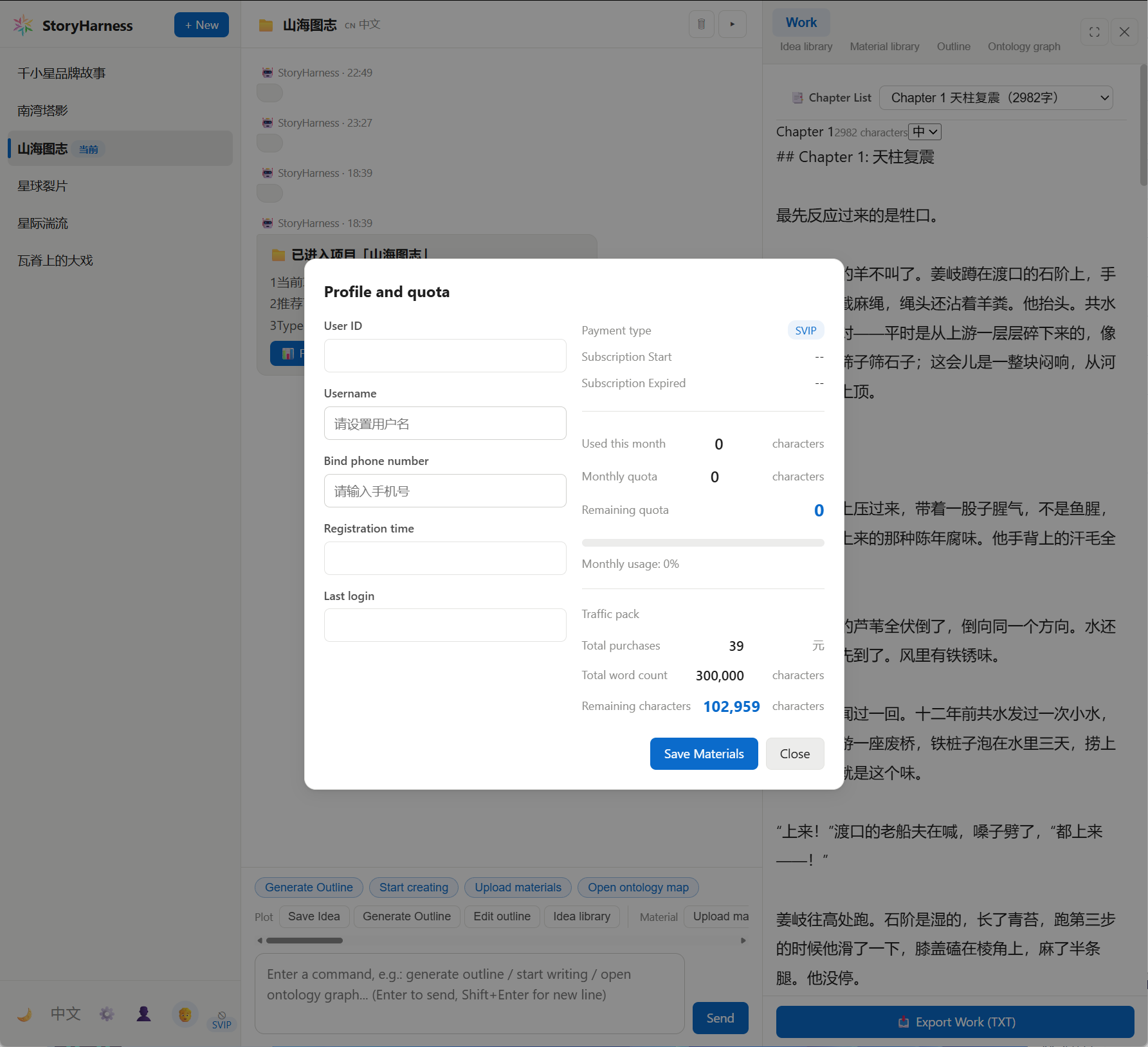
- Profile and quota screen with user ID, username, phone binding, registration time and last login
- Subscription tier (SVIP shown), monthly character quota, usage meter and remaining quota
- Traffic packs of characters (the sample shows a 39 yuan pack of 300,000 characters)
Marketing website
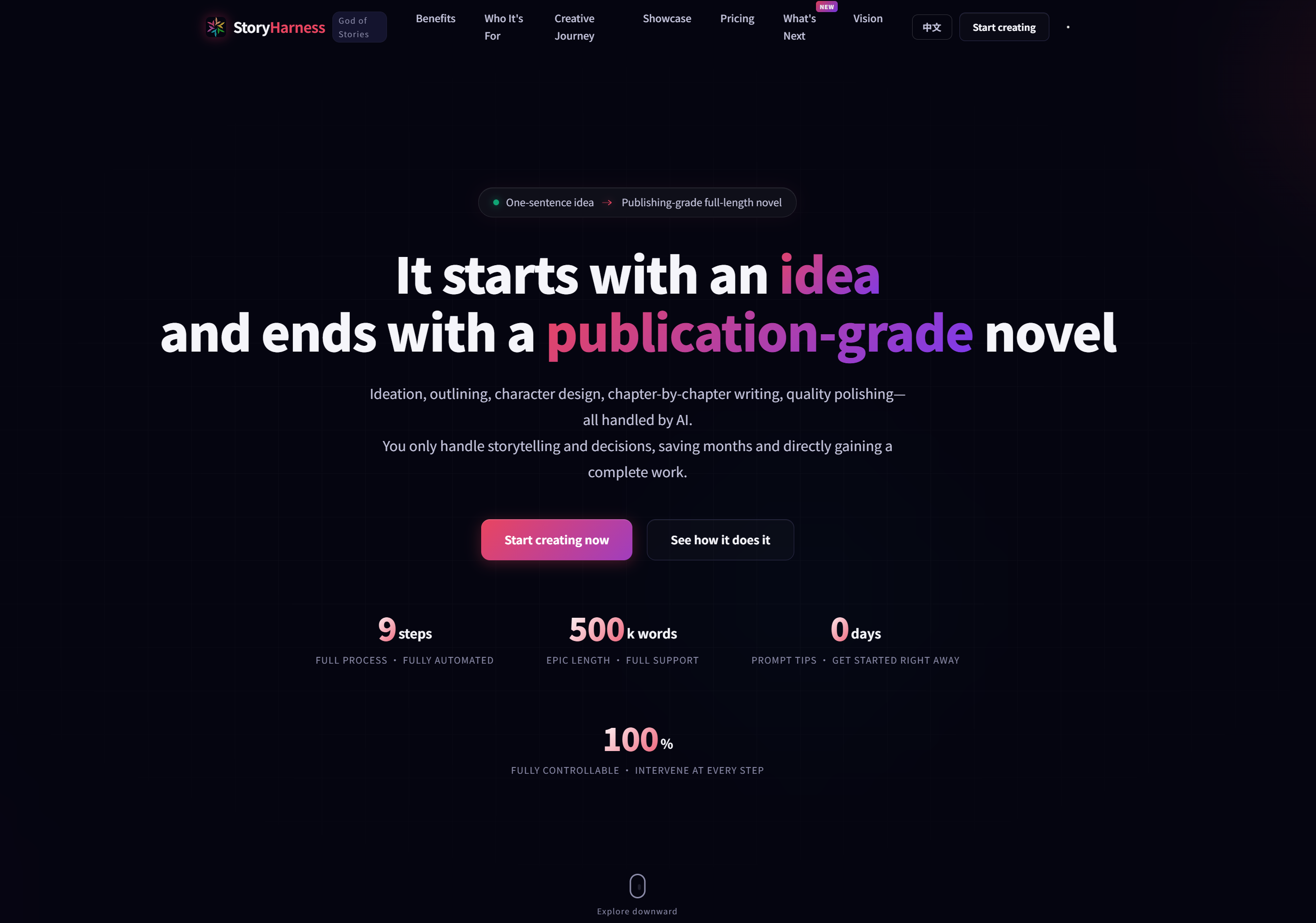
- Dark landing page with Benefits, Who It's For, Creative Journey, Showcase, Pricing, What's Next and Vision sections and a Chinese toggle
Who it is for
- Founders launching an AI fiction or AI writing SaaS, especially for the web-novel and serial-fiction market
- Web fiction platforms and publishers that want an in-house co-writing tool for daily serial updates
- Script and content studios needing outline-to-multi-act structure with pacing and hooks planned
- Brand and documentary content teams that upload materials, set a theme and have the AI expand the narrative
How it works
- The writer creates a project and enters a one-sentence idea, genre and output language.
- StoryHarness builds the story bible (characters, worldbuilding) and the outline.
- Agents write the work chapter by chapter, sharing state through the memory store.
- The QA agent and rules evaluate the draft; the revision orchestrator and validator fix and check it.
- The writer reviews, steers at any step and exports the manuscript as TXT.
Ways to monetize
The built-in model is a monthly character quota on subscription tiers plus one-off character traffic packs. A buyer could also sell team or studio plans, white-label the tool to fiction platforms, or charge per finished manuscript.
Technology
Python · FastAPI · SQLite · REST API · Vanilla JavaScript · HTML5/CSS3 · Nginx · Docker
What you get
- Source code for the writing application and admin panel (Python, FastAPI, SQLite, vanilla JavaScript)
- Source code for the marketing website (HTML5, CSS3, JavaScript, served via Nginx and Docker)
- 30 days of seller support
中文简介
StoryHarness(故事之神)是一款基于多智能体协作与"故事圣经优先"原则的 AI 长篇小说创作系统:一句话灵感即可生成大纲,逐章写作,并通过质检、修订与校验闭环保持人物与设定的一致性。内置本体关系图、灵感库、素材库、按字数计费的会员与流量包,支持中英文界面与 TXT 导出。
Good to know
- AI model. The listing does not name the language model or provider behind the agents. Confirm which LLM APIs it calls and budget for your own API keys and usage costs.
- Seller claims. The seller reports reinforcement-learning writing agents that let small models outperform top-tier models, and consistency across a million words. These are not independently verified; ask for sample manuscripts and evaluation results.
- Language and market. The sample projects and outputs shown are in Chinese and the quota screen prices packs in yuan. Check English output quality and swap the payment setup for your market.
- Payments. Subscriptions and traffic packs appear in the UI, but no payment gateway is named. Confirm with the seller what is wired up.
- Traction. No user or revenue figures are given, so treat it as a product, not a running business.
- Database. SQLite suits a single server; plan a move to PostgreSQL or MySQL if you expect many concurrent writers.
- Content and copyright. AI-generated fiction raises copyright and platform-policy questions that vary by country and publisher.
What's included
- Admin Panel
- Website
Documentation
Support
Included: 30 days
Contact the publisher
Reviews
No reviews yet.