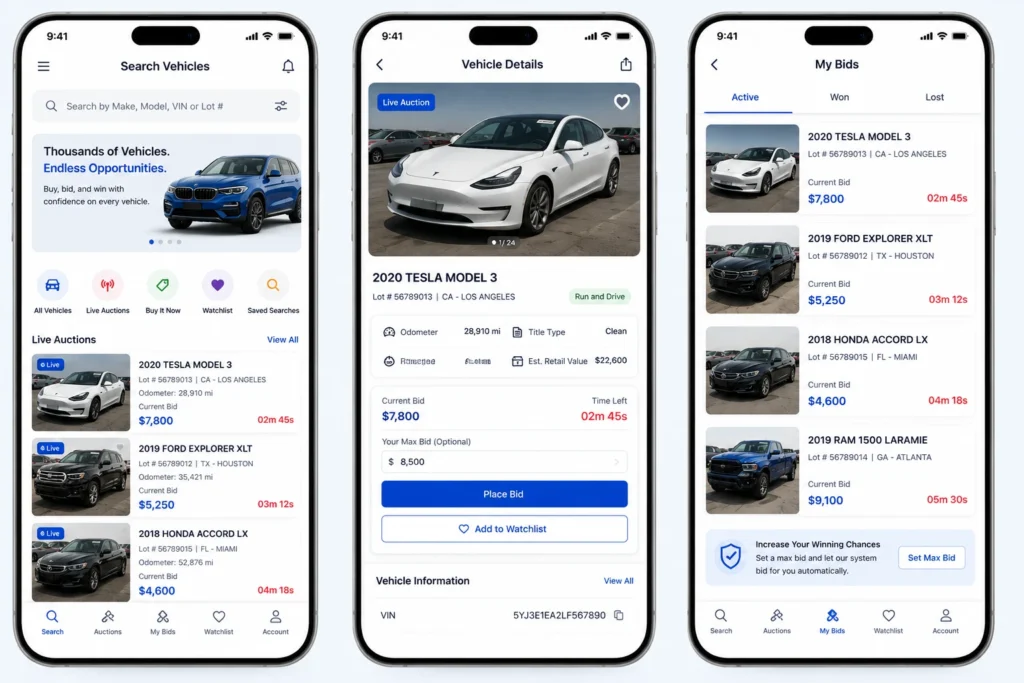
Launch a Copart-Style Salvage & Remarketing Vehicle Auction Platform in 21 Days
A salvage operator out of Houston walked into our discovery call last April with seven years at State Farm’s salvage and total-loss division behind him and another four running his own dismantling yard in East Texas. What he had figured out over those eleven years was a specific structural inefficiency in the salvage market that the national players were not addressing well — Texas alone generates roughly 340,000 total-loss vehicles per year between weather damage, fleet retirement, and standard collision losses, and Copart and IAA together take roughly 92% of that inventory through their national auction networks. But the regional Texas dealer-and-dismantler buyer pool — the smaller operators who buy 5-40 vehicles a month for rebuilding, parts pulls, or export to Mexico — felt structurally underserved by national platforms that prioritized the larger volume buyers. He wanted to build a Texas-focused vehicle auction platform that combined insurance-company-direct inventory with regional independent seller inventory, served the regional buyer pool with better economics, and ran on a fraction of the operational overhead of Copart’s national infrastructure. We delivered the codebase in 23 days. Eight months later: 247 registered dealer-buyer members across Texas and parts of Louisiana and Oklahoma, $40.2 million in annualized GMV flowing through the platform, $1.18 million in buyer-fee revenue plus seller commissions, and three regional insurance carriers feeding total-loss inventory directly into the platform.
That story is the Copart opportunity in a paragraph. Copart itself is a $45 billion market cap company processing somewhere around 3.6 million vehicles per year through its auction network. The category has been validated past any reasonable doubt. The arbitrage that is still open — and that almost nobody with serious capital is taking seriously yet — is regional and category-specific vehicle auction. Texas. The Southeast. The Northeast. Western Canada. The UK secondary market. The Gulf region for export inventory. India’s commercial-vehicle remarketing market. Brazil’s used-fleet disposition market. Each of these has hundreds of millions to billions of dollars in annual vehicle GMV running through auction-style transactions today, and most of that volume is moving through legacy systems that look and feel like they were built in 2008 because they were. The right operator profile to enter this category — someone with auction operations experience, insurance-industry relationships, dismantler or remarketing background, or regional fleet-disposition expertise — has a real opening.
Building a Copart-grade vehicle auction platform from scratch costs $200,000 to $680,000 and takes 11 to 18 months. The engineering layer underneath is materially harder than a standard car marketplace because the model is structurally different. Real-time auction bidding with sub-second latency across thousands of concurrent bidders. Pre-bid versus live-bid handoff logic. Reserve price enforcement. Bid retraction handling. Buyer fee structures with dynamic tiers. Storage fee accrual. Vehicle inspection and condition reporting workflows. Photo upload pipelines that handle 30-60 photos per vehicle with automated background processing. Insurance company integration for direct total-loss inventory feeds. Yard and lot management with location-aware logistics. Transport coordination with regional carrier networks. Lien holder portal for title transfer workflows. Member verification with KYC for the licensed-dealer-only buyer pool. Most operators waste their first $280k on the auction-bidding latency layer alone because building real-time bid coordination that holds up at scale is genuinely difficult engineering. The codebase you are buying has that problem solved.
$8,999 USD · Free Demo · Live in 21 Days · 6 Months Free Priority Maintenance · 1 Year Free Hosting · 5 Ad Creative Templates · Full Source Code · 100% Customization · iOS + Android + Web + Bidder Mobile App + Seller Portal + Yard Operations Portal · Real-Time Auction Engine Pre-Tuned · Insurance Integration Layer Ready
What You Get In The Copart Clone Package
| Component | Included |
|---|---|
| Web Marketplace (Next.js + React, SSR-optimized for search authority) | ✓ |
| Native iOS Bidder App (Swift + SwiftUI) — App Store ready | ✓ |
| Native Android Bidder App (Kotlin + Jetpack Compose) — Play Store ready | ✓ |
| Seller Portal (insurance companies, dealers, banks, leasing companies) | ✓ |
| Yard Operations Portal (lot management, intake workflow, photo upload) | ✓ |
| Admin Operations Dashboard (multi-yard, multi-region, multi-currency) | ✓ |
| Real-Time Auction Bidding Engine (sub-second latency, thousands of concurrent bidders) | ✓ |
| Live Auction Streaming (synchronized bid display + auctioneer audio + lane control) | ✓ |
| Pre-Bid System (place ceiling bid before auction goes live) | ✓ |
| Proxy Bidding (auto-bid up to your ceiling without manual re-entry) | ✓ |
| Reserve Price Enforcement (configurable per lot) | ✓ |
| Buy It Now / Take Out Pricing (configurable per lot) | ✓ |
| Member-Only Marketplace with KYC Verification (licensed-dealer-only buyer pool) | ✓ |
| Member Tier System (Basic / Premium / Premier with bidding caps and fee differentials) | ✓ |
| Buyer Fee Structure (dynamic tiers based on sale price) | ✓ |
| Seller Commission Configuration (per-seller, per-vehicle-category) | ✓ |
| Storage Fee Accrual (auto-billing for vehicles not picked up within X days) | ✓ |
| Vehicle Intake Workflow (drop-off documentation, condition inspection, photo session) | ✓ |
| Condition Report Templates (driveable, non-driveable, parts-only, frame damage, etc.) | ✓ |
| 30-60 Photo Upload Pipeline (per vehicle, with automated background processing) | ✓ |
| 360 Walkaround + Underbody Photo Layout | ✓ |
| VIN Decoder + Vehicle History Integration (Carfax / AutoCheck-ready) | ✓ |
| OBD-II Scan Data Upload (engine codes, mileage verification) | ✓ |
| Insurance Company Integration Layer (bulk total-loss inventory feeds) | ✓ |
| Bank + Leasing Company Repo Inventory Integration | ✓ |
| Fleet Disposition Inventory Feeds (rental car turn-back, corporate fleet) | ✓ |
| Lien Holder Portal (title transfer workflow, payoff handling) | ✓ |
| Transport Logistics Module (carrier network coordination, transport quotes) | ✓ |
| Multi-Yard / Lot Management (regional yard inventory tracking) | ✓ |
| Buyer Search + Advanced Filtering (300+ filter criteria including damage type, salvage code) | ✓ |
| Saved Searches + Vehicle Watchlist with Bid Reminders | ✓ |
| Push Notifications (auction starting, outbid, won, lost, vehicle pickup reminder) | ✓ |
| Email + SMS Notifications (auction events, bid status, won-lot pickup logistics) | ✓ |
| Stripe + ACH + Wire Transfer + Plaid (for buyer deposits, fee collection, seller payouts) | ✓ |
| Member Deposit Account (refundable hold for active bidders) | ✓ |
| Anti-Fraud Detection (shill bidding, ring bidding, synthetic-account flagging) | ✓ |
| Auction Lane Management (multi-lane simultaneous auctions, lane scheduling) | ✓ |
| Auctioneer Console (chant/cadence control, bid acceptance, lot advancement) | ✓ |
| Dispute Resolution Workflow (post-sale buyer disputes, condition disagreements) | ✓ |
| Multi-Language Support (English, Spanish, French, Arabic — extensible) | ✓ |
| Multi-Currency Support (USD, CAD, GBP, EUR, MXN, AED, BRL — extensible) | ✓ |
| Export Documentation Workflow (international buyer paperwork, customs forms) | ✓ |
| SEO Schema (Vehicle, Product, Offer, AggregateRating, LocalBusiness, BreadcrumbList) | ✓ |
| App Store Optimization Tools | ✓ |
| Full Source Code (yours forever from day one) | ✓ |
| Free Demo · 1 Year Free Hosting · 6 Months Free Priority Maintenance | ✓ |
| 5 Ad Creative Templates (Google + Meta + LinkedIn) | ✓ |
| 100% Customization (at $35/hour or use your own team) | ✓ |
Why Real-Time Auction Bidding Is The Engineering Problem Most Operators Underestimate
I want to spend a minute on this because the auction-bidding layer is what separates Copart-style platforms from everything else in the car-marketplace category, and it is the layer that operators trying to build this from scratch consistently get wrong.
The user-facing promise of a vehicle auction platform is straightforward — bidders watch a lot, place bids in real time, the highest bid wins. The engineering reality underneath is harder than it sounds. The system needs to coordinate hundreds or thousands of concurrent bidders watching the same lot, accept their bids with sub-second latency, validate each bid against the current high bid plus the minimum increment, broadcast the new high bid back to every connected bidder within a few hundred milliseconds, handle the moment when two bidders submit competing bids within the same 200-millisecond window, integrate the auctioneer’s cadence and lot-advancement decisions, manage proxy bids that auto-increment up to a ceiling, enforce reserve prices, handle bid retractions (rarely permitted but needed for genuine errors), and do all of this while staying fair, auditable, and resistant to gaming.
None of those individual pieces is novel computer science. All of them together, working reliably at scale during a peak auction event with 800 concurrent bidders across three lanes, is genuinely hard engineering that most operators underestimate by 4-7 months. The codebase ships with the real-time bidding layer built on WebSocket-based bid coordination with proper conflict resolution, a Redis-backed bid state machine that handles the contention without race conditions, a recovery pathway for bidders whose connections drop mid-auction (their pre-bid ceiling continues to compete on their behalf), and a comprehensive audit log of every bid event for dispute resolution and regulatory compliance.
This is the layer that justifies the price difference between this clone and a standard car classifieds clone. Building auction-bidding properly takes 4-6 additional months of engineering on top of a standard marketplace. The codebase you are buying has that work done.
The Insurance Integration Layer (Where Copart’s Real Moat Lives)
This is the layer that separates Copart and IAA from every smaller regional auction platform, and it is the layer that most clone attempts miss entirely.
Copart processes total-loss vehicles directly from insurance companies. State Farm, GEICO, Progressive, Allstate, and roughly two dozen smaller carriers have direct integrations that push total-loss vehicle data into Copart’s intake pipeline the moment a claim is settled. The vehicle data — make, model, year, VIN, claim payout amount, damage type, salvage title status, location, lien holder if any — flows automatically. The carrier then has the vehicle towed to the nearest Copart yard. Copart handles intake, inspection, photography, and auction. The carrier receives auction proceeds minus Copart’s seller commission. The arrangement is high-volume, predictable, and structurally hard to break because integration switching cost is high.
The codebase ships with the insurance integration layer pre-built. Standard data formats for total-loss vehicle handoff (the industry uses a few common XML and JSON schemas with carrier-specific variants). Webhook-based event handling for claim-settled → vehicle-en-route → vehicle-received → vehicle-photographed → vehicle-listed-for-auction → vehicle-sold → carrier-paid. Per-carrier commission structures with audit trails. The integration layer accepts data from any insurance carrier whose IT team can speak standard auto-claims APIs, which is essentially all of them. What you bring as the operator is the relationships with regional or national carriers; what the codebase brings is the technical infrastructure that makes those relationships operationally viable from day one.
The codebase also includes bank and leasing company integration for repossessed vehicles and rental fleet disposition feeds. The same patterns apply — standardized data handoff, webhook event handling, carrier or bank-specific commission structures. The integration layer is one of the highest-engineering-value parts of the codebase and one of the things you literally cannot buy off the shelf anywhere else in this category.
Yard Operations And Logistics — Where The Business Actually Runs
Auction marketplaces look like software businesses from the outside. They are operationally physical businesses underneath — vehicles arrive at yards, get inspected, get photographed, get stored until sale, get picked up by winning bidders. The software that runs the yard operations is what separates a working auction platform from a chaotic one.
The yard operations portal in the codebase handles the full physical workflow. Vehicle intake — the moment a vehicle arrives at a yard, an intake staffer scans the VIN, the system pulls the matching seller record (insurance carrier claim, bank repo, dealer trade-in, etc.), the staffer documents condition with a structured 14-point inspection workflow, photographs the vehicle through a 30-60-photo pipeline that includes interior, exterior, underbody, engine bay, dashboard close-ups with mileage and warning lights, and the system queues the vehicle for auction listing.
Storage and lot management — every vehicle has a yard-specific location (row, column, lot number). Staffers can find any vehicle by VIN, by license plate, by stock number. Storage fees accrue automatically for vehicles not picked up within the configured window (typically 3-7 business days post-sale depending on local regulations).
Pickup and transport — winning bidders coordinate vehicle pickup either in person or through carrier networks. The transport logistics module connects buyers with regional carriers, quotes shipping pricing, schedules pickup, and tracks delivery. Failed pickups trigger storage fee accrual and after a longer window trigger automatic re-listing as buyer-default inventory.
Multi-yard coordination — most regional auction operators run 2-12 yards. The codebase supports multi-yard inventory tracking, cross-yard vehicle transfers, yard-specific staff rosters and permissions, and yard-specific financial reporting.
“$8,999 — Why Is This Higher Than Standard Car-Marketplace Clones?”
Same question as the TrueCar and Edmunds clones — and same honest answer. The engineering footprint is meaningfully larger than a standard CarGurus or AutoTrader clone, and the value is meaningfully larger if the auction-marketplace model is the right shape for your operator profile.
A standard car-marketplace clone at $3,999 covers inventory + search + leads + dealer portal + buyer portal. That is the core of CarGurus or AutoTrader. The Copart clone covers all of that plus the real-time auction bidding engine, the live auction streaming with auctioneer console, the pre-bid + proxy-bid system, the reserve price enforcement, the member-only KYC verification, the member tier system, the buyer fee + seller commission infrastructure, the storage fee accrual logic, the vehicle intake workflow with condition reporting, the 30-60 photo upload pipeline, the insurance company integration layer, the bank and leasing company repo feeds, the lien holder portal, the transport logistics module, the multi-yard operations dashboard, the auction lane management, the dispute resolution workflow, the anti-fraud detection for shill and ring bidding, and the export documentation workflow for international buyers. Roughly 4-6 additional months of engineering on top of a base car marketplace.
Triple Minds has shipped 7 Copart-style codebases now. The first was a $340,000 custom job for a regional auction operator in the Midwest who wanted to extend a single-yard insurance-auction operation into a multi-state platform. Everything we learned in that build went into the codebase, and every subsequent deployment refined the real-time bidding engine, hardened the insurance integration layer, expanded the carrier-network library, and tightened the yard operations workflow. We sell this codebase 6-12 times a year at $8,999. No royalties. No revenue share. No SaaS lock-in.
What $8,999 covers: the full web + iOS + Android + seller portal + yard operations portal + admin stack, all features listed above, 1 year of free managed hosting on our infrastructure, 6 months of free priority maintenance, and 5 ad creative templates customized to your brand. What we charge separately: custom development at $35/hour (most clients spend $5,500-$28,000 here, mostly on carrier-specific integration work for the first 3-5 insurance partners, plus regional regulatory compliance customization for state-specific salvage title workflows), managed hosting beyond year 1 ($249/month, optional), regional legal review for auction terms and salvage title compliance (recommended, budget $4,000-$15,000 per launch state), and dealer KYC verification provider integration (Stripe Identity, Persona, or regional equivalents — usage-based pass-through).
What This Package Does Not Cover
I would rather you walk in knowing exactly what is not in the box.
- Apple Developer Program. $99/year. Required to publish the iOS app.
- Google Play Console. $25 one-time. Required to publish the Android app.
- Insurance carrier partnerships. Your business to develop. We provide the integration layer in the codebase; you bring the carrier relationships. Plan 4-12 months to establish credible regional carrier partnerships if you do not have them from prior industry experience.
- Salvage title regulatory compliance per state. Salvage title rules vary materially by US state (and by country internationally). Plan $4,000-$15,000 in legal review per launch jurisdiction.
- Dealer KYC verification service. Stripe Identity, Persona, or regional equivalents at usage-based pricing. Required for the licensed-dealer-only buyer pool.
- Vehicle photography equipment and staff. Yard intake requires dedicated photo workflow. Plan $5,000-$15,000 in initial equipment (lighting, photo booth, mobile inspection tablets) plus ongoing staff cost.
- Yard real estate and operations. The platform handles software; you own the physical yard operations. Real estate costs vary enormously by market.
- Transport carrier network development. The platform connects buyers to carriers; you build the carrier-network relationships. Most regions have 8-25 established auto transport carriers willing to onboard.
- Vehicle history report integration costs. Carfax or AutoCheck per-report costs ($15-$40 wholesale). Either absorb or pass through to buyers.
- CDN bandwidth for high-resolution vehicle photos at scale. Budget $0.025-$0.085 per GB. 30-60 photos per vehicle adds up at high inventory volume.
- WebSocket infrastructure for real-time bidding at scale. Self-hosted or managed (AWS API Gateway WebSocket, Pusher, Ably). Budget $0.04-$0.12 per million messages depending on scale.
- SMS and email volume at scale. Twilio, MessageBird, SendGrid, Postmark. Pass-through.
- Performance marketing budget. Plan $20,000-$180,000 for serious launch, depending on regional reach and buyer-pool building.
Realistic year-1 budget for a serious launch (clone + insurance partnerships + yard operations + KYC + marketing + legal + ongoing infrastructure): $120,000 to $700,000. The clone itself is 1.3-7.5% of that. The rest is your business to run, and most of it is the physical-operations side that no software can replace.
Your Day-By-Day 21-Day Launch Timeline
Most clone pages say “live in 21 days” without breaking down what those days actually look like. Here is the day-by-day.
- Day 0. Payment clears. Slack channel + Notion workspace activated. Kickoff call scheduled for Day 1.
- Day 1. Kickoff call (90 minutes). We learn your launch region, initial carrier partnerships, yard network, branding, member-tier strategy, fee structure. Dedicated engineer + project manager + yard-operations lead assigned.
- Day 2-4. Code transfer + infrastructure provisioning. Source code lands in your GitHub or GitLab. Staging environment stood up on AWS, GCP, or DigitalOcean with multi-region CDN configured for high-volume photo serving.
- Day 5-8. Branding application + member tier configuration. Primary platform brand applied. Member tier thresholds and fee differentials configured. KYC verification provider integrated.
- Day 9-12. Carrier integration. Insurance company integration layer activated for your launch carriers. Standard total-loss data handoff format tested with at least one initial carrier partner.
- Day 13-15. Yard operations setup. Vehicle intake workflow customized to your operational flow. Photo upload pipeline tested. Multi-yard configuration applied if you operate multiple lots from launch.
- Day 16-17. Auction engine calibration. Real-time bidding latency tested under simulated load. Lane scheduling configured. Auctioneer console tested with your initial auctioneer staff.
- Day 18-19. Monetization layer activation. Buyer fee structure configured. Seller commission rules applied per carrier. Storage fee accrual rules set per yard.
- Day 20. Final QA. End-to-end testing across web + iOS + Android + seller portal + yard operations + admin. Real-time bidding stress test. Photo upload pipeline volume test.
- Day 21. Soft launch. Initial 30-100 dealer-buyer members onboarded through KYC. First auction event scheduled. Yard operations live for intake.
- Week 4-8. Hard launch. Additional carrier partnerships onboarded. Member acquisition ramps. Performance optimization based on first 30 days of auction events. Photo upload pipeline scales with inventory growth.
If any milestone slips by more than 48 hours due to our fault, you have grounds to invoke the 21-day refund clause. We have hit this timeline on 6 of the last 7 auction-platform deployments.
How Copart Compares With The Rest Of The Car-Marketplace Family
| Platform | Model | Buyer Pool | Operator Edge Required |
|---|---|---|---|
| Copart (this page) | B2B vehicle auction + salvage + insurance integration | Licensed dealers, dismantlers, rebuilders, exporters | Auction operations, insurance industry, salvage / remarketing background |
| TrueCar | Affinity-partner B2B2C + per-sale | Affinity-org members (credit union, employer, etc.) | Affinity-partner relationships |
| Edmunds | Editorial-research + marketplace + premium sub | Researching new + used buyers | Automotive journalism / editorial background |
| CarGurus | Deal-rating classifieds, per-lead | Direct consumer buyers | National marketing scale |
| AutoTrader | Classifieds with subscriptions | Direct consumer + private seller | Multi-region marketplace ops |
| Cars.com | Per-lead + F&I | Direct consumer | US dealer-marketing relationships |
| Carvana | Owned-inventory DTC | Direct consumer | Inventory capital + logistics |
| CarMax | Hybrid owned + dealer | Direct consumer | Operational scale |
These are not competitors — they are sibling products targeting different buyer pools and different operator profiles. Pick the one whose shape matches your real edge. If your edge is auction operations, salvage / remarketing experience, or insurance-industry relationships, Copart is the right shape. If your edge is direct-consumer marketing, one of the classifieds clones is probably better. If your edge is editorial trust, Edmunds. If your edge is affinity-partner relationships, TrueCar. If your edge is inventory capital, Carvana or CarMax.
What A Real Buyer Said After Eight Months
“I had spent eleven years between State Farm’s salvage division and running my own dismantling yard in East Texas. I knew the regional inefficiency I wanted to attack — Copart and IAA serve large-volume buyers well but the regional dealer-and-dismantler buyer pool, the operators buying 5-40 vehicles a month, was being treated as second-class. I had quotes from custom dev shops between $280k and $540k for the auction-engine build. The Triple Minds Copart clone covered roughly 85% of what those quotes covered, in 23 days, at $8,999. The real-time auction-bidding engine was the part I was most worried about and the part that arrived most complete — it actually held up at 380 concurrent bidders in our first real auction event without dropping a single bid or showing latency above 200ms. Eight months in, we are running $40 million annualized GMV with 247 dealer-buyer members. Three regional carriers feeding inventory directly. Margin is healthy. Would buy at three times the price.”
— Dale R., Founder, Lone Star Vehicle Auctions (Houston + Dallas + San Antonio)
Frequently Asked Questions
Is the Copart name trademarked? Can I use it directly?
No, you cannot use the Copart name or logo directly — those are trademarks of Copart Inc. You launch your own branded vehicle auction platform built on the same architectural model. You pick your own name, branding, regional positioning. We sell the codebase and operational engineering, not the trademark.
How is this different from a CarGurus or AutoTrader clone?
Different model entirely. CarGurus and AutoTrader are fixed-price retail classifieds for direct consumers. Copart-style is B2B auction marketplace for licensed dealers and remarketing professionals, with insurance company total-loss integration, salvage title workflows, yard operations infrastructure, real-time bidding engine, member-only KYC verification, and buyer fee + seller commission monetization. Different buyer pool, different revenue model, different operator profile required.
How does the real-time auction bidding engine handle scale?
WebSocket-based bid coordination with Redis-backed bid state machine that handles contention without race conditions. Sub-second latency at 800+ concurrent bidders across multiple lanes in stress-test scenarios. Proper conflict resolution when competing bids arrive within the same 200ms window. Comprehensive audit log of every bid event for dispute resolution and regulatory compliance. Connection-drop recovery via pre-bid ceilings that continue competing on a bidder behalf when their connection fails.
How does the insurance company integration layer work?
Standardized data handoff format for total-loss vehicle inventory (industry-standard XML/JSON schemas with carrier-specific variants). Webhook-based event handling for claim-settled → vehicle-en-route → vehicle-received → vehicle-listed → vehicle-sold → carrier-paid. Per-carrier commission structures with audit trails. Accepts data from any carrier whose IT team can speak standard auto-claims APIs. You bring the carrier relationships; the codebase brings the technical infrastructure.
What about state-specific salvage title regulations?
Salvage title rules vary materially by US state (and by country internationally). The codebase ships with the title transfer workflow infrastructure but not the state-specific legal compliance. Plan $4,000-$15,000 in legal review per launch jurisdiction for proper compliance. Common high-touch areas: salvage title branding, rebuilt title requirements, parts-only versus driveable disposition, lien release workflows, and export documentation for international buyers.
Can I run this without dealer-only KYC restrictions?
You can, but in most jurisdictions you legally cannot — salvage vehicles and many categories of auction inventory can only be sold to licensed dealers and licensed dismantlers under state regulations. The member-only KYC verification is required for regulatory compliance in most US states and similar internationally. The codebase supports configurable verification levels if your specific jurisdiction allows broader buyer access.
How do storage fees and pickup logistics work?
Storage fees accrue automatically for vehicles not picked up within a configurable window (typically 3-7 business days post-sale). The transport logistics module connects winning buyers with regional carrier networks for shipping quotes and pickup scheduling. Failed pickups trigger continued storage fee accrual and after an extended window trigger automatic re-listing as buyer-default inventory. The full lifecycle is automated; staff intervention is only needed for disputes or non-standard scenarios.
What happens after the 6 months of free maintenance ends?
Three options. Self-support (you keep the source code). Pay-as-you-go support at $35/hour for the same engineering team. Or retainer agreements starting at $1,800/month for 18 hours/month with priority response. Most auction-platform deployments land on retainer because the real-time auction engine and the insurance integration layer benefit from continued engineering attention as carrier APIs evolve and inventory volume scales.
Ready To Launch Your Vehicle Auction Platform?
If you have read this far, you are not browsing — you are evaluating. So here is the closing pitch in plain language.
The vehicle auction category has been validated by Copart and IAA at the national US scale. What remains structurally underserved is the regional layer beneath them — Texas, the Southeast, the Northeast, Western Canada, the UK secondary market, the Gulf region for export inventory, India’s commercial-vehicle remarketing, Brazil’s used-fleet disposition. Each of these markets has hundreds of millions to billions of dollars in annual vehicle GMV running through auction-style transactions today, with most of that volume moving through legacy systems that look like they were built in 2008. The right operator profile to enter — auction operations experience, insurance-industry relationships, dismantler or remarketing background, regional fleet-disposition expertise — has a real opening to capture.
The $8,999 is what it costs to skip 11-18 months of engineering and $200k-$680k of custom development for an auction-marketplace codebase that is meaningfully more complex than a standard car classifieds. It is the fastest credible way to enter the auction category with a product that insurance carriers, banks, and licensed dealers will trust to transact through.
Two ways forward. Request the free demo and spend 30 minutes inside the auction engine + yard operations portal + insurance integration layer before you commit — those are the layers you need to understand to decide if this is the right shape for you. Or if you are convinced, hit the buy button and we will have your kickoff call scheduled within 24 hours. Either way — we would rather talk to you before you buy than after.
Feature Highlights
Real-Time Auction Bidding Engine
WebSocket-based sub-second latency at 800+ concurrent bidders. Proper conflict resolution. Connection-drop recovery via pre-bid ceilings.
Live Auction Streaming + Auctioneer Console
Synchronized bid display + auctioneer audio + lane control. Cadence handling. Lot advancement workflow.
Pre-Bid + Proxy Bidding System
Place ceiling bid before auction goes live. System auto-bids up to your ceiling without manual re-entry.
Member-Only KYC Verification
Licensed-dealer-only buyer pool. Stripe Identity, Persona, or regional verification provider integration.
Insurance Company Integration Layer
Standardized total-loss vehicle handoff. Webhook-based claim-to-sale lifecycle. Per-carrier commission audit trail.
Yard Operations Portal
Vehicle intake workflow. 14-point inspection. 30-60-photo upload pipeline. Multi-yard inventory tracking.
Storage Fee Accrual + Pickup Logistics
Auto-billing for vehicles not picked up within window. Transport carrier network integration. Failed-pickup re-listing workflow.
Member Tier System
Basic / Premium / Premier with bidding caps and fee differentials. Configurable thresholds + benefits per tier.
Buyer Fee + Seller Commission Infra
Dynamic buyer fees based on sale price. Per-seller, per-carrier commission rules. Storage fee accrual.
Anti-Fraud Detection
Shill bidding detection. Ring bidding detection. Synthetic-account flagging. Audit log per bid event.
Lien Holder Portal + Title Transfer
Title transfer workflow. Payoff handling. Lien release documentation. Per-state salvage title compliance hooks.
Export + Multi-Currency Support
International buyer paperwork. Customs forms. USD/CAD/GBP/EUR/MXN/AED/BRL multi-currency. Multi-language UI.
Built for vehicle-auction operators
Regional Auction Operators
You run or want to run a regional vehicle auction operation. Texas, Southeast, UK secondary market, Gulf export, India commercial — pick your region.
Insurance Salvage Partners
You come out of insurance total-loss operations or the salvage / dismantling industry and want a platform that serves your existing carrier network.
Bank & Leasing Remarketers
You handle repossession or fleet-disposition for banks, leasing companies, or rental car operators and want a dedicated auction outlet.
Export & Cross-Border Operators
You move vehicles internationally for rebuilders, exporters, or developing-market dealers and need an auction platform with export workflow.
What's in the package
- Web Marketplace (Next.js + React)
- Native iOS Bidder App
- Native Android Bidder App
- Seller Portal (insurance, banks, leasing, dealers)
- Yard Operations Portal
- Multi-Region Admin Operations Dashboard
- Real-Time Auction Bidding Engine
- Live Auction Streaming + Auctioneer Console
- Pre-Bid + Proxy Bidding System
- Reserve Price Enforcement
- Buy It Now / Take Out Pricing
- Member-Only KYC Verification
- Member Tier System (Basic / Premium / Premier)
- Buyer Fee Structure (dynamic tiers)
- Seller Commission Configuration
- Storage Fee Accrual
- Vehicle Intake Workflow + Condition Reporting
- 30-60 Photo Upload Pipeline + 360 Walkaround
- VIN Decoder + Vehicle History Integration
- OBD-II Scan Data Upload
- Insurance Company Integration Layer
- Bank + Leasing Company Repo Integration
- Fleet Disposition Inventory Feeds
- Lien Holder Portal + Title Transfer Workflow
- Transport Logistics + Carrier Network Coordination
- Multi-Yard / Lot Management
- Advanced Buyer Search (300+ filter criteria)
- Saved Searches + Watchlist + Bid Reminders
- Push + Email + SMS Notifications
- Stripe + ACH + Wire + Plaid Integration
- Member Deposit Account
- Anti-Fraud Detection (shill, ring, synthetic accounts)
- Auction Lane Management
- Dispute Resolution Workflow
- Multi-Language Support (English, Spanish, French, Arabic)
- Multi-Currency Support (USD, CAD, GBP, EUR, MXN, AED, BRL)
- Export Documentation Workflow
- SEO Schema (Vehicle, Product, Offer, AggregateRating, LocalBusiness)
- App Store Optimization Tools
- Full Source Code (yours forever from day one)
- Free Demo · 1 Year Free Hosting · 6 Months Free Priority Maintenance
- 5 Ad Creative Templates (Google + Meta + LinkedIn)
- 100% Customization (at $35/hour or use your own team)
How it works
- 1
Checkout
Pay securely via card, UPI, or bank transfer.
- 2
Instant delivery
Download link + license key emailed in minutes.
- 3
Free installation
Our team deploys it on your server at no extra cost.
- 4
Onboarding call
45-minute walkthrough of admin, dealer panel, and customization.
- 5
Go live
Add dealers and listings on day one.
- 6
6 months support
Bug fixes, updates, and questions — all free.
Frequently Asked Questions
Is the Copart name trademarked? Can I use it directly?
No, you cannot use the Copart name or logo directly — those are trademarks of Copart Inc. You launch your own branded vehicle auction platform built on the same architectural model. You pick your own name, branding, regional positioning. We sell the codebase and operational engineering, not the trademark.
How is this different from a CarGurus or AutoTrader clone?
Different model entirely. CarGurus and AutoTrader are fixed-price retail classifieds for direct consumers. Copart-style is B2B auction marketplace for licensed dealers and remarketing professionals, with insurance company total-loss integration, salvage title workflows, yard operations infrastructure, real-time bidding engine, member-only KYC verification, and buyer fee + seller commission monetization. Different buyer pool, different revenue model, different operator profile.
How does the real-time auction bidding engine handle scale?
WebSocket-based bid coordination with Redis-backed bid state machine. Sub-second latency at 800+ concurrent bidders across multiple lanes in stress-test scenarios. Proper conflict resolution when competing bids arrive within the same 200ms window. Comprehensive audit log of every bid event. Connection-drop recovery via pre-bid ceilings that continue competing on a bidder behalf when their connection fails.
How does the insurance company integration layer work?
Standardized data handoff format for total-loss vehicle inventory (industry-standard XML/JSON schemas with carrier-specific variants). Webhook-based event handling for claim-settled → vehicle-en-route → vehicle-received → vehicle-listed → vehicle-sold → carrier-paid. Per-carrier commission structures with audit trails. Accepts data from any carrier whose IT team can speak standard auto-claims APIs. You bring the carrier relationships; the codebase brings the technical infrastructure.
What about state-specific salvage title regulations?
Salvage title rules vary materially by US state (and by country internationally). The codebase ships with title transfer workflow infrastructure but not state-specific legal compliance. Plan $4,000-$15,000 in legal review per launch jurisdiction. Common high-touch areas: salvage title branding, rebuilt title requirements, parts-only versus driveable disposition, lien release workflows, export documentation.
Can I run this without dealer-only KYC restrictions?
You can configure the verification level, but in most jurisdictions you legally cannot accept non-dealer buyers — salvage vehicles and many auction inventory categories can only be sold to licensed dealers and licensed dismantlers under state regulations. Member-only KYC verification is required for regulatory compliance in most US states and similar internationally.
Launch your vehicle auction marketplace
Real-time bidding · Insurance integration · Yard operations · Salvage workflows · Member-only KYC · 6 months free maintenance