Live acquisition program sales@sellmycode.co
Mobile Apps › E-commerce & Marketplace

White Label Multi-Vendor App Development

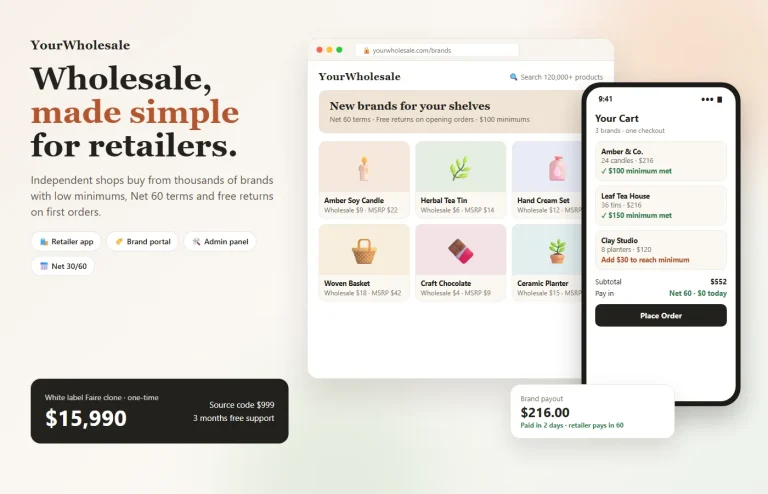
A multi-vendor app turns your store into a platform other businesses sell on. Each vendor gets their own storefront and dashboard inside your app; the buyer sees one brand and checks out once; and the money splits to each vendor automatically with your commission held back.

Every build here ships as a white-label codebase with full source: vendor onboarding and KYC, per-vendor stores, split payouts, commission tiers, product approval and a platform admin over all of it. Launch your multi-vendor marketplace in 14–30 days.

1Live listing
Code-reviewed listingsEvery product is vetted by our engineering team before it goes live.
Full source codeUnencrypted code handover — your servers, your accounts, no lock-in.
White-label licenceRebrand and launch under your own name on the App Store & Google Play.
Post-sale supportDocumentation, launch assistance, and a support window on every kit.
1 listing
Free consultation

Didn't find the right app? Tell us what you want to launch.

Share your requirements and our engineering team will reply within 24 hours with a recommended platform, timeline, and a transparent fixed-bid quote — free, no pressure.

  • Response within 24 hours
  • Free demo & consultation call
  • Full source code on delivery
Why this category

Why buy a multi-vendor app

A multi-vendor app turns your store into a platform other businesses sell on. You stop buying and holding every product yourself and start earning a cut while your vendors carry the inventory, the packing and the risk. The catch is operational, not technical: onboarding vendors, paying each of them the right amount on time, and keeping the bad ones out. Get that machinery right and you scale range without scaling your warehouse.

$3.8T Runs through platforms most of it multi-seller
3–5x Wider catalogue without holding the stock
$7,999 Starting price full source, your brand
14–30 days To soft launch written into the contract
The basics

What a multi-vendor app actually is

Think of an ordinary online store, then give every vendor their own version of it inside yours. Each has a storefront, a dashboard, their own products and their own orders — but the buyer sees one branded app and checks out once. Where a plain marketplace mostly connects buyers and sellers, a multi-vendor platform is built around running the vendors: onboarding them, approving their products, splitting the money, and settling their payouts. That vendor machinery is what you're really buying.

📝

Vendor onboarding and KYC

Self-serve sign-up, document and bank verification, and an approval queue. The gate that decides who gets to sell under your name.

🏪

Per-vendor storefronts

Each vendor gets a branded store page, their own catalogue and their own dashboard for products, orders and payouts — all inside your app.

💰

Split payments and payouts

One buyer payment, automatically divided across every vendor in the cart, your commission held back, and scheduled payouts to each vendor's account.

📈

Commission and plan tiers

Set commission by vendor, category or plan. Offer paid vendor tiers with lower rates or more listings. All configurable, no code.

🚚

Per-vendor shipping and stock

Each vendor sets their own shipping, handles their own inventory, and manages returns — while the buyer still gets one clean order experience.

Platform admin over everything

Approve products, resolve disputes, suspend a vendor, read platform-wide numbers. The control room for a store with a hundred sellers behind it.

Need a specific payout or commission model?

Marketplace-of-record, vendor-of-record, tiered commissions, B2B terms — if the ready clones don't match how you pay vendors, we build it. Full source, your IP, a fixed quote in two days.

Talk to an engineer
Making money

How a multi-vendor platform earns

Your income rides on your vendors' sales, so the model rewards you for signing good vendors and helping them sell — not for squeezing them. Most operators combine a commission with a vendor plan.

💵

Commission per sale

8–25%

Held back automatically on every vendor order. The core line, and the one your whole payout engine is built to handle cleanly.

🔒

Vendor subscription tiers

$19–$499/mo

Monthly plans with lower commission, more listings or better tools. Turns lumpy sales income into predictable recurring revenue.

🔥

Featured vendors and products

per placement

Vendors pay to be promoted on the home screen or top of a category. High margin once you have buyer traffic.

💼

Onboarding and services

one-off

Setup fees, verification, photography or account management for bigger vendors. Small line, but it filters for serious sellers.

Choosing one

How to pick the right multi-vendor clone

Most multi-vendor apps look alike until you ask how the money and the goods actually move. That's where they differ.

💳

Who holds the money?

Marketplace-of-record (you collect, you pay out) or vendor-of-record (each vendor is the merchant)? This decides your tax, refunds and which payout provider fits. Sort it before you buy.

📦

Physical, digital or services?

Physical needs per-vendor shipping and returns. Digital needs instant delivery and licences. Services need booking. Match the clone to what your vendors actually sell.

👥

How many vendors, how big?

A handful of large vendors is a different app from thousands of small ones — onboarding, moderation and payout batching all change with scale. Be honest about where you're headed.

Build vs buy

White label multi-vendor app cost

The payout and commission engine alone is what makes a multi-vendor build so long from scratch — splitting money correctly, at scale, with tax and refunds, is genuinely hard. A white-label clone ships that engine already tested.

From scratch $150k – $560k 10–16 months, a full engineering team
  • Native iOS and Android, roughly $30k each
  • Split payouts and commission engine, $40k–$90k
  • Vendor dashboards and onboarding, $30k–$60k
  • Product approval, disputes and moderation, $25k–$50k
  • Payout bugs are the ones that cost you vendors and lawsuits
The timeline

From payment to your first vendor payout

The 14–30 day window is a clause, not a slogan. If we miss it by more than a couple of days and it's on us, the refund term kicks in.

Day 0–1

Kickoff

Payment clears, we meet, the engineer assigned to you gets the repo ready and hands over access.

Day 2–7

Your brand on it

Source transferred, hosting set up, your logo, colours and type applied across both apps and the web platform.

Day 8–15

Payouts and commission

Split-payout provider connected, commission tiers configured, vendor onboarding switched on, and your first pilot vendors invited.

Day 16–22

Testing and store review

Both apps submitted to Apple and Google. A full cycle tested: vendor signs up, lists, sells, and gets paid the right amount.

Day 23–30

Go live

Seed vendors onboarded with real products, first buyers invited, payouts running, apps clearing store approval.

Learn from others

Mistakes that sink multi-vendor platforms

These platforms rarely fail on the storefront. They fail on the parts vendors feel: getting in, getting paid, getting help.

Underestimating payouts and tax

Paying many vendors correctly, on time, with tax handled, is the hard core of this business. Treat it as an afterthought and you'll be reconciling money by hand within a month.

Painful vendor onboarding

If it takes a vendor a week and three emails to start selling, most won't finish. Fast, self-serve onboarding is how you fill the catalogue.

Letting anyone in

One bad vendor — fakes, no-ships, scams — taints your whole brand. Verification and a quick suspend button protect the vendors doing it right.

Pricing commission wrong

Too high and good vendors leave for a cheaper platform; too low and you can't fund support. Benchmark your category, then move with data.

No vendor support

Vendors are your suppliers, not just users. Slow answers and no help mean churn, and a shrinking catalogue quietly kills the buyer side too.

Who buys this

Who a multi-vendor app is for

The build is the easy part. Whether it works comes down to who's running the platform and how well they treat their vendors.

🛍

Retailers going platform

You already sell online and want to add third-party vendors so your catalogue grows without your warehouse growing with it.

🌱

Vertical operators

You know a category — handmade, auto parts, groceries, B2B supply — and want a focused platform its sellers actually want to be on.

🤝

Agencies and resellers

You build for clients and want a multi-vendor platform you can rebrand and redeploy per client instead of quoting a ground-up build.

🏪

Associations and networks

You represent a group of sellers — a co-op, a mall, a trade body — and want to put all of them in one branded app buyers shop across.

Ready to launch your multi-vendor platform?

Pick the clone that matches your payout model and vendor mix from the listings above, or tell us how you want to run vendors and we'll quote a custom build.

Frequently asked questions

What is a multi-vendor app?

A marketplace where many vendors each get their own storefront and dashboard inside one branded app. You run the platform, they carry the stock, and you earn a commission on their sales.

How is it different from a plain marketplace?

A multi-vendor app is built around running vendors — onboarding, per-vendor stores, split payouts and commission tiers — rather than just connecting buyers and sellers.

How do vendor payouts work?

A buyer’s single payment is divided across every vendor in the cart, your commission deducted, and each vendor paid out to their own account on a schedule you set.

What is included?

Full source for iOS, Android and web: vendor onboarding and KYC, per-vendor storefronts, split payments, commission tiers, product approval, disputes and the platform admin.

How long until it is live?

14 to 30 days from kickoff to soft launch, including branding, payout setup and app-store submission.

Can I set different commissions per vendor?

Yes. Commission can be set by vendor, category or plan, and you can offer paid vendor tiers with lower rates. It is all configurable, and you have the source to go further.