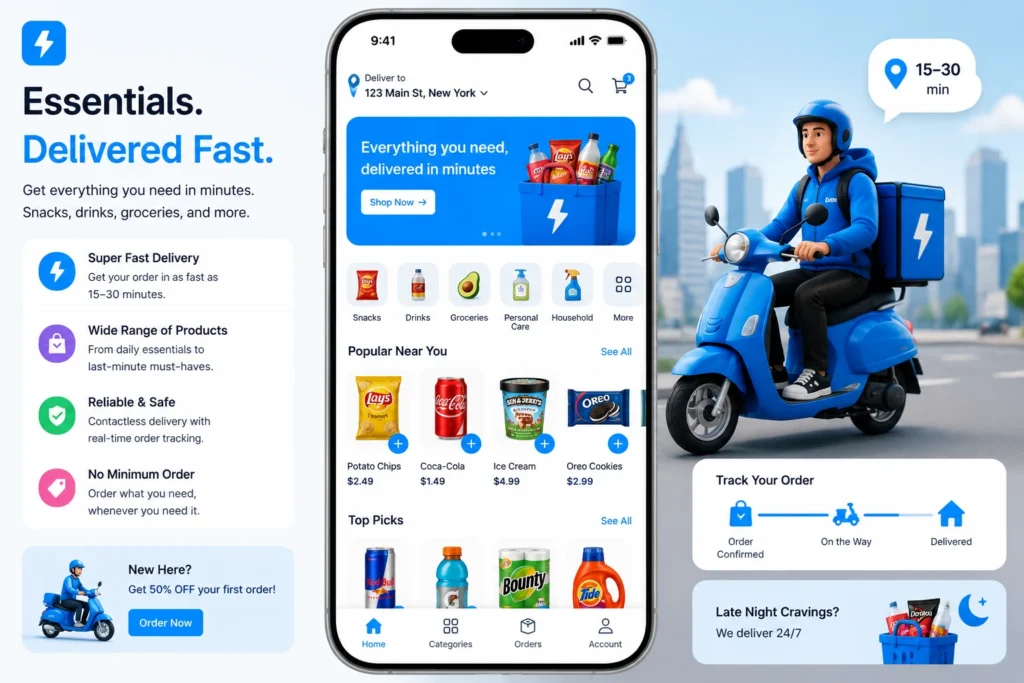
Launch a Gopuff-Style Vertically-Integrated Quick Commerce Platform in 21 Days
A quick commerce operator out of Bangalore reached out last September with a problem most Tier-1 city operators have not even noticed yet. He had spent four years at Zepto’s product team before going solo and what he had watched build up was a specific gap in the Indian quick commerce market — Blinkit, Zepto, Swiggy Instamart, and BB Now were collectively spending hundreds of crores acquiring users in Bangalore, Mumbai, Delhi, Hyderabad, Chennai, Pune, and Kolkata. Meanwhile Indore, Bhopal, Lucknow, Kanpur, Visakhapatnam, Coimbatore, Surat, Jaipur, Patna, Nagpur — cities with 1.5 to 4 million population each, smartphone penetration north of 70%, growing disposable income, and zero serious quick commerce presence — were structurally underserved. The Tier-1 incumbents were not going to enter these Tier-2 markets soon because the unit economics looked thin from their cost basis. But for an operator with regional supply-chain knowledge, smaller dark stores (1,200-1,800 sqft instead of 2,500-4,000), local fast-moving SKU curation, and a fraction of the corporate overhead, the math worked. He wanted to build a regional quick commerce platform for Tier-2 India. We delivered the codebase in 23 days. Eleven months later: 14 dark stores live across Indore, Bhopal, Lucknow, and Kanpur; roughly 42,000 orders per month flowing through the platform; average order value of ₹240 (about $2.90); 18-minute average delivery time; ₹1.02 crore (about $122,000 USD) in monthly recurring revenue; and his platform has become the dominant quick commerce option in two of his four launch cities.
That story is the Gopuff opportunity in a paragraph. Gopuff itself does somewhere around $1.7 billion in annual revenue, operates across 1,000+ US cities plus the UK, and has fundamentally proven that the vertically-integrated quick commerce model — own dark stores, own inventory, employ drivers rather than rely on gig workers — works at scale when you control the operational layer underneath. The same model is the dominant force in India right now where Blinkit (owned by Zomato), Zepto, Swiggy Instamart, and BB Now combined are doing several billion dollars in annualized GMV growing faster than almost any e-commerce category in the world. The arbitrage that is wide open in 2026 — and that almost nobody with serious capital has captured yet — is the Tier-2 and Tier-3 city layer beneath the Tier-1 incumbents in every major market. India. Indonesia. The Philippines. Vietnam. Brazil. Mexico. Egypt. South Africa. Each of these has dozens of underserved metros with the demographics quick commerce works in but no serious local platform. The right operator profile to enter this — someone with regional supply-chain knowledge, retail operations background, FMCG distribution experience, or convenience-store franchise operations — has a substantial opening.
Building a Gopuff-grade quick commerce platform from scratch costs $200,000 to $620,000 and takes 10 to 16 months. The engineering layer underneath is harder than it looks because quick commerce is structurally a logistics + inventory + retail + payments + real-time tracking + multi-app stack rather than just a delivery app. Customer apps for iOS and Android with sub-second product search across 5,000-15,000 SKUs per dark store. Driver apps for iOS and Android with turn-by-turn navigation, pickup orchestration, and delivery confirmation. Dark store operations app that handles order picking, packing, and dispatch with mobile barcode scanning. Admin dashboard that runs across multiple dark stores in multiple cities. Inventory management with real-time SKU-level stock visibility per dark store. Order routing engine that decides which dark store fulfills which order based on inventory + distance + driver availability. Driver assignment algorithm balancing pickup distance, current load, and delivery time SLA. Real-time order tracking via WebSocket. Surge pricing engine. Promo + loyalty engine. Age verification for alcohol categories. Most operators waste their first $240k on the order routing engine alone because routing optimization across dark stores and drivers with multiple constraint variables is genuinely hard engineering. The codebase you are buying has that work done across 9 deployments now.
$11,500 USD · Free Demo · Live in 21 Days · 6 Months Free Priority Maintenance · 1 Year Free Hosting · 5 Ad Creative Templates · Full Source Code · 100% Customization · 4 Native Mobile Apps (Customer iOS + Android, Driver iOS + Android) · Dark Store Ops App · Multi-City Admin Dashboard · Real-Time Order Routing Engine Pre-Tuned · 18-Minute Average Delivery Demonstrated
What You Get In The Gopuff Clone Package
| Component | Included |
|---|---|
| Customer Web Platform (Next.js + React, SSR-optimized for SEO) | ✓ |
| Native iOS Customer App (Swift + SwiftUI) — App Store ready | ✓ |
| Native Android Customer App (Kotlin + Jetpack Compose) — Play Store ready | ✓ |
| Native iOS Driver App (delivery riders + dispatcher mode) | ✓ |
| Native Android Driver App (delivery riders + dispatcher mode) | ✓ |
| Dark Store Operations App (Android tablet-optimized for picker workflow) | ✓ |
| Multi-City Admin Operations Dashboard | ✓ |
| Real-Time Order Routing Engine (dark store selection + driver assignment) | ✓ |
| Inventory Management System (SKU-level real-time stock per dark store) | ✓ |
| Multi-Dark-Store Catalog (5,000-15,000 SKUs per store, per-store availability) | ✓ |
| Sub-Second Product Search (Elasticsearch / OpenSearch) | ✓ |
| Hyperlocal Delivery Radius Configuration (per dark store, polygon-based) | ✓ |
| Real-Time Order Tracking (WebSocket-based with map overlay) | ✓ |
| Driver Assignment Algorithm (distance + load + SLA optimization) | ✓ |
| Order Picking + Packing Workflow (barcode scan, photo verification) | ✓ |
| Dispatch Console (assign orders to drivers, monitor in-flight deliveries) | ✓ |
| Turn-by-Turn Navigation (Mapbox / Google Maps / HERE integration) | ✓ |
| 15-30 Minute Delivery Promise Engine (SLA tracking + alerts) | ✓ |
| Surge Pricing Engine (configurable rules by demand + time + zone) | ✓ |
| Promo Code + Loyalty Program (referrals, points, tier-based rewards) | ✓ |
| Subscription Tier (Gopuff Fam-style — free delivery + perks for monthly fee) | ✓ |
| Age Verification (alcohol + tobacco categories, ID upload + photo match) | ✓ |
| Cart + Checkout Flow with Single-Tap Reorder | ✓ |
| Multi-Payment Methods (Stripe + Razorpay + Apple Pay + Google Pay) | ✓ |
| Regional Payment Rails (UPI, SPEI, PIX, OXXO, GCash, Fawry, M-Pesa, etc.) | ✓ |
| Cash on Delivery Workflow (with driver cash collection tracking) | ✓ |
| Tipping Flow (driver tips with configurable defaults) | ✓ |
| Push Notifications (order accepted, picked up, in-transit, delivered) | ✓ |
| WhatsApp Business API Bridge (order updates in India, LATAM, MENA, SEA) | ✓ |
| SMS Notifications (order updates + OTP for age verification) | ✓ |
| Order Review + Rating System (driver rating + product feedback) | ✓ |
| Returns + Refunds Workflow (one-tap refund within configurable window) | ✓ |
| Driver Earnings Dashboard (real-time, with daily/weekly/monthly summary) | ✓ |
| Driver Onboarding Workflow (document verification, training modules, KYC) | ✓ |
| Driver Shift Management (clock-in/clock-out, scheduled shifts, on-demand) | ✓ |
| Inventory Replenishment Alerts (low-stock SKU + auto-PO generation) | ✓ |
| Supplier Portal (vendors submit catalog, manage PO, invoice) | ✓ |
| Pricing Management (per-SKU + per-store + promotional pricing engine) | ✓ |
| Analytics Dashboard (orders, GMV, AOV, delivery times, driver performance) | ✓ |
| Category + SKU CMS (bulk upload via CSV + manual edit) | ✓ |
| Multi-Language Support (English, Spanish, Portuguese, Hindi, Arabic, Bahasa) | ✓ |
| Multi-Currency Support (USD, INR, MXN, BRL, IDR, AED, NGN, KES) | ✓ |
| Anti-Fraud Detection (synthetic accounts, payment fraud, refund abuse) | ✓ |
| API Access for Third-Party Integrations (REST + Webhooks) | ✓ |
| App Store Optimization Tools | ✓ |
| Full Source Code (yours forever from day one) | ✓ |
| Free Demo · 1 Year Free Hosting · 6 Months Free Priority Maintenance | ✓ |
| 5 Ad Creative Templates (Meta + Google + TikTok) | ✓ |
| 100% Customization (at $35/hour or use your own team) | ✓ |
Why The Order Routing Engine Is The Hardest Problem In Quick Commerce
I want to spend a minute on this because the routing engine is what separates working quick commerce platforms from the ones that consistently miss their delivery SLA, and it is the layer that operators trying to build this from scratch consistently underestimate by 3-5 months.
The user-facing promise of a quick commerce platform looks simple — customer orders something, driver delivers it in 15-30 minutes. The engineering reality underneath is harder than it sounds. The platform receives an order. The order has a delivery address. The platform needs to instantly decide which dark store fulfills it based on (1) inventory availability across all dark stores in the customer’s delivery radius, (2) current order backlog at each dark store (a store that already has 8 orders in the queue cannot promise 15-minute delivery on a 9th), (3) distance from each dark store to the delivery address, (4) which drivers are currently available at each dark store, (5) which drivers are currently in-flight with deliveries that would route past or near the new delivery address (route optimization with rideshare-style chaining). All of that decision making happens in under 800 milliseconds because the customer is waiting for the order confirmation screen to load.
Then the routing engine has to update continuously as conditions change. A driver completes a delivery and becomes available — the engine re-evaluates which queued order is best assigned to them. A dark store runs out of an SKU mid-shift — the engine re-routes orders that included that SKU to a different store if possible. A driver goes offline due to a flat tire — the engine reassigns their pending pickups. A new order comes in that could be batched efficiently with a driver currently picking up an order at the same store — the engine evaluates whether batching improves total efficiency or hurts the SLA on the existing order.
None of this individually is novel computer science. All of it together, working reliably at peak hours when 200+ orders per hour are flowing through a 14-dark-store network, is genuinely difficult engineering. The codebase ships with the routing engine built on a constraint-optimization layer that evaluates the candidate set in roughly 600-1100 milliseconds per order at production load. Dark store selection. Driver assignment. Order batching. Re-routing on state changes. Real-time SLA tracking with operator alerts when an order is at risk of breaching the delivery promise.
This is the layer that justifies the price difference between this clone and a standard delivery marketplace clone. Building routing properly takes 4-6 additional months of engineering on top of a base on-demand stack. The codebase you are buying has that work done.
The Dark Store Operations Layer (Where Your Margin Actually Lives)
This is the layer that separates working quick commerce platforms from chaotic ones, and it is the layer most operators treat as an afterthought.
Each dark store in your network handles 80-400 orders per day depending on city size and density. The order arrives at the dark store. A picker has to find the SKUs, scan them into the order, pack them, and hand them off to the assigned driver within 6-10 minutes of order receipt for the platform to make its 15-30 minute delivery promise. The dark store operations app handles this workflow end-to-end. Pickers see incoming orders in priority order (sorted by promised delivery time and order age). The app shows each SKU’s exact location in the store (aisle + shelf + bin). Pickers scan barcodes as they pull each SKU; the app validates that the scanned SKU matches the order line item. Substitutions (when a SKU is out of stock) trigger a customer notification with one-tap accept/reject. Packing photos are captured to defend against later disputes. The packed order moves to the driver pickup zone with a status broadcast to the assigned driver.
The operations app also handles inbound inventory. New stock arriving from suppliers gets scanned into the store with quantity and location. Low-stock SKUs trigger replenishment alerts to the central inventory team. Returns from customers (rejected substitutions, damaged items) flow through a separate scan-back workflow that puts them back into available inventory or marks them as damaged.
Multi-city operations layer sits above the dark stores. The admin dashboard shows real-time order flow across every dark store in the network. Operations leads can see which stores are at capacity, which drivers are running late, which SKUs are short across the network. Per-store performance dashboards show daily orders, average pick time, average packing time, customer ratings, driver ratings, and gross margin. The accounting layer handles per-store P&L with proper cost allocation for shared infrastructure.
The Multi-Region Architecture (Where Tier-2 City Strategy Wins)
Most quick commerce operators trying to clone Gopuff start with a single city and never get past it because the multi-city operational layer is structurally different from single-city operations. The codebase ships ready for multi-city from day one.
Each city in your network has its own dark store cluster, its own driver pool, its own delivery radius polygons, its own pricing rules, its own surge pricing parameters, and its own promotional campaign management. Catalog management is global with per-city availability overrides — a SKU can be available in some cities, unavailable in others, or available at different prices in different cities. The admin dashboard supports city-level views as well as network-wide views.
This is the architecture that lets the regional Tier-2 strategy work. Launch in Indore. Prove unit economics. Add Bhopal. Add Lucknow. Add Kanpur. Each city gets its own dark store cluster and driver pool but shares the same platform infrastructure, catalog system, and operations dashboard. The marginal cost of adding a new city to a working platform is a fraction of the cost of launching the first city, which is what makes regional quick commerce viable as a business.
“$11,500 — Where’s The Catch?”
A reasonable question for a codebase of this scope. The honest answer.
Triple Minds has shipped 9 quick commerce codebases now. The first was a $310,000 custom job for a Mumbai-based dark store operator who wanted to extend their B2B grocery distribution platform into B2C consumer delivery. Everything we learned in that build went into the codebase, and every subsequent deployment refined the order routing engine, hardened the dark store operations app, expanded the regional payment rail library, and tightened the multi-city admin dashboard. We sell this codebase 6-10 times a year at $11,500. The engineering investment is amortized across a smaller pool of buyers than our marketplace clones because the operational complexity is meaningfully higher. No royalties. No revenue share. No SaaS lock-in.
What $11,500 covers: the full customer web + customer iOS + customer Android + driver iOS + driver Android + dark store operations app + admin dashboard + all features listed above, 1 year of free managed hosting on our infrastructure, 6 months of free priority maintenance, and 5 ad creative templates customized to your brand. What we charge separately: custom development at $35/hour (most clients spend $6,000-$25,000 here, mostly on regional payment rail integrations beyond the 8 included, regional supplier integrations, customizations specific to local FMCG distribution practices, and per-state or per-country alcohol delivery compliance workflows), managed hosting beyond year 1 ($299/month, optional), map tile licensing (Mapbox or Google Maps usage-based, typically $0.50-$2.00 per 1,000 map loads at scale), and per-city operational consulting if you want help with dark store layout design, supplier onboarding, or driver training programs.
What This Package Does Not Cover
I would rather you walk in knowing exactly what is not in the box.
- Apple Developer Program. $99/year. Required to publish customer + driver iOS apps.
- Google Play Console. $25 one-time. Required to publish all Android apps.
- Dark store real estate. 1,200-4,000 sqft retail space per dark store. Your operational responsibility. Plan $3,000-$15,000 per month in rent per dark store depending on city.
- Inventory acquisition. Initial dark store stocking typically $25,000-$80,000 per store. Ongoing replenishment varies. Your business to manage with your supplier network.
- Supplier and vendor onboarding. The platform handles the workflow; you handle the relationships. Plan 2-4 months to build a credible regional supplier network if you are not coming from FMCG distribution background.
- Driver fleet hiring and training. Driver app handles operational workflow; you hire, train, and manage the drivers. Typical fleet size is 8-25 drivers per dark store depending on city density.
- Alcohol delivery compliance. State, country, and city-specific licensing for alcohol delivery. Plan $2,000-$15,000 per launch jurisdiction for proper compliance review.
- Map tile licensing. Mapbox or Google Maps usage-based pricing. Budget $0.50-$2.00 per 1,000 map loads.
- WebSocket infrastructure at scale. Self-hosted or managed (AWS API Gateway, Pusher, Ably). Budget $0.04-$0.12 per million messages depending on scale.
- SMS sending at scale. Twilio, MessageBird, regional equivalents. Quick commerce generates significant SMS volume — every order has 3-5 status messages. Budget $0.01-$0.05 per SMS.
- WhatsApp Business API. Free at low volume; tiered after. Pass-through.
- Payment processing fees. Stripe 2.9% + 30¢, Razorpay 2%, regional rails vary. Pass-through.
- Marketing budget for customer acquisition. Realistic CAC for quick commerce in Tier-2 markets is $1.20-$3.50 per first-time order. Plan $30,000-$200,000 for a serious launch across 2-4 cities.
Realistic year-1 budget for a serious launch (clone + real estate + inventory + supplier onboarding + driver fleet + marketing + operations): $180,000 to $900,000 depending on city count and density. The clone itself is 1-6% of that. The rest is the physical operations business you are building, and most of it is the side no software can replace.
Your Day-By-Day 21-Day Launch Timeline
Most clone pages say “live in 21 days” without breaking down what those days actually look like. Here is the day-by-day.
- Day 0. Payment clears. Slack channel + Notion workspace activated. Kickoff call scheduled for Day 1.
- Day 1. Kickoff call (90 minutes). We learn your launch cities, initial dark store locations, branding, subscription pricing strategy, regional payment rail priorities, alcohol delivery scope. Dedicated engineer + project manager + operations lead assigned.
- Day 2-4. Code transfer + infrastructure provisioning. Source code lands in your GitHub or GitLab. Multi-region staging environment stood up on AWS, GCP, or DigitalOcean with proper data residency and CDN configuration.
- Day 5-8. Branding application + multi-city configuration. Primary platform brand applied across customer + driver + dark store ops apps. Initial 1-4 city configurations with delivery radius polygons.
- Day 9-12. Catalog seeding + dark store setup. Initial SKU catalog imported (typically 3,000-8,000 SKUs for first dark store). Per-store availability + pricing configured. Picker workflow tested with dark store ops app.
- Day 13-15. Routing engine calibration. Dark store selection rules tuned for your dark store + city pattern. Driver assignment algorithm tested with simulated load. SLA tracking thresholds set.
- Day 16-17. Payment + map integration. Stripe + regional payment rails activated. Map provider configured (Mapbox / Google Maps / HERE). Turn-by-turn navigation tested across driver app.
- Day 18-19. Mobile app builds. Customer iOS + Customer Android + Driver iOS + Driver Android all submitted to App Store + Play Store. Push notification certificates configured. Dark store ops app deployed to first-store Android tablets.
- Day 20. Final QA. End-to-end testing across customer flow, driver flow, dark store ops flow, admin flow. Load testing on routing engine with simulated 200 orders/hour. Payment flows tested per region.
- Day 21. Soft launch. First dark store goes live. Initial 30-100 pilot customers onboarded via WhatsApp + organic channels. Driver fleet starts operating live shifts. Operations monitoring activated.
- Week 4-8. Hard launch. App Store + Play Store approvals come through. Additional dark stores onboarded. Performance optimization based on first 30 days of order data. Driver fleet scales with demand.
If any milestone slips by more than 48 hours due to our fault, you have grounds to invoke the 21-day refund clause. We have hit this timeline on 7 of the last 9 quick commerce deployments.
How Gopuff Compares With Other Delivery Models
| Platform | Model | Distinct Engineering | Best For Cloning Into |
|---|---|---|---|
| Gopuff (this clone) | Vertically-integrated quick commerce — own stores, own inventory, employed drivers | Order routing across dark stores, dark store ops app, multi-city architecture | Regional quick commerce founders, convenience chains, FMCG D2C operators |
| DoorDash / Uber Eats | Restaurant marketplace — gig drivers pick up from restaurants | Restaurant onboarding, menu management, gig driver pool | Restaurant marketplace operators |
| Instacart | Shopper marketplace — workers shop at retail grocery stores | Retail store catalog integration, shopper assignment, basket substitution | Marketplace-style grocery delivery operators |
| Blinkit / Zepto / Swiggy Instamart | Indian vertically-integrated quick commerce (Gopuff model in India) | Same as Gopuff with India-specific payment rails + alcohol rules + density assumptions | Indian and South Asian quick commerce operators |
| Glovo / Rappi (LATAM segment) | Hybrid marketplace + dark store quick commerce | Multi-vertical (food + grocery + pharmacy) with mixed gig + employee models | LATAM multi-vertical operators |
The Gopuff clone is the right shape for vertically-integrated quick commerce — you own the dark stores, you own the inventory, you employ the drivers. If your business model is restaurant marketplace, the DoorDash/Uber Eats shape is different and we have a separate codebase for that. If your edge is multi-vertical hybrid (food + grocery + pharmacy under one app), the Glovo/Rappi shape is different. Pick the clone whose shape matches your real operational model.
What A Real Buyer Said After Eleven Months
“I spent four years at Zepto’s product team before going solo. I had watched Blinkit, Zepto, Swiggy Instamart, and BB Now burn through capital fighting each other in Bangalore, Mumbai, Delhi, and the other Tier-1 metros — meanwhile every Tier-2 city with two million people and 70% smartphone penetration had nothing serious. I had quotes from custom dev shops between $260,000 and $480,000 for the build. The Triple Minds Gopuff clone covered roughly 85% of what those quotes covered, in 23 days, at $11,500. The order routing engine was the part I was most worried about and the part that arrived most complete — it actually held up at peak hours in Indore, our launch city, without breaching the 25-minute delivery promise on more than 4% of orders. Eleven months in we are running 14 dark stores across four Tier-2 cities. 42,000 orders monthly. $122,000 USD in MRR. The economics work because we are not fighting four well-funded competitors for every customer. Best regional infrastructure investment I have made.”
— Aditya R., Founder, QuickReach Bharat (Indore + Bhopal + Lucknow + Kanpur)
Frequently Asked Questions
Is the Gopuff name trademarked? Can I use it directly?
No, you cannot use the Gopuff name or logo directly — those are trademarks of GoBrands Inc. (the parent company). You launch your own branded quick commerce platform built on the same architectural model. You pick your own name, branding, regional positioning, dark store network strategy. We sell the codebase and operational engineering, not the trademark.
How is the Gopuff clone different from a DoorDash or Uber Eats clone?
Different operational model entirely. DoorDash and Uber Eats run restaurant marketplaces where gig drivers pick up food from restaurants and deliver it. Gopuff runs vertically-integrated quick commerce — owns the dark stores, owns the inventory, employs the drivers. The Gopuff clone ships with dark store operations app, multi-store inventory management, order routing across dark stores, and employed driver workflow. Different stack, different operator profile required.
How does the order routing engine work?
WebSocket-coordinated constraint-optimization engine. When an order arrives, the engine evaluates which dark store fulfills it based on inventory availability, current store backlog, distance to delivery address, available driver pool at each store, and possible batching with in-flight deliveries. Decision typically completes in 600-1100ms per order at production load. Re-routes continuously as conditions change — driver completes a delivery, dark store runs out of an SKU, new order arrives that batches efficiently with an existing pickup. Comprehensive audit log of every routing decision for operations debugging.
How do I onboard dark stores and what does the operations app handle?
Each dark store gets configured via the admin dashboard — location, delivery radius polygon, operating hours, picker staff accounts, driver pool assignment. The dark store operations app (Android tablet-optimized) handles the daily workflow — incoming orders prioritized by SLA, SKU-level pick-and-pack workflow with barcode scanning, photo verification, substitution flow for out-of-stock SKUs, packed-order handoff to drivers. Inbound inventory scanning, low-stock alerts, returns processing all run through the same app.
Which payment rails are included?
Standard: Stripe, Apple Pay, Google Pay, Razorpay. Regional rails: UPI + IMPS (India), SPEI + PIX + OXXO + Boleto (LATAM), GCash + DANA + OVO (SEA), M-Pesa + Flutterwave (Africa), Fawry + Mada (MENA). Cash on Delivery workflow with driver cash collection tracking is built in for markets where COD is dominant. Adding additional regional rails costs $1,500-$4,000 per integration.
Does the platform handle alcohol delivery with age verification?
Yes. Age verification workflow with ID upload, photo match, and driver-side ID re-verification at delivery. State, country, and city-specific compliance rules are configurable per launch jurisdiction. The platform ships the framework; you provide jurisdiction-specific legal review ($2,000-$15,000 per launch state/country recommended) and obtain the operational licensing required to deliver alcohol commercially.
Can the platform handle multi-city operations?
Yes — multi-city is built in from day one. Each city has its own dark store cluster, driver pool, delivery polygons, pricing rules, surge parameters, and promotional campaigns. Catalog management is global with per-city availability overrides. Admin dashboard supports both city-level and network-wide views. Adding a new city to a working platform takes 1-3 weeks (vs. 4-6 months for the first city).
What is the typical infrastructure footprint and CDN cost?
For a 4-city, 14-dark-store operation processing ~42,000 orders per month, typical infrastructure footprint is one regional AWS / GCP region, 6-12 EC2 instances or equivalent, managed PostgreSQL + Redis + Elasticsearch. CDN bandwidth for image-heavy catalogs typically runs $200-$600/month at moderate scale. WebSocket infrastructure for real-time tracking adds $80-$300/month at this scale. We provide the infrastructure during the 1-year free hosting period; budgeting is your responsibility after.
What happens after the 6 months of free maintenance ends?
Three options. Self-support (you keep the source code, no ongoing cost). Pay-as-you-go support at $35/hour for the same engineering team. Or retainer agreements starting at $1,800/month for 18 hours/month with priority response. Most quick commerce deployments land on retainer because the routing engine and the multi-city operations layer benefit from continued engineering attention as the platform scales and new edge cases surface in production.
Ready To Launch Your Quick Commerce Platform?
If you have read this far, you are not browsing — you are evaluating. So here is the closing pitch in plain language.
The vertically-integrated quick commerce category is one of the most operationally serious clones in our entire catalog. The features are not for show — every routing decision, every dark store operations workflow, every multi-city configuration exists because real operators running real dark stores delivering real orders to real customers cannot operate without exactly that capability. The market that needs this product is enormous and growing rapidly outside the Tier-1 metros. Indore. Bhopal. Lucknow. Kanpur. Visakhapatnam. Coimbatore. Surat. Jaipur. Patna. Nagpur. Outside India: dozens of similar Tier-2 cities across Indonesia, Philippines, Vietnam, Brazil, Mexico, Egypt, South Africa. Each of them has the demographics quick commerce works in but no serious local platform serving them. The right operator profile to enter — someone with regional supply chain knowledge, FMCG distribution background, retail operations experience, or convenience store franchise operations — has a substantial and time-sensitive arbitrage to capture before the Tier-1 incumbents notice the opening.
The $11,500 is what it costs to skip 10-16 months of engineering and $200k-$620k of custom development for a quick commerce codebase that is meaningfully more complex than a typical delivery marketplace. It is the fastest credible way to enter the quick commerce category with a platform that customers will actually trust to deliver in under 30 minutes and operations teams will actually be able to run at scale.
Two ways forward. Request the free demo and spend 30 minutes inside the customer app + dark store operations app + admin dashboard + routing engine before you commit — those are the layers you need to understand to decide if this is the right shape for your operator profile. Or if you are convinced, hit the buy button and we will have your kickoff call scheduled within 24 hours. Either way — we would rather talk to you before you buy than after.
Feature Highlights
Real-Time Order Routing Engine
Dark store selection + driver assignment + order batching in 600-1100ms. Handles 200+ orders/hour at peak.
Dark Store Operations App
Android tablet-optimized. SKU pick-and-pack with barcode scan. Substitution flow. Photo verification. Inbound + returns.
4 Native Mobile Apps
Customer iOS + Customer Android + Driver iOS + Driver Android. All App Store + Play Store ready.
Multi-City Architecture
Per-city dark store clusters, driver pools, delivery polygons, pricing rules, surge parameters, promo campaigns.
Inventory Management
SKU-level real-time stock per dark store. Low-stock alerts. Auto-PO generation. Supplier portal.
Sub-Second Product Search
Elasticsearch / OpenSearch across 5,000-15,000 SKUs per store with autocomplete + faceted filters.
Surge Pricing + Loyalty Engine
Demand-based surge with configurable rules. Subscription tier (Gopuff Fam-style). Promo codes + referrals.
Age Verification for Alcohol
ID upload + photo match + driver-side re-verification at delivery. Per-jurisdiction compliance config.
Regional Payment Rails
Stripe + Razorpay + UPI + SPEI + PIX + GCash + M-Pesa + Fawry. Cash on Delivery with driver cash tracking.
Real-Time Order Tracking
WebSocket-based with map overlay. Turn-by-turn driver navigation via Mapbox / Google Maps / HERE.
Driver Earnings + Shift Management
Real-time earnings dashboard, scheduled + on-demand shifts, clock in/out, performance ratings.
Multi-Language + Multi-Currency
English, Spanish, Portuguese, Hindi, Arabic, Bahasa built-in. 8 currencies with FX + rounding rules.
Built for quick commerce operators
Regional Quick Commerce Founders
You see a Tier-2 city opening — Indore, Bhopal, Surat, Recife, Cebu, Cairo — where Tier-1 incumbents have not entered yet.
Convenience Store Chains
You operate a regional convenience or mini-mart chain and want to launch your own quick delivery operation.
FMCG & D2C Brands
You distribute FMCG, snacks, beverages, or D2C consumer products and want a direct hyperlocal channel to customers.
Dark Store & Logistics Operators
You run dark stores, microfulfillment centers, or last-mile logistics and want a customer-facing platform layer.
What's in the package
- Customer Web Platform (Next.js + React, SSR-optimized)
- Native iOS Customer App (Swift + SwiftUI)
- Native Android Customer App (Kotlin + Jetpack Compose)
- Native iOS Driver App
- Native Android Driver App
- Dark Store Operations App (Android tablet-optimized)
- Multi-City Admin Operations Dashboard
- Real-Time Order Routing Engine
- Inventory Management System with SKU-Level Stock
- Multi-Dark-Store Catalog (5,000-15,000 SKUs per store)
- Sub-Second Product Search (Elasticsearch / OpenSearch)
- Hyperlocal Delivery Radius Configuration (polygon-based)
- Real-Time Order Tracking (WebSocket + Map Overlay)
- Driver Assignment Algorithm with Order Batching
- Order Picking + Packing Workflow with Barcode Scan
- Dispatch Console for Operations Teams
- Turn-by-Turn Navigation (Mapbox / Google Maps / HERE)
- 15-30 Minute Delivery Promise Engine with SLA Tracking
- Surge Pricing Engine
- Promo Code + Loyalty Program (Referrals, Points, Tiers)
- Subscription Tier (Gopuff Fam-style)
- Age Verification (Alcohol + Tobacco, ID + Photo Match)
- Cart + Checkout with Single-Tap Reorder
- Multi-Payment Methods (Stripe + Apple/Google Pay + Razorpay)
- Regional Payment Rails (UPI, SPEI, PIX, OXXO, GCash, M-Pesa, Fawry)
- Cash on Delivery with Driver Cash Tracking
- Tipping Flow (configurable defaults)
- Push + WhatsApp + SMS Notifications
- Order Review + Rating System
- Returns + Refunds Workflow
- Driver Earnings Dashboard + Shift Management
- Driver Onboarding (Document Verification, KYC, Training)
- Inventory Replenishment Alerts + Auto-PO Generation
- Supplier Portal (Vendor Catalog, PO, Invoice)
- Pricing Management (Per-SKU + Per-Store + Promotional)
- Analytics Dashboard (Orders, GMV, AOV, Delivery Times)
- Category + SKU CMS with Bulk CSV Upload
- Multi-Language Support (6 languages built-in)
- Multi-Currency Support (8 currencies built-in)
- Anti-Fraud Detection (Synthetic Accounts, Payment Fraud, Refund Abuse)
- REST API + Webhooks for Third-Party Integrations
- Full Source Code (yours forever from day one)
- Free Demo · 1 Year Free Hosting · 6 Months Free Priority Maintenance
- 5 Ad Creative Templates (Meta + Google + TikTok)
- 100% Customization (at $35/hour or use your own team)
How it works
- 1
Checkout
Pay securely via card, UPI, or bank transfer.
- 2
Instant delivery
Download link + license key emailed in minutes.
- 3
Free installation
Our team deploys it on your server at no extra cost.
- 4
Onboarding call
45-minute walkthrough of admin, dealer panel, and customization.
- 5
Go live
Add dealers and listings on day one.
- 6
6 months support
Bug fixes, updates, and questions — all free.
Frequently Asked Questions
Is the Gopuff name trademarked? Can I use it directly?
No, you cannot use the Gopuff name or logo directly — those are trademarks of GoBrands Inc. You launch your own branded quick commerce platform built on the same architectural model. You pick your own name, branding, regional positioning, dark store network strategy. We sell the codebase and operational engineering, not the trademark.
How is the Gopuff clone different from a DoorDash or Uber Eats clone?
Different operational model entirely. DoorDash and Uber Eats run restaurant marketplaces where gig drivers pick up food from restaurants. Gopuff runs vertically-integrated quick commerce — owns the dark stores, owns the inventory, employs the drivers. The Gopuff clone ships with dark store operations app, multi-store inventory management, order routing across dark stores, and employed driver workflow.
How does the order routing engine work?
WebSocket-coordinated constraint-optimization engine. When an order arrives, it evaluates which dark store fulfills it based on inventory availability, current store backlog, distance to delivery address, available driver pool, and possible batching with in-flight deliveries. Decision typically completes in 600-1100ms per order at production load. Re-routes continuously as conditions change. Comprehensive audit log for operations debugging.
How do I onboard dark stores and what does the operations app handle?
Each dark store gets configured via the admin dashboard — location, delivery radius polygon, operating hours, picker staff, driver pool assignment. The dark store operations app (Android tablet-optimized) handles the daily workflow — incoming orders prioritized by SLA, SKU-level pick-and-pack with barcode scan, photo verification, substitution flow, packed-order handoff to drivers. Inbound inventory + low-stock alerts + returns run through the same app.
Which payment rails are included?
Standard: Stripe, Apple Pay, Google Pay, Razorpay. Regional: UPI + IMPS (India), SPEI + PIX + OXXO + Boleto (LATAM), GCash + DANA + OVO (SEA), M-Pesa + Flutterwave (Africa), Fawry + Mada (MENA). Cash on Delivery workflow with driver cash collection tracking is built in. Adding additional regional rails costs $1,500-$4,000 per integration.
Does the platform handle alcohol delivery with age verification?
Yes. Age verification workflow with ID upload, photo match, and driver-side ID re-verification at delivery. State, country, and city-specific compliance rules are configurable per jurisdiction. We provide the framework; you provide jurisdiction-specific legal review ($2,000-$15,000 per launch state/country recommended) and obtain operational licensing.
Launch your quick commerce platform
Order routing engine · Dark store ops · Multi-city architecture · 4 native apps · Age verification · 6 months free maintenance