Shop Project Tracker: Parts & Inventory Tracking SaaS for Car Restoration Shops (Web + Android)
Shop Project Tracker ties every part to a project, a storage bin and the employee who moved it. Restoration and fabrication shops scan QR codes to check parts in and out, change bins, and transfer parts between projects and locations, with audit history and cross-location reports. Multi-tenant SaaS built on FastAPI, PostgreSQL and Expo React Native.
Screenshots
About this product
A classic car restoration starts with a teardown. Hundreds of parts come off the vehicle, get inspected, photographed and put on a shelf, sometimes for months. In most shops the record of where each part went lives on handwritten tags, a spreadsheet or someone's memory. Parts go missing, get re-ordered by mistake, or end up on the wrong car, and technicians lose hours hunting for them at reassembly.
Shop Project Tracker (SPT) is a multi-tenant parts, bin and project tracking platform built for that problem. Generic inventory software counts stock; SPT ties every physical part to a project (for example a 1965 Ford Mustang), a storage location and bin, and the employees who moved it. QR-code scanning lets staff scan parts in and out, move them between bins, transfer them between projects and between shop locations, with an audit trail of who did what. It runs in the browser and as an Android app from one Expo React Native codebase, backed by FastAPI and PostgreSQL.
Features
Projects and parts
- Projects (vehicles or other jobs) with configurable project categories
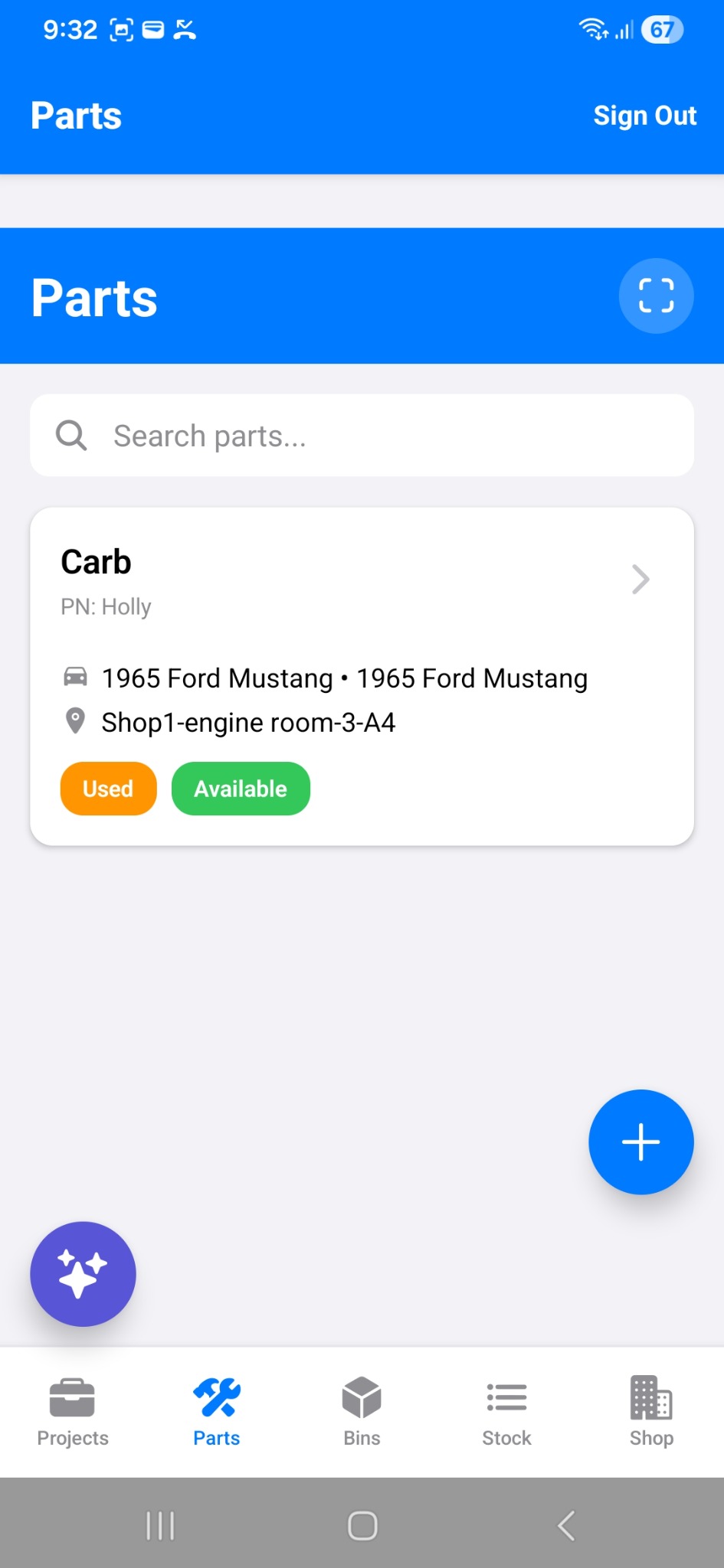
- A searchable parts list showing each part's project, storage location, condition (e.g. Used) and status (e.g. Available)
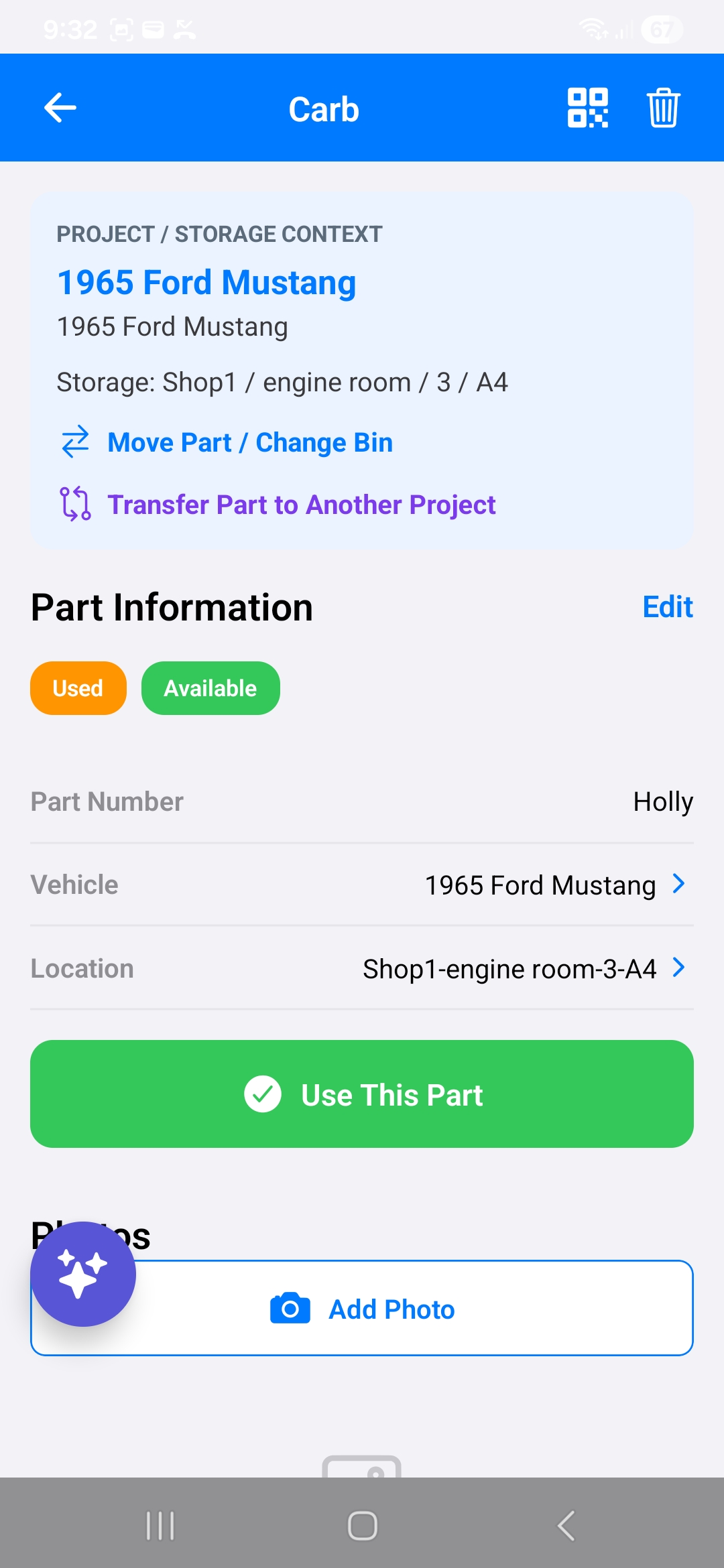
- Part detail screens with part number, vehicle, location, an Edit action, a per-part QR code and Add Photo documentation
- A Use This Part action to record a part going back on the job
- Disassembly and reassembly tracking, per the seller
Bins, storage and transfers
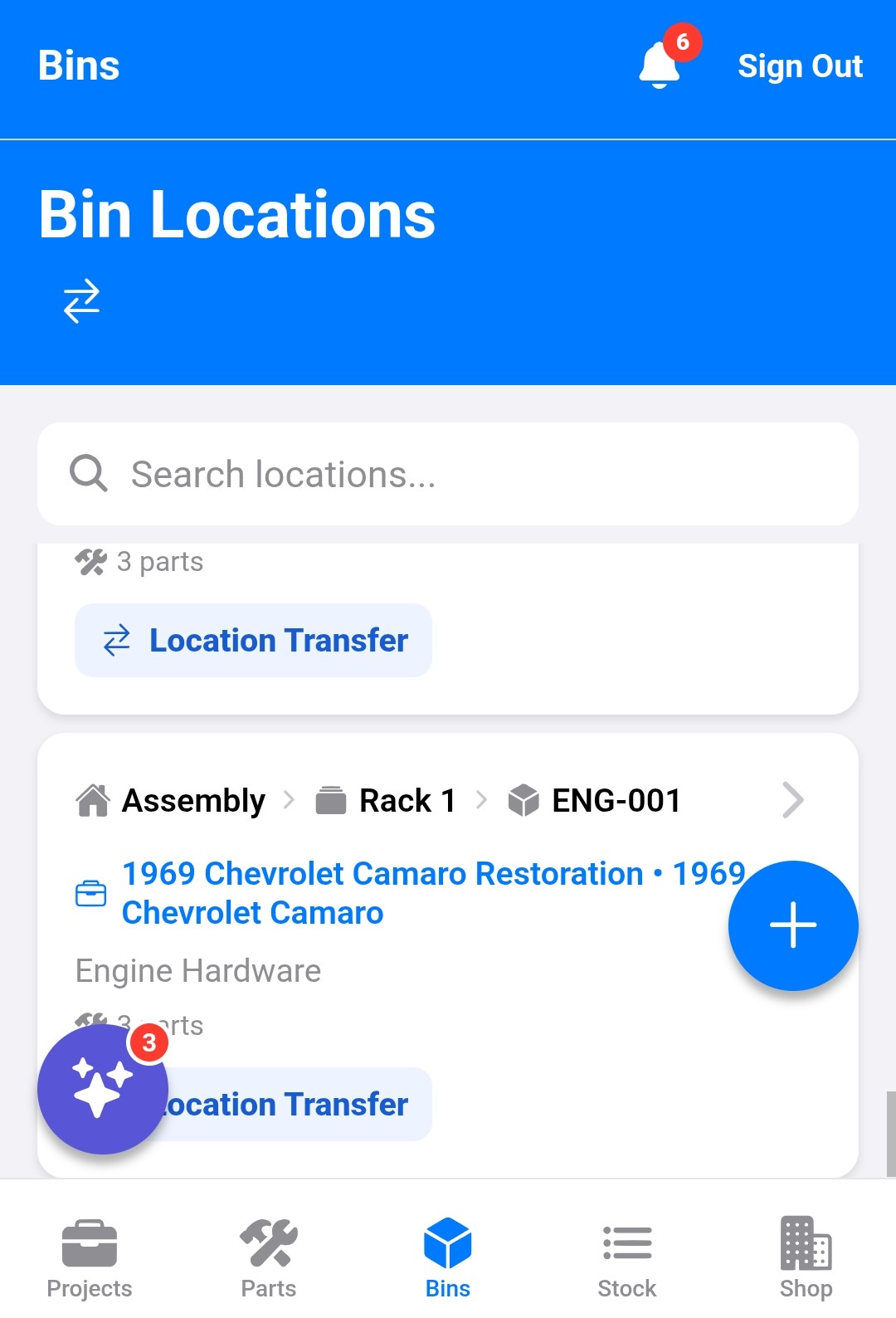
- Bin Locations organized as a hierarchy (for example Assembly › Rack 1 › ENG-001), each showing its project, description and part count
- Move Part / Change Bin and Transfer Part to Another Project from the part screen
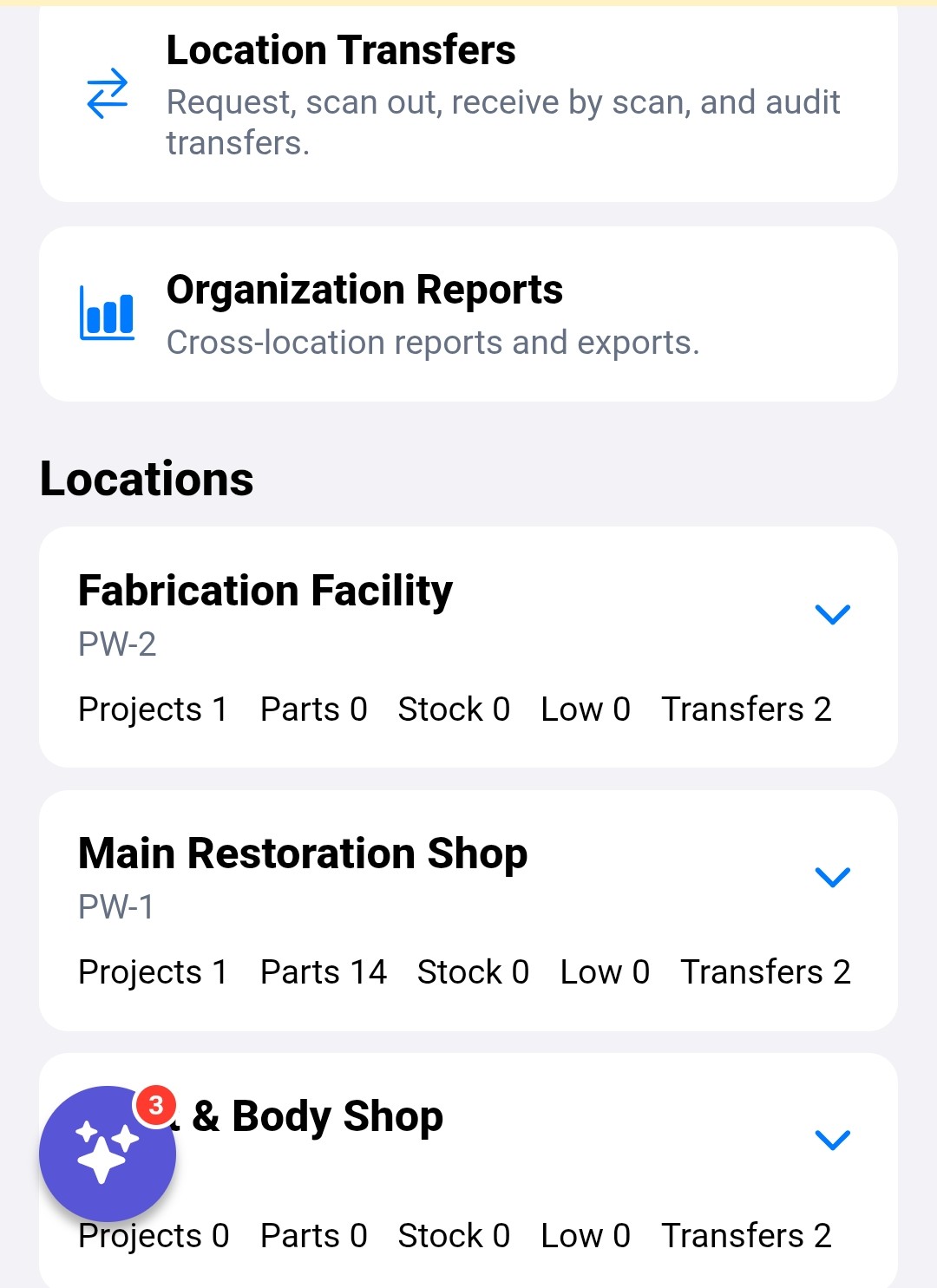
- Location Transfers between shop sites: request, scan out, receive by scan, and audit transfers
QR and barcode scanning
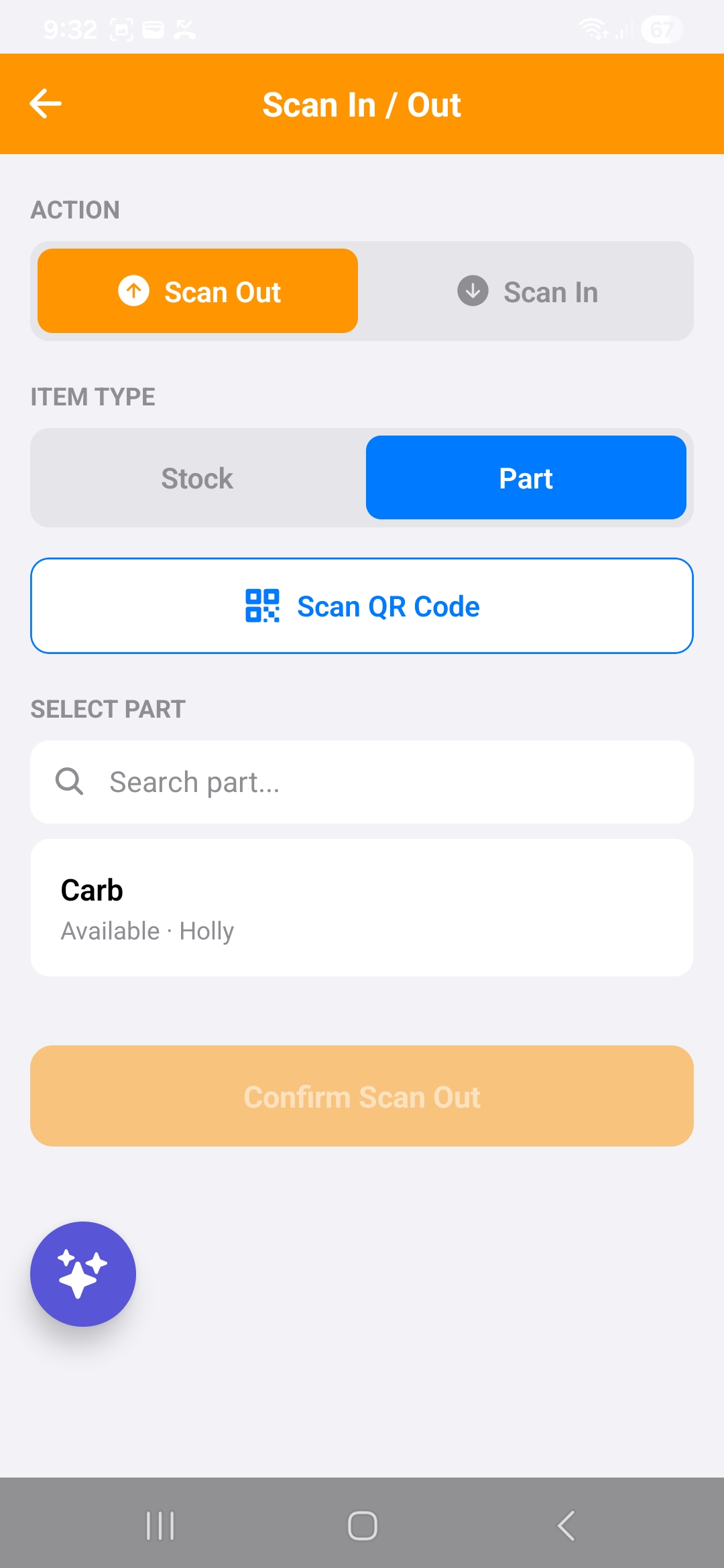
- A Scan In / Out screen for both Stock items and Parts, using the phone camera to scan QR codes or a part search
- Support for compatible HID barcode scanners, per the seller
Multi-location shops and reporting
- Multiple locations per organization (e.g. a main restoration shop, a fabrication facility, a body shop), each with counts of projects, parts, stock, low-stock items and transfers
- A Stock section for consumable inventory with low-stock tracking
- Organization Reports: cross-location reports and exports
- In-app notifications
SaaS administration
- Multi-tenant organization accounts with organization-level data separation
- Employee roles and permission-based access separating managers from technicians
- Activity history and audit logging
- Subscription billing and licensing administration, and a separate public demo environment, per the seller
Who it is for
- Founders and software companies wanting a ready vertical SaaS for classic car restoration, restomod, performance and racing shops
- Restoration and fabrication businesses that want to own their parts-tracking system outright
- Shop-management and DMS vendors looking to add project-based parts and bin tracking
- Teams adapting it to equipment restoration, specialty manufacturing or construction, where parts must be tracked per job
How it works
- A business creates an organization, then adds its locations, users and roles.
- Staff create a project for each vehicle or job.
- During disassembly, parts are registered against the project with condition, photos and a part number, and assigned to a bin.
- Parts, bins and projects get QR codes; staff scan parts in and out, change bins or transfer them to other projects or locations.
- At reassembly, technicians find each part by search or scan and mark it used.
- Managers review activity history, transfers and cross-location reports.
Ways to monetize
The seller positions SPT as a subscription SaaS with tiers for single-location shops, multi-location organizations and enterprise customers. A buyer could also sell white-label, self-hosted or perpetual licences, onboarding and data-migration services, or industry-specific modules.
Technology
Python · FastAPI · PostgreSQL · Expo · React Native (web and Android) · HTML/CSS/JavaScript marketing website · Docker · Nginx · Ubuntu Linux · HTTPS
What you get
- FastAPI backend and PostgreSQL database (admin side)
- Expo React Native app for web and Android
- The public marketing website (HTML, CSS, vanilla JavaScript)
- 30 days of seller support
Good to know
- Revenue. The seller describes the commercial model and a cloud deployment but gives no customer or revenue figures. Ask the seller for traction data before you buy.
- Platforms. Web and Android are covered. No iOS build is mentioned; Expo can target iOS, but that would need testing and an Apple developer account.
- Billing. Subscription billing and licensing administration are described, but the payment provider is not named. Confirm which gateway is wired in.
- Floating button. A purple sparkle-icon button with a badge appears on every screen, but the seller does not describe it. Ask what it does.
- Domain and brand. Confirm whether the shopprojecttracker.com domain, demo environment and Android store listing transfer with the sale.
- Hosting. You run your own Linux server with Docker, Nginx and HTTPS.
Demo
What's included
- Admin Panel
- Website
- Android
Documentation
Shop Project Tracker operates as a centralized project and inventory management system that connects physical components, storage locations, and employee activity to individual business projects.
**1. Organization and Project Setup**
A business creates an organization account and establishes its projects, locations, and authorized users. Projects can represent vehicle restorations, custom fabrication jobs, or other supported project types.
**2. Parts and Inventory Registration**
Employees register parts and components against specific projects. Records can include identifying information, condition, category, storage location, and photographs.
**3. QR-Code and Barcode Scanning**
Parts, bins, and projects can be associated with scannable identifiers. Employees use supported mobile or HID scanning workflows to access records, locate inventory, and perform operational actions.
**4. Disassembly, Storage, and Reassembly**
During disassembly, components are documented and assigned to storage bins or locations. During reassembly, employees retrieve the relevant records and update project activity, reducing reliance on handwritten labels and spreadsheets.
**5. Transfers and Audit History**
Authorized users can move or reassign parts through supported transfer workflows. Activity records help maintain accountability and traceability.
**6. Management and Administration**
Managers oversee projects, employees, inventory, and operational workflows through a centralized interface. Role-based access controls help distinguish management responsibilities from technician activities.
**Technical Implementation**
The backend is developed using Python FastAPI, with PostgreSQL handling persistent relational data. The frontend uses Expo React Native to support browser-based and Android application access.
Cloud deployment uses Ubuntu Linux, Docker, Nginx, and HTTPS. The platform supports separate production and demonstration environments.
The commercial architecture includes organization-level tenancy, subscription licensing, and administrative controls for managing subscription plans.
**Deployment and Expansion**
The primary commercial model is cloud-hosted SaaS, with enterprise, self-hosted, and white-label licensing positioned as additional commercial opportunities.
The platform is designed to support ongoing development of industry-specific modules and integrations.
Support
Included: 30 days
Contact the publisher
Reviews
No reviews yet.