RouteCart: Multi-Vendor Marketplace with Route-Based Delivery & Order Tracking (React Source Code)
RouteCart is a multi-vendor e-commerce marketplace where parcels travel on transport routes: customers shop from sellers and pick up at their nearest stage. It includes a storefront, cart, order tracking, seller and transport-operator portals and an admin dashboard, built with React, TypeScript, Vite, Tailwind CSS and Supabase auth. Sold as a front-end prototype.
Screenshots
About this product
In many markets, the hard part of online shopping isn't the storefront, it's the last mile. Sellers can list products, but getting a parcel from a shop in one town to a buyer in another often depends on informal transport networks: buses, matatu SACCOs, couriers and stage-to-stage routes. A regular e-commerce template has no idea those routes exist, so builders end up bolting delivery on as an afterthought.
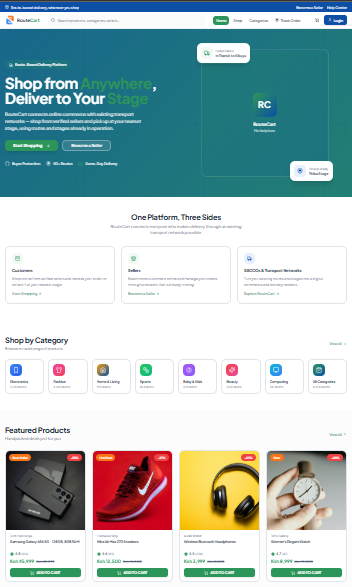
RouteCart is a multi-vendor e-commerce marketplace with route-based delivery built in. Its pitch is "Shop from Anywhere, Deliver to Your Stage": customers buy from verified sellers and pick up at their nearest stage, using routes that transport operators already run. It is designed as "One Platform, Three Sides" (customers, sellers, and SACCOs & transport networks) plus an admin dashboard. The demo is set up for Kenya (prices in Ksh, +254 phone numbers, Nairobi, Mombasa and Kisumu examples). The seller describes it honestly as a working, interactive front-end prototype built with React, TypeScript, Vite, Tailwind CSS and Supabase auth, best suited to a buyer ready to finish the backend.
Features
Customer marketplace
- Landing page with a hero, an "In transit" order card, the three-sided platform explainer, Shop by Category and Featured Products with ratings, sale badges and Add to Cart
- Global search for products, categories and sellers
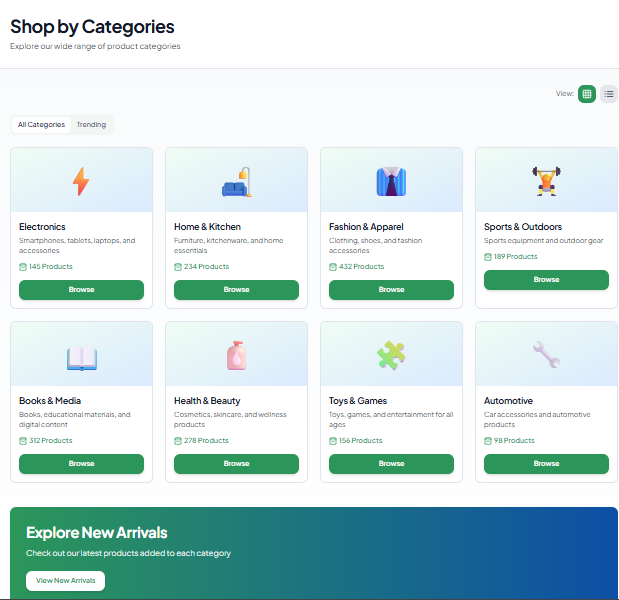
- Category browsing (Electronics, Home & Kitchen, Fashion & Apparel, Sports & Outdoors, Books & Media, Health & Beauty, Toys & Games, Automotive) with grid and list views and an All / Trending switch
- Responsive layout for desktop, tablet and mobile
Cart and checkout
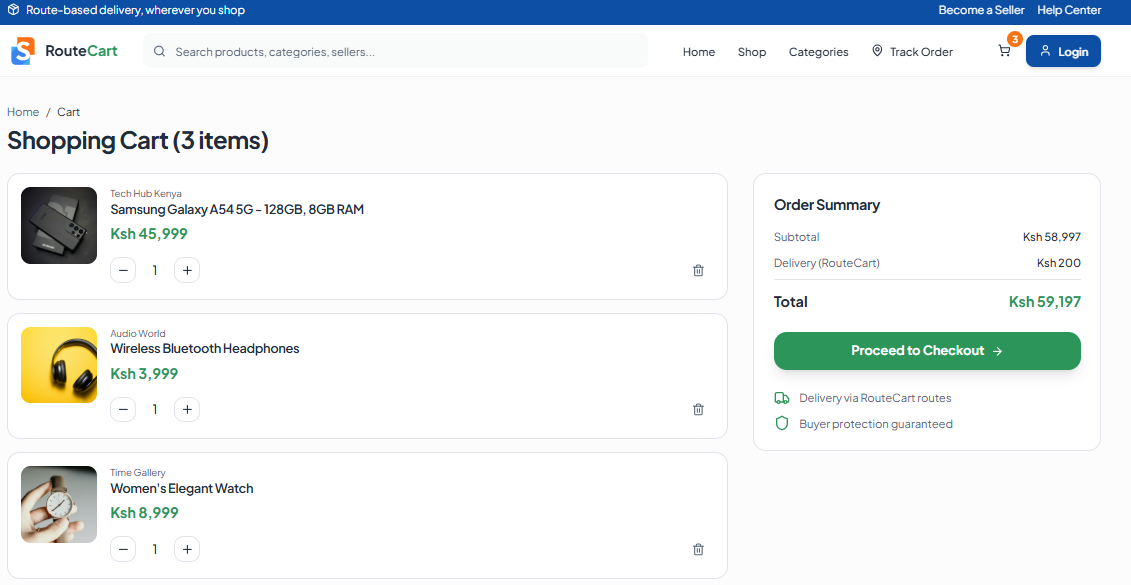
- Shopping cart showing each item's seller, with quantity controls and remove buttons
- Order summary with subtotal, a RouteCart delivery fee and total
- Proceed to checkout flow (payment is simulated in the current build)
Order tracking
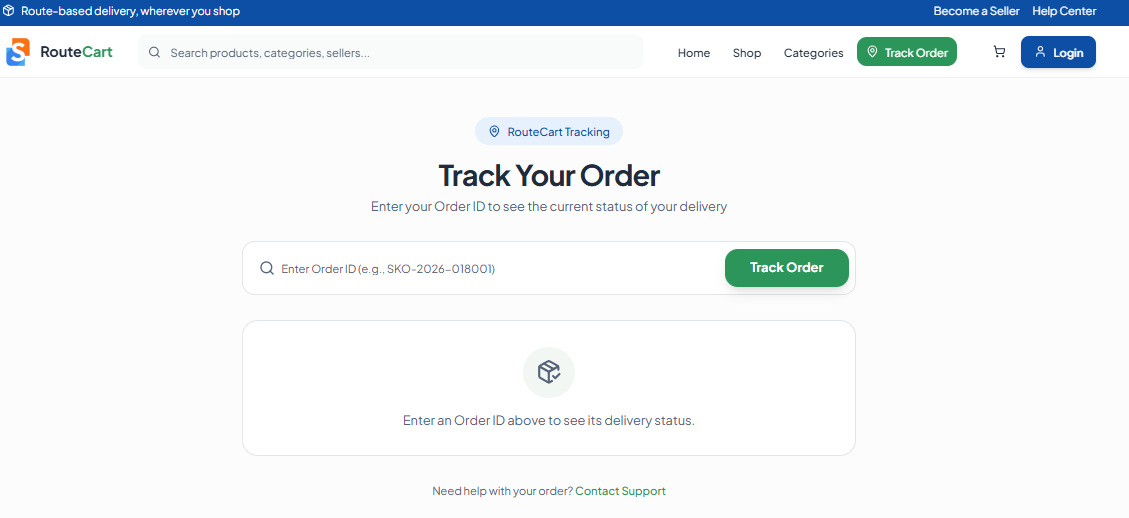
- Track Your Order page: enter an order ID to see delivery status
- Order lifecycle stages: pending, processing, ready for transport, picked up, in transit, arriving at a stage and delivered
Seller portal
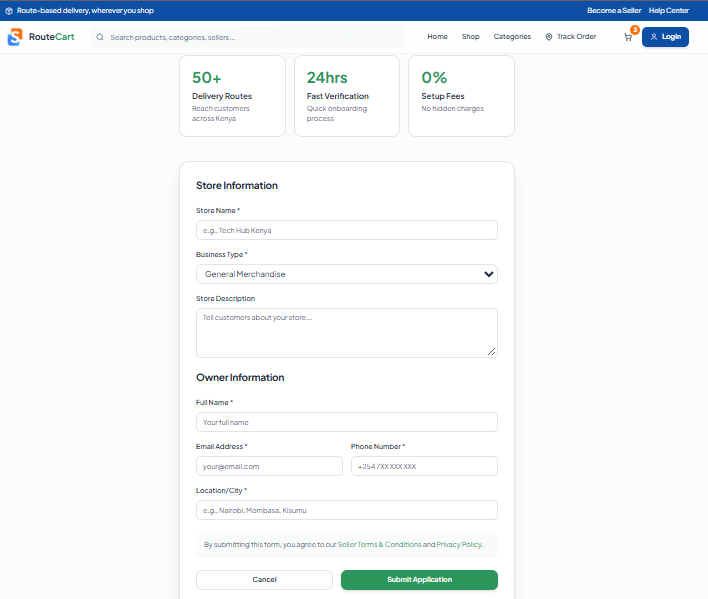
- Become a Seller application form: store name, business type, store description, owner name, email, phone and location/city, with terms acceptance
- A dedicated seller interface for seller-related workflows
Transport operations portal
- Interfaces for SACCOs and transport operators built around routes, stages and parcel movement
Admin dashboard
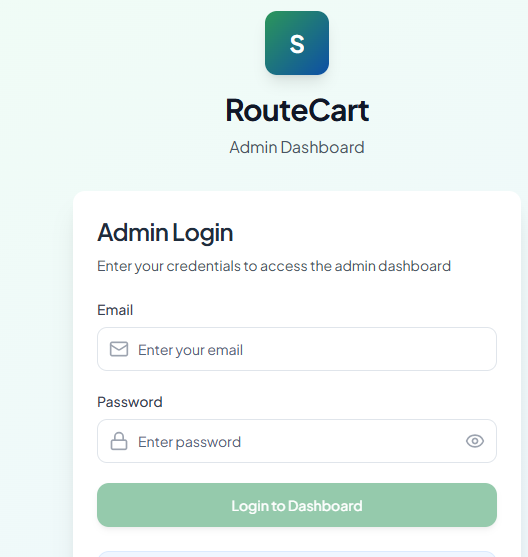
- Separate admin login and an administrative interface for overseeing the platform
- Demo data for products, sellers, transport operators, routes, stages and orders
Who it is for
- Developers and agencies who want a ready-made UI for a multi-vendor marketplace with delivery and don't want to design every screen
- E-commerce founders in Kenya and East Africa, or any market where parcels travel on bus, matatu or courier routes
- Courier companies, SACCOs and transport operators that want to add a shop or parcel booking front end to their routes
- Builders of a parcel delivery management system, a transport-enabled marketplace or a route-based logistics app
How it works
- A customer browses products by category or search and adds items from one or more sellers to the cart.
- Checkout totals the order and adds a RouteCart delivery fee.
- The order moves through processing and becomes ready for transport.
- A transport operator picks it up and carries it along a route, stage by stage.
- The customer tracks the order by ID until it arrives at their stage and is delivered.
- Sellers apply through Become a Seller; admins oversee the platform from the dashboard.
Ways to monetize
A finished build could take a commission on each sale, charge the delivery fee shown at checkout and share it with transport operators, sell seller subscriptions or featured listings, and charge SACCOs or couriers for parcel booking tools. None of this is implemented as live billing yet.
Technology
React · TypeScript · Vite · Tailwind CSS · React Router · Supabase (client authentication) · React Hook Form · Zod · Recharts · reusable UI components
What you get
- Source code for the customer marketplace website
- Seller portal, transport operations portal and admin dashboard interfaces
- Demo data and project assets
- 30 days of seller support
Good to know
- Prototype, not a finished platform. The seller states that much of the data comes from static demo data and browser local storage, not a production database. Budget for building the backend and data model.
- Payments are simulated. You need to integrate a real provider (for Kenya, typically M-Pesa or a card gateway) yourself.
- Security. Production-grade role-based permissions, backend workflows, notifications and mapping are not yet implemented, per the seller.
- Pre-revenue. There are no customers or revenue; this is a sale of source code and assets.
- Demo numbers. Figures on the screens (product counts per category, "50+ delivery routes", "24hrs verification") are demo copy, not real metrics.
- Branding. The admin login shows an "S" logo and the order ID example uses an "SKO-" prefix, which suggests an earlier name; confirm with the seller that all old branding is easy to remove.
- Your own accounts. You need your own Supabase project and hosting.
What's included
- Admin Panel
- Website
Documentation
Customers can browse the product marketplace, explore available items, add products to a cart, proceed through the checkout demonstration, and view order statuses. The order lifecycle illustrates stages such as pending, processing, ready for transport, picked up, in transit, arriving at a stage, and delivered.
Sellers have a separate portal for seller-related activities, while transport operators have an operations interface built around routes, stages, and parcel movement. An administration interface provides another view of the platform's management workflows.
The application uses React and TypeScript for the frontend, Vite for development and production builds, Tailwind CSS for styling, and Supabase client authentication. The current demonstration relies heavily on static sample data and browser local storage; the complete production data and workflow architecture has not yet been implemented.
A buyer can review the source code, customize the interfaces, connect a production database and backend, implement secure role-based access, integrate payment providers, and add notifications and mapping services according to their requirements.
Support
Included: 30 days
Contact the publisher
Reviews
No reviews yet.