How Much Does It Cost to Build an App Like Whatnot?
A custom build runs $63,000 to $360,000 depending on where your team sits. But the cost nobody quotes is live streaming: the same 90,000 viewer-hours a month costs $810 or $21,600 depending on architecture.

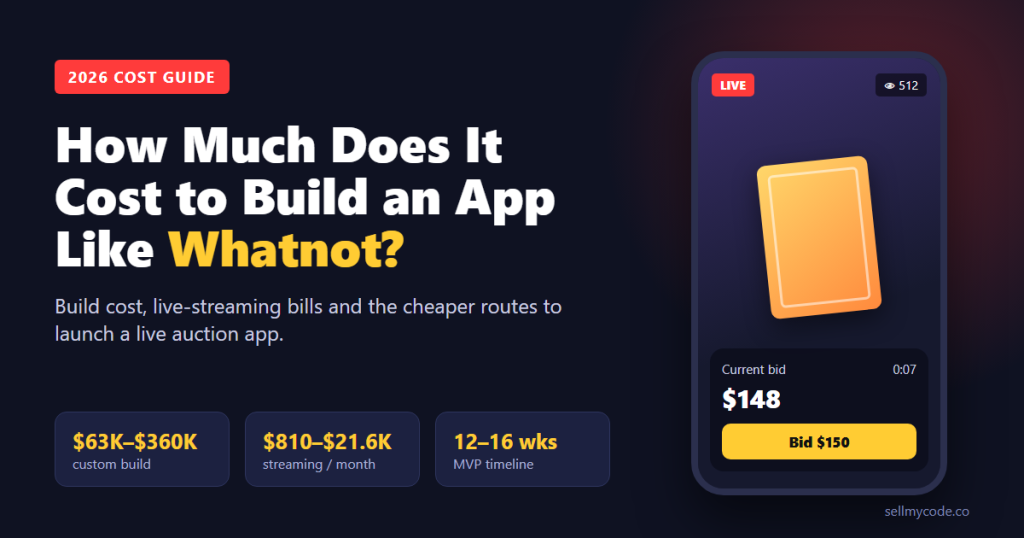
Agency quotes for a Whatnot-style live shopping app run from $20,000 to $600,000 — a thirty-fold spread, which tells you the question is badly posed rather than the answers being wrong. Nobody is defining scope, and almost nobody is pricing the part that actually decides whether the business survives: what it costs to run live video every day after launch. This guide builds the number from the bottom up, prices the streaming bill honestly, and compares the three realistic routes to launch.
TL;DR
- Custom build: roughly $63,000 to $360,000 for ~1,800 engineering hours, depending entirely on where your team sits.
- Published agency ranges: $120,000–$250,000 for a real-time auction MVP; $20,000–$120,000+ for a “complete” live shopping app; $250,000–$600,000 quoted at the top end.
- The number nobody quotes: live streaming. The same 90,000 viewer-hours a month costs $810 or $21,600 depending on architecture — a 27× spread.
- Timeline: 12–16 weeks minimum for a credible MVP, longer once payments and KYC are real.
- White-label alternative: around $14,990 deployed, or $999 for source only — which is roughly 428 hours of offshore development, against a build that needs more than four times that.
What You Are Copying: Whatnot in 2026
Whatnot is a US live shopping marketplace where sellers run live video shows and buyers bid in real-time auctions or buy at a fixed price. It started with trading cards, comics and collectibles and has since spread into sneakers, fashion, vintage and electronics. It is also one of the most valuable marketplaces built in the last decade:
- $20 billion valuation after a $545 million Series G in August 2026, roughly double its October 2025 mark of $11.5 billion.
- About $8 billion in GMV in 2025, according to the company, up from a $2 billion milestone it highlighted for 2024.
- Revenue from a take rate, not ads or subscriptions. Sellers pay an 8% commission on the item price in most categories, plus 2.9% + $0.30 payment processing on the order. There are no listing fees and no monthly seller subscription. Some categories, such as coins and electronics, carry lower commission.
That fee model matters for your cost question because it tells you what the platform has to earn back. At an 8% commission, a marketplace doing $500,000 of GMV a month earns about $40,000 before processing costs. Hold that number next to the streaming bills further down: a $21,600 monthly video bill eats more than half of it, while an $810 bill barely registers. The software you build or buy has to make that margin possible.
Why Every Number You Find Is Wrong
Search this question and you will get confident figures from development agencies. Three problems with all of them.
The quotes come from people selling the build. Nearly every published range is an agency’s content marketing. That does not make the numbers dishonest, but it does mean scope is defined to fit a comfortable quote.
“An app like Whatnot” is undefined. Whatnot is live video, a real-time auction engine, split payments with seller KYC, shipping label generation, dispute handling, content moderation at scale, and native apps on two stores. Quote any two of those and you get $40,000. Quote all of them and you are deep into six figures. Most cheap quotes silently assume a webview wrapper and a chat window.
Build cost is the smaller number. A live commerce platform is an operating cost business. Spend $150,000 building it and then discover streaming costs $20,000 a month, and the build price was never the decision that mattered.
What “An App Like Whatnot” Actually Contains
Before anyone can price it, here is the real component list. If a quote does not name all of these, it is pricing something else.
| Component | Why it is hard |
|---|---|
| Live video, sub-second | Auctions need latency under about 400ms. If a bid lands two seconds late the format breaks. Standard HLS at 6–30s is unusable for the host view. |
| Real-time auction engine | Anti-snipe timer extensions, reserve prices, proxy bidding, buy-now alongside live bidding, and a bid ledger that survives two determined buyers and a network hiccup. |
| Seller onboarding, KYC and payouts | Split payments to hundreds of sellers. Get custody wrong and you are an unlicensed money transmitter. |
| Multi-item cart with combined shipping | A buyer wins four lots from one seller in one show and checks out once, with shipping recalculated. |
| Shipping labels and tracking | Carrier integration, correct buyer billing, webhook-driven status, returns. |
| Moderation and trust | Live video means live risk. Counterfeits, prohibited goods, and whatever someone says on camera at 2am. |
| Native iOS and Android | Background video, push, in-app purchase rules, and two store review processes. |
| Admin and analytics | GMV, take rate, payouts, KYC queue, disputes, ads. The part nobody demos and everybody needs. |
Building the Estimate From the Bottom Up
A credible first version of the above is around 1,800 engineering hours. That is roughly four to five people for twelve to sixteen weeks, which matches the timelines agencies quote for this category.
The cost then depends almost entirely on geography:
| Where your team sits | Senior rate | 1,800 hours |
|---|---|---|
| US agency | $150–$300/hr | ~$360,000 at $200 |
| US contractor | $100–$250/hr | ~$270,000 at $150 |
| Latin America agency | $40–$100/hr | ~$126,000 at $70 |
| Eastern Europe | $35–$90/hr | ~$117,000 at $65 |
| India | $20–$65/hr | ~$63,000 at $35 |
That $63,000 to $360,000 band is the honest answer to the headline question, and it brackets most of the published agency ranges. Note that the same scope varies by 5.7× purely on where the work happens — which is why comparing quotes without comparing teams is meaningless.
One caveat worth stating: hourly rate is not productivity. A cheaper team that takes 2,600 hours instead of 1,800 has eaten a third of the saving, and live video plus real-time bidding is exactly the kind of work where experience compounds.
The Cost Nobody Quotes: Running Live Video
This is the section that should change your plan.
Take a modest operation: 500 concurrent viewers, three shows a day, two hours each. That is 90,000 viewer-hours a month — small for a marketplace with ambitions. Here is the monthly bill on identical traffic, by architecture:
| Approach | Per viewer-hour | Monthly at 90,000 viewer-hours |
|---|---|---|
| Agora HD (managed WebRTC) | ~$0.24 | $21,600 |
| LiveKit Cloud + bandwidth | ~$0.16 | $14,400 |
| AWS IVS Real-Time | ~$0.072 | $6,480 |
| Cloudflare Stream | ~$0.060 | $5,400 |
| Mux (720p LL-HLS) | ~$0.048 | $4,320 |
| Self-hosted + budget CDN | ~$0.009 | $810 |
$810 against $21,600 for the same audience watching the same shows. A 27× spread, decided by an architecture choice most founders delegate to whoever builds the app.
The underlying physics: a 1080p stream at 5 Mbps consumes about 2.25 GB per viewer-hour. Our modest 90,000 viewer-hours is therefore roughly 202 TB of egress a month. Bandwidth at that volume is the business.
How the cheap end is actually reached
You do not get to $0.009 by buying a cheaper vendor. You get there architecturally:
- Hybrid delivery. WebRTC only for people who need sub-second — the host, co-hosts, and the handful of active bidders. Low-latency HLS for everyone watching. Most of your audience does not need sub-second, they need to see the lot before the timer ends.
- Self-host above a threshold. Self-hosted media servers plus multi-CDN run roughly 4–8× cheaper per hour once you clear about 5,000 concurrent. Below that, managed is cheaper than the engineer you would hire to run it.
- Adaptive bitrate that defaults down. Most live commerce is a person holding a trading card. 720p is fine, and it halves your egress.
- Committed CDN rates. Spot pricing versus a commit is the difference between $110–190 and $6–11 per 1,000 viewer-hours.
Whatever route you take, insist your build includes a swappable media-server adapter. Being locked to one streaming vendor when your bill reaches five figures a month is the most expensive architectural mistake available in this category.
The Other Running Costs
| Cost | Typical | Notes |
|---|---|---|
| Cloud and media infrastructure | $1,500–$4,000/mo | At around 1,000 concurrent bidders, excluding the streaming delivery above |
| Payment processing | ~2.9% + fixed, plus payout fees | Comes off your take rate, not your revenue |
| KYC verification | Per seller verified | Scales with seller growth, not GMV |
| Moderation | AI pass + human queue | Live video cannot be moderated after the fact |
| Apple and Google | $99/yr + $25 one-off | Plus store commission where it applies |
| Maintenance | 15–20% of build cost annually | Standard for a platform of this complexity |
What to Cut for a Cheaper First Version
If you are building custom, the single biggest lever on cost is refusing to ship the whole thing at once. Here is what can wait and what genuinely cannot.
| Component | Verdict | Reasoning |
|---|---|---|
| Live video + auction engine | Cannot cut | This is the product. Everything else is commerce plumbing. |
| Payments and payouts | Cannot cut | Sellers will not come back if they are not paid reliably. |
| Basic moderation | Cannot cut | Live video without a kill switch is a legal and store-review problem on day one. |
| Native apps | Defer | Launch mobile web first. You lose push notifications — which matter — but save months and two store reviews. Add native once the format is proven. |
| Shipping label integration | Defer | Sellers can use their own labels at launch. Painful at a hundred sellers, fine at ten. |
| Advertiser portal | Defer | Nobody buys ads on a marketplace with no audience. |
| Subscription tiers | Defer | Commission alone is enough until you know what people pay for. |
| Multi-currency and multi-language | Defer | Launch one market properly first. The architecture should allow for it; the implementation can wait. |
| AI moderation | Defer | Human review works to a few hundred shows a week and costs less than the integration. |
Deferring that list realistically takes an 1,800-hour build down toward 900–1,100 hours — call it $32,000–$70,000 offshore instead of $63,000, or $135,000–$165,000 at US contractor rates. It also halves your time to first real show, which matters more than the saving.
The trap to avoid: deferring is only cheaper if the architecture anticipates it. Bolting multi-currency onto a system that hardcoded dollars costs more than building it correctly the first time. Defer the implementation, not the design.
The Three Routes, Compared Honestly
| Custom build | Source code licence | White-label deployed | |
|---|---|---|---|
| Upfront | $63,000–$360,000 | ~$999 | ~$14,990 |
| Time to live | 12–16 weeks minimum | Depends on your team | Days |
| You get | Exactly your spec | Codebase, you deploy | Deployed, branded, on both stores |
| You need | Budget and a technical lead to manage the build | Your own developers | Operating ability, not engineering |
| Risk | Scope creep, vendor quality, 12+ weeks before you learn anything | Integration and deployment are yours | Differentiation is on you — see below |
| Best when | Your mechanic genuinely differs from Whatnot’s | You have engineers and want the head start | Your edge is a category or region, not the software |
Put the numbers side by side and the comparison sharpens. $14,990 buys roughly 428 hours of offshore development. The build above needs more than 1,800. So a white-label deployment is about a quarter the cost of the cheapest credible custom build — and roughly a twentieth of a US agency quote.
That is not an argument that buying always wins. It is an argument about where your money should go. In live commerce the software is table stakes; sellers and audience are the business. Spending $270,000 to build what you can license for $14,990 is $255,000 not spent acquiring the sellers who make it work — and acquisition is the hard part, as our guide to getting your first 1,000 users sets out in detail.
What We Would Actually Tell You
We sell a white-label Whatnot-style platform, so treat this with appropriate scepticism — but the honest version has conditions attached.
Build custom if your auction mechanic genuinely differs from Whatnot’s, you are in a regulated vertical needing bespoke compliance, or you have raised enough that twelve weeks and $150,000+ is a rounding error against the strategic value of owning every line.
Licence the source if you have engineers who will own it. At $999 you are buying a twelve-week head start, then paying your own team to shape it.
Take the white-label if your advantage is a category or a region rather than the technology. Someone with deep relationships among sneaker resellers in Jakarta does not need a bespoke bid engine — they need to be live this month with payouts that work locally.
And in every case, price the streaming before you commit to anything. The 27× architectural spread above will outweigh the build decision within the first year of real traffic. Ask any vendor — us included — which media server they use, whether it is swappable, and what 90,000 viewer-hours costs on their default setup. A vendor who cannot answer that has not run one of these at scale.
How to Read a Development Quote
If you are collecting quotes, these are the things that separate a real number from a number designed to win the project.
- No named media server. “We’ll handle streaming” is not an answer. Ask which one, whether it is swappable, and what it costs at 90,000 viewer-hours. The 27× spread above lives entirely in this answer.
- Latency unspecified. If the quote does not commit to a target under about 400ms for the host view, assume standard HLS — and assume the auction format will not work.
- Payments described as “Stripe integration.” Taking card payments is trivial. Splitting funds to hundreds of KYC’d sellers without taking custody is not. These are different jobs by an order of magnitude.
- No mention of the admin panel. It is 15–20% of the build and the thing your ops team lives in. Quotes that omit it are quoting the demo, not the business.
- A fixed price with no scope document. Fixed pricing against vague scope resolves as change requests, always in one direction.
- No post-launch plan. Maintenance runs 15–20% of build cost a year. A quote with no answer on support is a quote that ends at handover.
- Timeline under ten weeks. Possible only by cutting from the list above — which is fine, but you should know which items and have agreed to it.
One useful test: ask any vendor to walk you through what happens when two buyers bid in the final three seconds of a lot. The answer covers anti-snipe logic, bid ordering under network latency, and what the losing bidder sees. A team that has shipped this answers immediately. A team that has not will talk about websockets.
FAQ
How much does it cost to build an app like Whatnot?
Roughly $63,000 to $360,000 for a custom build of about 1,800 engineering hours, depending on where your team is based. Published agency ranges span $20,000 to $600,000 because scope is rarely defined. A white-label deployment of equivalent functionality runs around $14,990, or about $999 for source code only.
How does Whatnot make money?
Mostly through commission. Sellers pay 8% of the item price in most categories plus 2.9% + $0.30 payment processing, with no listing or subscription fees. A clone that copies this model earns about $40,000 a month on $500,000 of monthly GMV, which is why streaming costs need to stay well below that.
How long does it take to build?
Twelve to sixteen weeks for a credible MVP with live video, a bid engine and payments. Longer once seller KYC, payouts and store review are real. Anyone quoting six weeks is excluding something important.
What is the most expensive part?
Over a year, running live video. A modest 500-concurrent operation generates 90,000 viewer-hours a month, which costs between $810 and $21,600 depending on architecture. That decision outweighs the build price quickly.
Why do agency quotes differ so much?
Scope and geography. The same 1,800-hour build is $63,000 in India and $360,000 at a US agency — 5.7× on identical work. Beyond that, a quote covering live video, a real-time auction engine, split payments with KYC, shipping and moderation is a different product from one covering video and chat.
Can I use a hosted tool instead?
For testing the format, yes. Tools that bolt live auctions onto an existing store start around $20 a month. You are renting someone else’s rails, with their branding, their fee structure and no marketplace of your own — fine for validation, not a business.
What ongoing costs should I budget beyond streaming?
Cloud and media infrastructure at roughly $1,500–$4,000 a month around 1,000 concurrent bidders, payment processing against your take rate, per-seller KYC, moderation, $99 a year for Apple plus $25 once for Google, and maintenance at 15–20% of build cost annually.
Is a cheaper offshore team a false economy?
Not inherently, but rate is not productivity. A team at $35/hour taking 2,600 hours costs more than one at $50 taking 1,700. Real-time video and auction logic are exactly where experience shows, so weight the portfolio over the rate.
The Honest Wrap
The headline question has a real answer — $63,000 to $360,000 for a custom build — but it is the less important number. Live commerce is an operating-cost business wearing a software project’s clothes. The architectural choice that sets your streaming bill between $810 and $21,600 a month will matter more to your first year than whether the build came in at $90,000 or $140,000.
So price the running costs first, then decide how to get the software. If your edge is genuinely in the product mechanic, build it. If your edge is a category, a region or a set of seller relationships — which it usually is — put the capital into those and licence the platform.
Our Whatnot-style live shopping and auction platform ships with a swappable media-server adapter for exactly the reason above, plus the auction engine, Stripe Connect payouts, combined shipping and moderation console described here. Full breakdown and pricing on the page, or see the wider catalogue if live commerce is one of several routes you are weighing.
Sources: TechCrunch: Whatnot raises 5M · Value Added Resource: Whatnot raises 5M at a B valuation · Whatnot: official seller fees · Mux pricing · Amazon IVS pricing · Cloudflare Stream pricing · Agora pricing · LiveKit Cloud pricing · Apple Developer Program fees · Google Play registration fee
A note on sourcing: the build-cost and developer-rate ranges in this article come from estimates published by development agencies. We have deliberately not linked to them. As set out above, those figures are produced by firms selling the build, with scope defined to fit the quote — so they are reported here as a category of claim rather than endorsed as independent research. Streaming and platform costs are cited to each vendor’s own published pricing.
Related reading: How to Get Your First 1,000 Users · Which Country Should You Launch In? · How to Buy Apps From Developers · Whatnot Clone: live shopping & auction app
Turn your code into cash — confidentially.
We buy complete working apps and source code directly from developers. No identity reveal, 48-hour evaluation, direct payment. Camera-off demo is the default.
Start the confidential evaluation No obligation · NDA on request · Direct payment, no broker feesSchedule your confidential demo.
A 20-minute call. Camera off. No real name required. Fair offer within 48 hours.