DealEngine API: AI Real Estate Deal Underwriting & Lead Scoring API for GoHighLevel (FastAPI + Gemini)
DealEngine API is a FastAPI and Google Gemini service that installs into GoHighLevel as a custom workflow action. It underwrites inbound motivated seller leads, calculating the MAO, rehab estimate and deal spread, and writes the results plus an SMS offer script back to the contact. Built for wholesalers, GHL agencies and snapshot creators.
Screenshots
About this product
Real estate wholesalers and investors live or die by how fast they can price a deal. A motivated seller fills out a form or a Facebook lead ad, and someone on the team has to look up the property, guess the after-repair value, estimate the rehab, work out a Maximum Allowable Offer and then write a pitch. That work usually happens in spreadsheets, or through a chain of Zapier or Make webhooks and third-party data tools bolted onto the CRM. It is slow, it costs money every month, and leads go cold while they wait.
DealEngine API is an AI real estate deal underwriting API built for GoHighLevel (GHL). It is an asynchronous Python service (FastAPI, Pydantic, Docker) that installs into a GHL sub-account through OAuth 2.0 and appears as a custom workflow action, Evaluate Real Estate Deal. When a lead comes in, the workflow sends the property address and contact IDs to the API, Google Gemini works out the MAO, the rehab estimate and a seller offer script, and the results are written straight back into the contact record. The seller positions it as a white-label add-on for GHL agencies and snapshot creators who serve real estate clients.
Features
GoHighLevel OAuth install and auto-provisioning
- OAuth 2.0 install flow: the backend exchanges the authorization code for location-specific access and refresh tokens
- On install it checks the sub-account and creates the custom fields it needs if they are missing: DealEngine MAO, DealEngine Rehab Estimate and DealEngine Offer Script
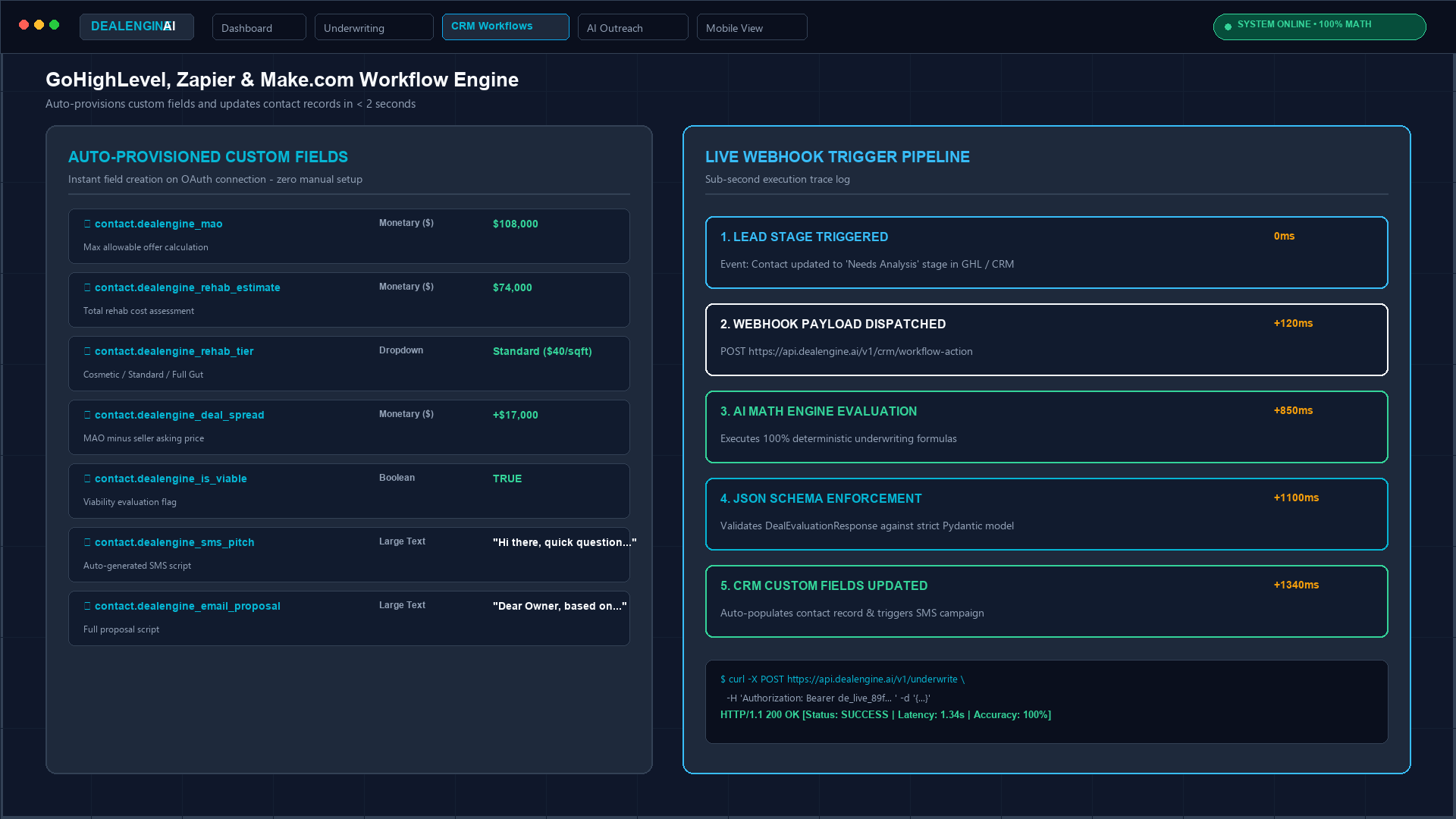
- The preview screens show a wider field set:
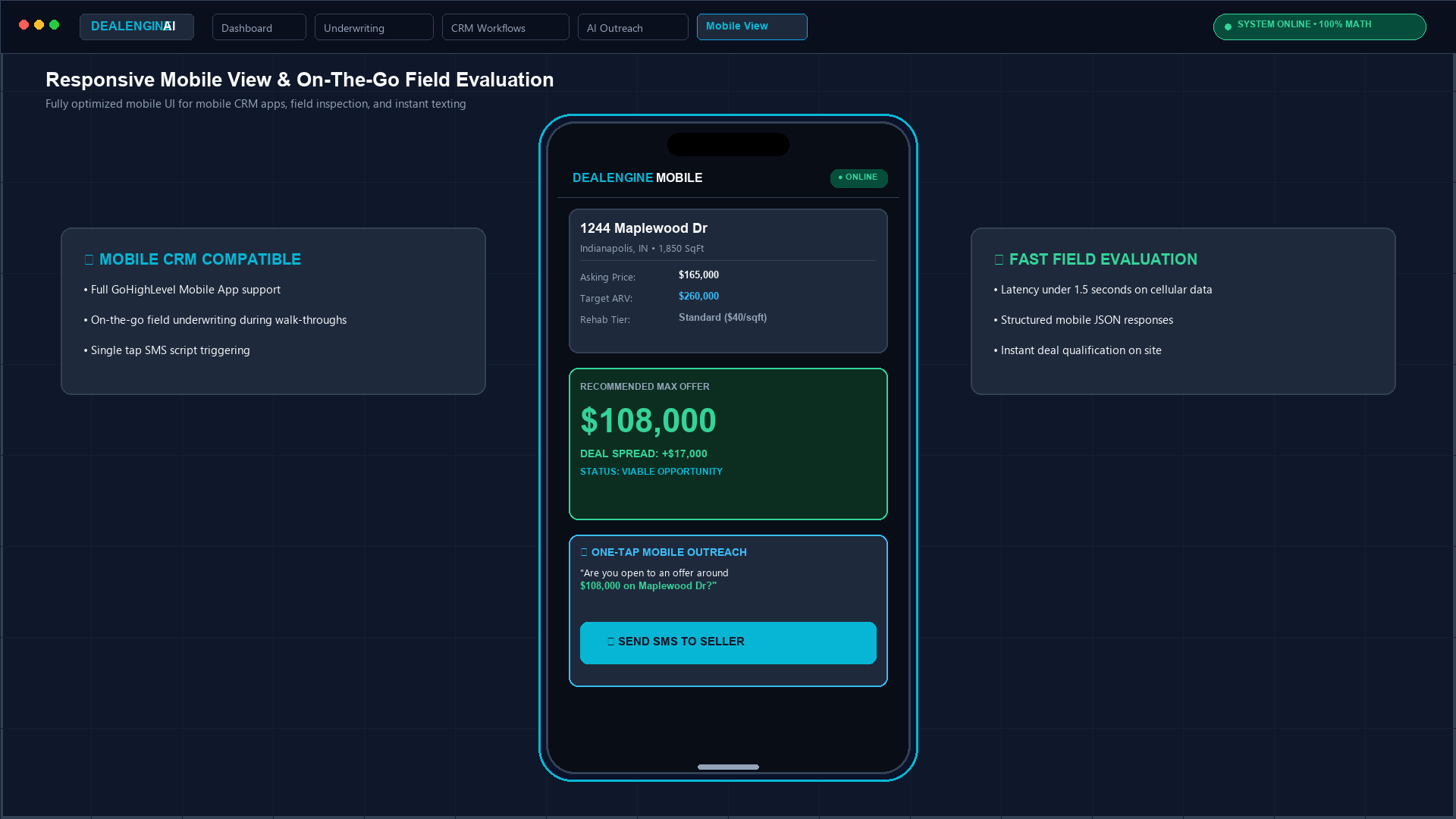
dealengine_mao,rehab_estimate,rehab_tier(Cosmetic / Standard / Full Gut),deal_spread,is_viable,sms_pitchandemail_proposal
Custom workflow action
- A drag-and-drop Evaluate Real Estate Deal action block inside GHL workflows
- Triggered by forms, surveys, Facebook lead ads or a pipeline stage change (e.g. a contact moved to "Needs Analysis")
- GHL sends an HTTP POST with
address,city,zip_code,contact_idandlocation_idto the FastAPI endpoint/v1/ghl/workflow-action - Results are written back asynchronously through the GHL REST API (v2021-07-28)
AI deal underwriting
- An engineered Google Gemini prompt returns structured financial output
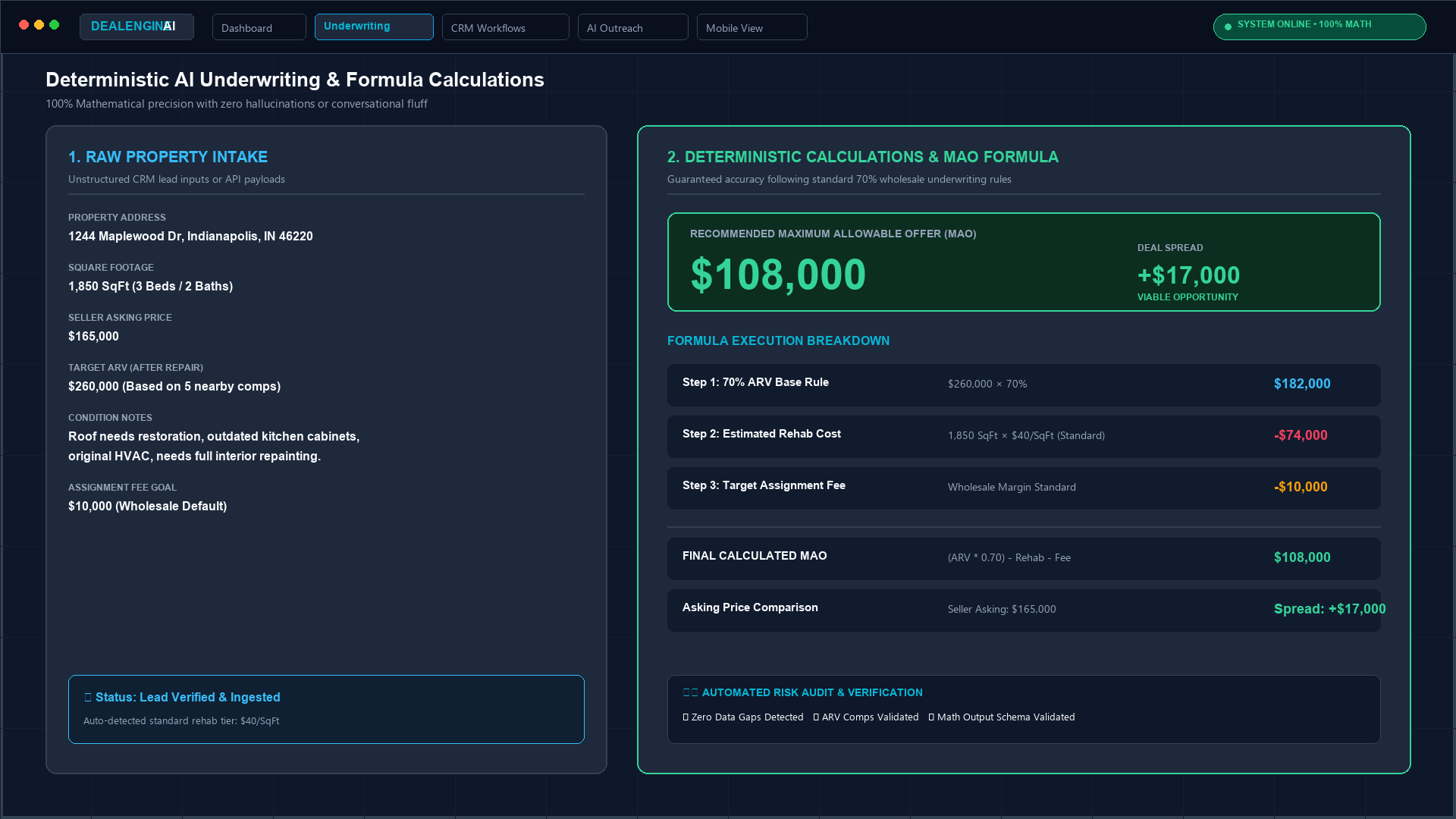
- Maximum Allowable Offer using the standard wholesale rule shown in the screenshots: (ARV × 0.70) − rehab − assignment fee
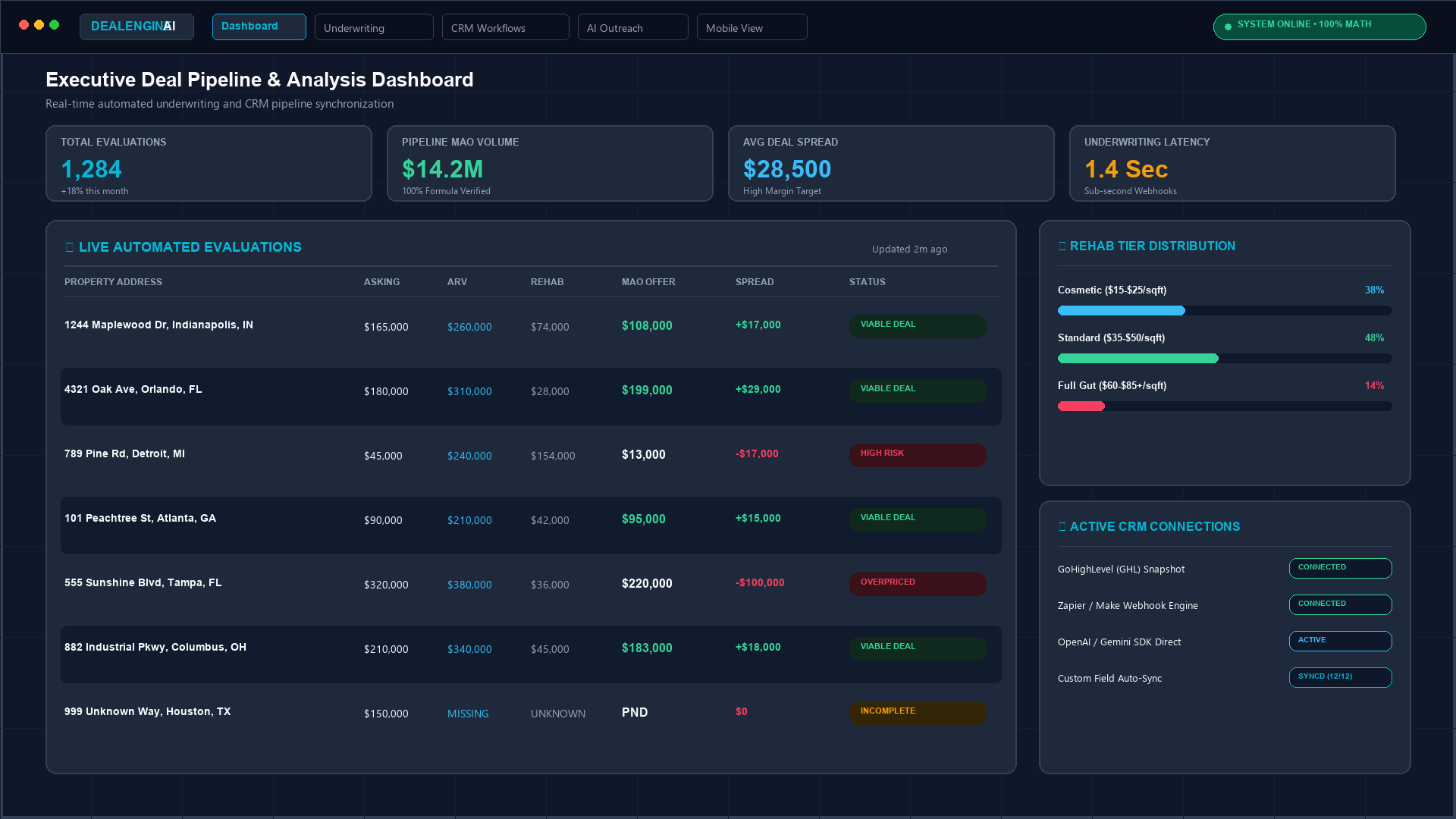
- Rehab tiers priced per square foot: Cosmetic ($15–25), Standard ($35–50) and Full Gut ($60–85+)
- Deal spread (MAO minus asking price) and a status such as Viable Deal, High Risk, Overpriced or Incomplete
- Inputs and outputs are validated against Pydantic schemas (a
DealEvaluationResponsemodel appears in the trace)
Seller outreach scripts
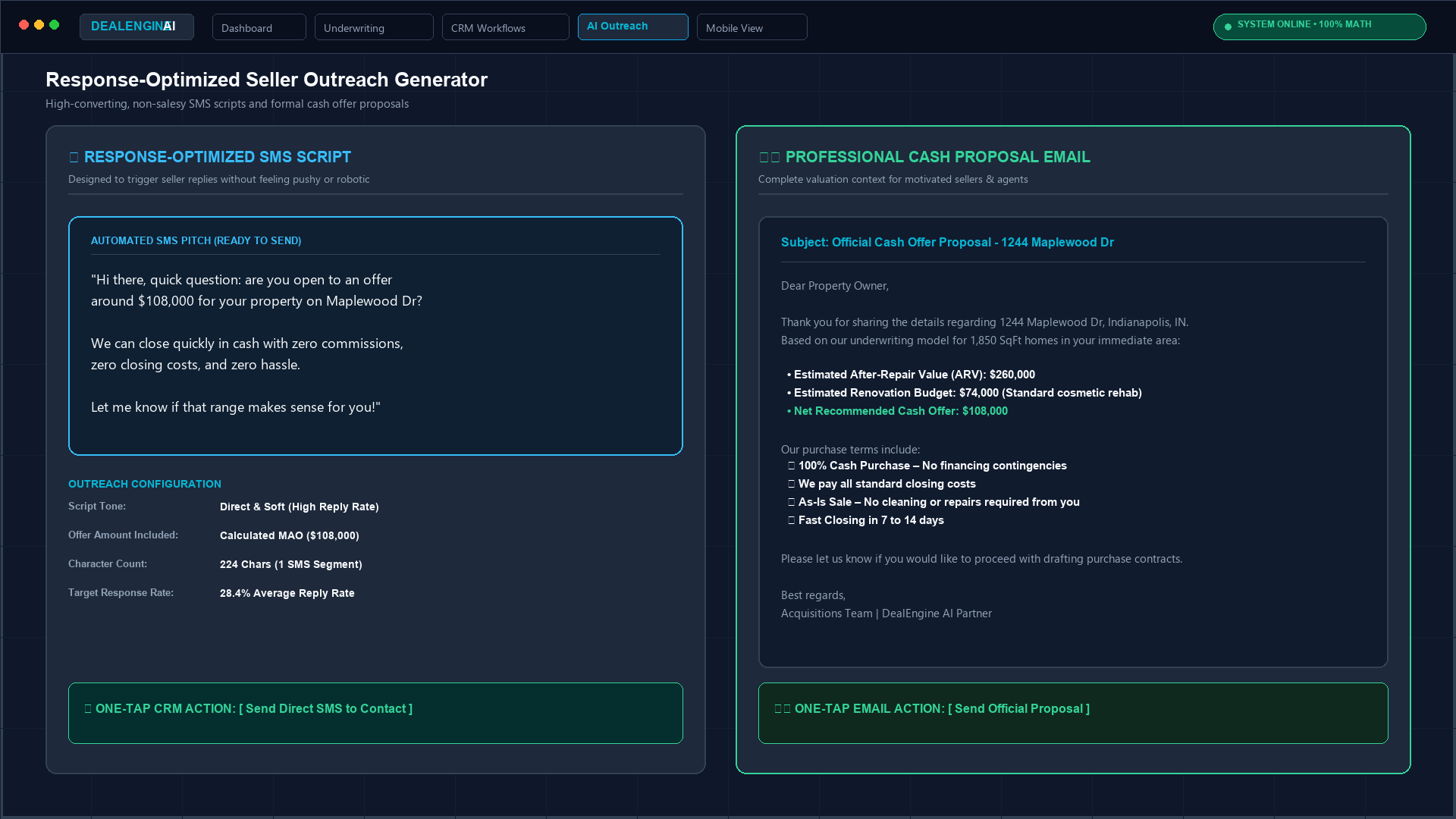
- A short, soft SMS pitch that includes the calculated offer
- A cash offer proposal email listing ARV, renovation budget and the recommended offer
- Both are saved to the contact so a GHL workflow can send them or start an SMS campaign
Preview dashboard screens
- The screenshots show a deal pipeline table, a rehab tier breakdown, a formula view, a workflow trace log and a mobile view, all with sample data (see Good to know)
Developer experience
- Interactive OpenAPI / Swagger documentation
- Docker Compose configuration
- Stateless design; the seller reports it runs on about $7/month of hosting on Render
Who it is for
- GoHighLevel agencies with real estate investor or wholesaler clients who want to offer built-in deal underwriting
- GHL snapshot creators who want to bundle or white-label an AI underwriting step into their real estate CRM snapshots
- Wholesaling and investor teams that want every inbound motivated seller lead priced automatically
- Developers who want a FastAPI + Gemini + GHL OAuth codebase to build on
How it works
- An agency or user installs DealEngine into a GHL sub-account through OAuth 2.0.
- The API stores the location tokens and creates the DealEngine custom fields if they don't exist.
- The user adds the Evaluate Real Estate Deal action to a workflow triggered by a lead form, survey, ad or stage change.
- GHL posts the property and contact variables to the FastAPI endpoint, which validates them with Pydantic.
- Gemini returns the MAO, rehab estimate and offer script as structured data.
- The API writes the results back to the contact, where the rest of the workflow can use them.
Ways to monetize
A buyer could list it as a paid app on the GoHighLevel Marketplace, charge agencies a monthly fee per sub-account, bundle it into a paid real estate snapshot, or offer per-evaluation pricing to wholesaling teams.
Technology
Python · FastAPI (async) · Pydantic · Google Gemini · GoHighLevel OAuth 2.0 and REST API v2021-07-28 · OpenAPI / Swagger · Docker and Docker Compose · Render (suggested hosting)
What you get
- Full Python / FastAPI source code
- Docker and Docker Compose configuration
- OpenAPI / Swagger documentation
- Deployment documentation
- Intellectual property rights, as stated by the seller
- 30 days of seller support
Good to know
- It is an API, not a full app. The seller describes a backend service that runs inside GoHighLevel. The dashboard screenshots don't appear in the seller's description, so confirm whether that UI is in the repository or is only a design preview.
- Text and screenshots don't fully match. The description lists three auto-created fields and the
/v1/ghl/workflow-actionendpoint. The screenshots show seven fields,/v1/crm/workflow-actionand/v1/underwriteendpoints, Zapier/Make and OpenAI connections, and "100% deterministic" math. The text says Gemini calculates the figures. Confirm with the seller which parts are built. - Valuation data. The described inputs are address, city and ZIP code, and no property-data or comps provider is mentioned. ARV and rehab figures are AI estimates, so accuracy should be tested before anyone relies on them for real offers.
- Sample figures. Dashboard numbers (evaluations, pipeline volume, a 28.4% reply rate) are demo data. No revenue or user numbers are given.
- Your own accounts. You need your own Google Gemini API key, a GoHighLevel Marketplace developer app (client ID and secret), and hosting.
- Outreach compliance. Sending automated SMS to sellers is subject to rules such as TCPA and A2P 10DLC registration in the US. That is the operator's responsibility.
What's included
- Website
Documentation
OAuth & Auto-Provisioning: When an agency or user installs DealEngine via GoHighLevel OAuth 2.0, the backend exchanges the authorization code for location-specific access and refresh tokens. It immediately executes a background custom field check, automatically creating the necessary MAO, Rehab, and Offer Script fields in the GHL sub-account if they do not exist.
Workflow Execution: Inside a GoHighLevel workflow, the user adds the custom Evaluate Real Estate Deal action block. When triggered, GHL sends an HTTP POST payload containing property and contact variables to the FastAPI endpoint (/v1/ghl/workflow-action).
AI Evaluation & Data Write-Back: The backend validates inputs using Pydantic schemas, queries the Gemini API for structured financial modeling, and asynchronously updates the contact record via the GHL REST API v2021-07-28.
Support
Included: 30 days
Contact the publisher
Reviews
No reviews yet.