Launch an Edmunds-Style Research-First Auto Marketplace with Expert Reviews + TMV Pricing in 21 Days
An operator in Toronto reached out last September with a thesis I had not heard articulated in this market before. He had spent nine years on the editorial side at Driving.ca and another four at AutoTrader Canada, and he had watched a strange gap develop in the Canadian auto market over the last decade. The classifieds side — AutoTrader Canada, Kijiji Autos, Auto.ca — was well-served. The pricing-intelligence layer (Black Book Canada, Canadian Black Book) was well-served. But the editorial-research layer — long-form expert reviews, instrumented testing in Canadian winter conditions, bilingual English-French coverage of Canadian-spec vehicles, side-by-side comparison tools, 5-year cost-to-own calculators that account for Canadian fuel taxes and insurance averages — was structurally underserved. Canadian car buyers were doing their research on Edmunds and Motor Trend, both of which cover the US market with US-spec vehicles and US-market pricing. Close enough to feel useful, wrong enough to mislead a Canadian buyer making a $48,000 decision. He wanted to build the Edmunds of Canada. We delivered the codebase in 23 days. Eight months later: 281,000 monthly active users across Ontario, Quebec, BC, Alberta, Manitoba, and the Maritimes; content-syndication partnerships with three Canadian publishing houses and two regional broadcasters; a fully-bilingual expert review team running scheduled new-vehicle testing; and roughly $340,000 in monthly recurring revenue from a mix of dealer-network leads, affiliate content monetization, premium-research subscriptions, and OEM content-sponsorship partnerships.
That story is the Edmunds opportunity in a paragraph. Most operators thinking about entering auto marketplaces immediately default to classifieds — list inventory, generate leads, charge dealers. That model is crowded everywhere and brutal to win without massive SEO investment. The structurally different model that Edmunds built over six decades — research first, editorial trust second, marketplace revenue third — is far less crowded and is far better positioned to compete in a world where Google has been steadily shifting traffic toward content that demonstrates expertise, experience, authoritativeness, and trustworthiness. Edmunds in the US gets 20+ million monthly unique visitors largely because their editorial reviews and TMV pricing data have built three decades of search authority that Google specifically rewards. That kind of editorial moat exists nowhere outside the US market. Canada, the UK, Australia, India, the Gulf, Southeast Asia, Latin America — every one of those markets has classifieds operators and pricing-data operators but no serious editorial-first auto research authority. The arbitrage is real and the right operator profile to capture it is someone with auto journalism, automotive editorial, or motorsport publishing background.
Building an Edmunds-grade research-first auto marketplace from scratch costs $180,000 to $620,000 and takes 10 to 17 months. The engineering layer underneath is larger than a standard marketplace because you are building two products in parallel — a sophisticated content management system designed specifically for auto editorial workflow (review scoring rubrics, structured vehicle test data, video review library management, comparison-tool data schemas, editorial calendar with embargo handling for OEM press fleets) plus a full marketplace stack on top (inventory, dealer portal, lead routing, F&I, trade-in, etc.). Most operators waste their first $240k building one of those two layers well and the other layer half-built, and then they cannot figure out why their bounce rate is so brutal. The codebase you are buying has both layers built deliberately together so the research content drives the marketplace conversion the way it does on Edmunds itself.
$8,999 USD · Free Demo · Live in 21 Days · 6 Months Free Priority Maintenance · 1 Year Free Hosting · 5 Ad Creative Templates · Full Source Code · 100% Customization · iOS + Android + Web + Editorial CMS + Dealer Portal · TMV-Style Pricing Engine Pre-Loaded · 5-Year Cost-to-Own Calculator · Comparison Tool Built-In
What You Get In The Edmunds Clone Package
| Component | Included |
|---|---|
| Web Platform (Next.js + React, SSR + ISR for editorial-content SEO) | ✓ |
| Native iOS App (Swift + SwiftUI) — App Store ready | ✓ |
| Native Android App (Kotlin + Jetpack Compose) — Play Store ready | ✓ |
| Editorial CMS (purpose-built for auto reviews — not generic WordPress) | ✓ |
| Dealer Portal (inventory, lead, listing management, reputation dashboard) | ✓ |
| Admin Operations Dashboard (multi-region, editorial + marketplace combined) | ✓ |
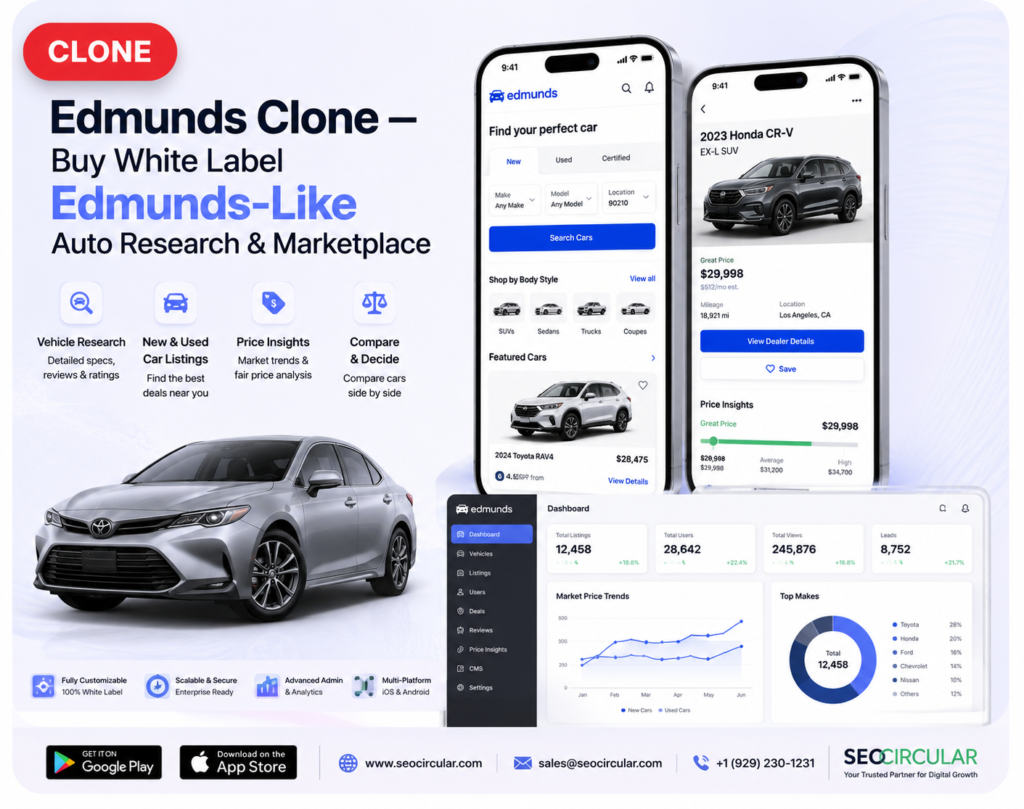
| TMV (True Market Value) Pricing Engine — regional-market-aware pricing intelligence | ✓ |
| 5-Year Cost to Own Calculator (depreciation + fuel + insurance + maintenance + repairs + taxes) | ✓ |
| Total Cost of Ownership Forecasting Engine (regional fuel/insurance/tax inputs) | ✓ |
| Side-by-Side Vehicle Comparison Tool (up to 4 vehicles, 200+ comparison data points) | ✓ |
| Long-Form Expert Review Templates (structured scoring across 14 categories) | ✓ |
| Vehicle Test Data Schema (0-60, braking, cargo, fuel economy real-world) | ✓ |
| Video Review Library Management (intro, b-roll, voiceover, scoring overlay) | ✓ |
| Editorial Calendar with OEM Embargo Handling | ✓ |
| Press Fleet Tracking (which reviewer has which vehicle for how long) | ✓ |
| Expert Review Scoring Rubric (configurable category weights per category type) | ✓ |
| Buying Guides + Long-Form Editorial Content (article templates, related-vehicle linking) | ✓ |
| Best Cars Lists (Best SUVs, Best Trucks, Best EVs, etc. — auto-generated from review scores) | ✓ |
| Used Car Verdicts + CPO Recommendations (per model-year-trim) | ✓ |
| Vehicle Configurator (new + used inventory, configurable trim + options + region) | ✓ |
| New + Used + CPO Inventory (hybrid marketplace) | ✓ |
| VIN Lookup + Vehicle History Integration (Carfax / AutoCheck-ready) | ✓ |
| Trade-In Valuation Engine (regional market-area pricing) | ✓ |
| F&I Module (financing offers, lease vs buy calculator, payment estimator) | ✓ |
| Loan Pre-Qualification Integration (regional lender partners) | ✓ |
| Dealer Ratings + Reviews System (verified-purchaser-only reviews) | ✓ |
| Dealer Reputation Dashboard (with response-to-reviews workflow) | ✓ |
| Recall + Safety Bulletin Database (regional-data-source integration) | ✓ |
| Vehicle Safety Ratings Display (IIHS, NHTSA, Euro NCAP, regional equivalents) | ✓ |
| Reliability Ratings + Owner-Reported Issue Tracking | ✓ |
| Lease Deal Aggregator (lease offers across dealers + manufacturers) | ✓ |
| Best Lease Deals Algorithm (lease cost analysis vs MSRP) | ✓ |
| Vehicle Photo + Gallery + 360 View + Video Walkaround | ✓ |
| Editorial Photo Library Management (with rights tracking + credit attribution) | ✓ |
| Dealer Inventory Bulk-Upload (CSV, XML, polk feed, vAuto, HomeNet, AutoFi) | ✓ |
| Lead Routing to Dealers (priority + radius + inventory-match) | ✓ |
| Affiliate Revenue Tracking (for content monetization — buying guides linking to inventory) | ✓ |
| Premium Research Subscription Tier (Edmunds Plus-style) | ✓ |
| OEM Content Sponsorship Module (sponsored reviews, sponsored comparison guides) | ✓ |
| SEO Schema (Vehicle, Product, Review, Article, FAQ, AggregateRating, LocalBusiness, BreadcrumbList) | ✓ |
| Google Vehicle Ads + Facebook Marketplace + Bing Cars Inventory Feeds | ✓ |
| Newsletter Engine (segmented by vehicle interest, body style, fuel type) | ✓ |
| Email Marketing Integration (Mailchimp, SendGrid, Customer.io) | ✓ |
| SMS Notifications (Twilio, MessageBird) | ✓ |
| Multi-Language Support (English, French, Spanish — extensible at $200/language) | ✓ |
| Stripe + PayPal + ACH + regional payment gateways | ✓ |
| App Store Optimization Tools | ✓ |
| Anti-Fraud Detection (synthetic-account flagging, dealer-inventory verification, review spam detection) | ✓ |
| Full Source Code (yours forever from day one) | ✓ |
| Free Demo · 1 Year Free Hosting · 6 Months Free Priority Maintenance | ✓ |
| 5 Ad Creative Templates (Google + Meta + YouTube + LinkedIn) | ✓ |
| 100% Customization (at $35/hour or use your own team) | ✓ |
The Editorial CMS — Why Generic WordPress Will Kill Your Launch
I want to spend a minute on this because every operator who has ever tried to build an Edmunds-style platform underestimated how specific the editorial workflow is and they paid for it later.
Auto editorial is not blog editorial. A blog has posts, categories, tags, an author, and a publish date. Auto editorial has structured vehicle reviews with 14 scoring categories that each have configurable weights depending on whether the vehicle is being reviewed as a daily driver, a luxury cruiser, a sports car, a truck, or an off-roader. Reviews have a designated reviewer, a press-fleet vehicle (with VIN, mileage in, mileage out, fuel economy observed, and notes about prior reviewers’ damage), a regional context (Canadian winter testing differs from Arizona summer testing differs from European autobahn testing), an embargo lift time set by the OEM that automatically gates publication, a structured-data export for the comparison tool, a video review with synchronized chapter markers and scoring overlay, and a relationship graph to competing vehicles for the recommendation algorithm. None of that fits a generic blog CMS. All of it is what makes editorial-research auto platforms convert at the rates they do.
The codebase ships with the editorial CMS purpose-built for this workflow. Reviewers log in, are assigned vehicles from the press-fleet calendar, fill in structured review forms that map to the comparison-tool data schema, attach photos with rights and credit metadata, attach video reviews with scoring overlays, and submit through an editorial review pipeline that handles fact-checking, OEM embargo lift, and scheduled publication. The output renders as the long-form expert review pages that anchor the platform’s SEO authority. The same structured data feeds the comparison tool, the best-cars lists, the buying guides, and the recommendation algorithm. One review, written once, surfaces in fifteen places where Google can find it.
This is the layer that separates a research-first auto platform from a classifieds clone with some buying guides bolted on. The CMS is two-to-three months of additional engineering that the codebase has already done.
TMV (True Market Value) Pricing Intelligence — How It Actually Works
TMV is Edmunds’ answer to “what is this car actually worth in my market.” It is not the MSRP. It is not the dealer invoice price. It is the regional-market-adjusted price that incorporates current incentives, regional supply-and-demand dynamics, seasonality, model-year transition pressure, and observed transaction prices in the buyer’s metro area.
The TMV engine in the codebase combines four data layers: (1) MSRP and invoice baseline from manufacturer data feeds (you license these or use OEM-provided press-fleet documentation), (2) current incentives and rebates by region and trim, (3) historical transaction data from your certified dealer network or licensed third-party providers (J.D. Power’s Power Information Network, MarketCheck, regional polk-feed providers in non-US markets), and (4) market dynamics adjusters (seasonality, end-of-quarter pressure, end-of-model-year pressure, dealer inventory levels). The output is a buyer-facing price intelligence display — “the typical buyer in your zip code is paying around $38,400 for this configuration, which is about $1,700 below MSRP and $300 above invoice; market trend is softening 2% over the last 30 days.”
The thing that separates a credible TMV implementation from a noisy one is statistical confidence handling. If you only have 4 comparable transactions in a buyer’s zip code, the system should widen the regional radius and acknowledge the lower confidence rather than confidently quoting a number that is essentially noise. The codebase ships with the confidence threshold model that handles this gracefully. You bring the data sources; the engine handles the math and the user-facing presentation.
5-Year Cost to Own — The Calculator That Actually Drives Purchase Decisions
Most car buyers focus on monthly payment. Sophisticated buyers focus on total cost of ownership over the holding period, which is where vehicle decisions are actually won and lost. The 5-Year Cost to Own calculator surfaces the TCO truth that monthly-payment thinking hides — that the Honda CR-V costing $4,000 more than the Jeep Cherokee actually saves $11,000 over five years because of depreciation, fuel economy, insurance, maintenance, and repair differentials.
The calculator combines six cost categories: depreciation (using ALG-style residual modeling), fuel costs (regional fuel price averages multiplied by the EPA-rated or regional-equivalent fuel economy adjusted for driver-input annual mileage), insurance (regional baseline rates by vehicle type plus optional driver-profile adjustments), maintenance (manufacturer-recommended service schedule cost), repairs (out-of-warranty repair cost forecasts based on reliability ratings), and taxes-and-fees (regional license, registration, and applicable taxes). The output is a year-by-year and five-year-total cost projection that the buyer can compare across multiple vehicle candidates.
The codebase ships with the calculator engine and a configurable regional cost-input library covering the US, Canada, UK, EU, Australia, India, UAE, and Singapore as starter regions. Adding additional regional cost-inputs is a $1,200-$2,500 per region custom job. The calculator output integrates with the comparison tool so a buyer comparing four vehicles sees the 5-year TCO ranking alongside the standard MSRP comparison — which is the moment where Edmunds historically wins conversions that pure classifieds platforms lose.
The Distribution Models — Editorial Authority As A Moat
The Edmunds business model has historically combined four revenue streams in proportions that have shifted over time but stay roughly stable: dealer-network leads from the marketplace side, premium research subscriptions for power users, OEM content-sponsorship deals, and affiliate revenue from content that links to inventory transactions. The codebase supports all four.
Dealer-network leads. Standard marketplace monetization — dealers pay per qualified lead (or per sale, depending on the configuration you choose to run). Average per-lead pricing in mature US markets is $15-$45; per-sale pricing is $299-$399. Regional variation is significant. Most Edmunds-style platforms run a hybrid where premium dealers pay subscription fees for enhanced placement plus per-lead fees for non-subscribed dealers. The dealer portal supports all three models with admin-configurable thresholds.
Premium research subscriptions. The Edmunds Plus model. Power users (people about to spend $40,000 on a car) pay $9.99-$29.99/month for ad-free editorial, deeper pricing intelligence, personalized buying guides, and concierge buying support. Conversion rates are modest (typically 0.4-1.2% of total monthly traffic) but the per-user revenue is high and the user profile is high-intent. The codebase ships with the subscription tier infrastructure including a configurable freemium-to-Premium upgrade flow at the moment of buying intent.
OEM content sponsorship. Manufacturers pay for sponsored long-form content — sponsored comparison guides (“Best Family SUVs Under $45,000” sponsored by Honda), sponsored review series (Tesla pays for an EV-focused review series), sponsored shopping guides (Hyundai pays for a college-graduate buying guide). The editorial-integrity model that makes this work without destroying editorial trust is that sponsored content is clearly labeled, editorially independent in conclusions, and OEMs cannot dictate what the review actually says. The codebase ships with the sponsorship workflow including OEM contract management, disclosure labeling automation, and editorial-firewall handling.
Affiliate revenue. Buying guides and review pages link to dealer inventory; the platform earns affiliate commission on lead generation or completed sales. The affiliate tracking is integrated with the editorial CMS so commercial intent does not corrupt editorial recommendations — the recommendation algorithm scores vehicles on review-based criteria, not on which affiliate pays the most.
This four-revenue-stream model produces materially higher revenue per visitor than pure-classifieds operators get from their dealer-lead-only monetization. The pilot operator in Toronto is running a roughly 55% lead-revenue / 18% premium-subscription / 22% OEM-sponsorship / 5% affiliate mix at $340k MRR. The premium-subscription and OEM-sponsorship revenue is what differentiates the unit economics from a CarGurus-style classifieds play.
“$8,999 — Why Is This Higher Than Other Car-Marketplace Clones?”
Fair question. The honest answer is the same as the TrueCar clone — the engineering footprint is materially larger than a standard CarGurus or AutoTrader clone, and the value is materially larger too if the editorial-research model is the right shape for your operator profile.
A standard car-marketplace clone at $3,999 covers inventory + search + leads + dealer portal + buyer portal. That is the core of CarGurus or AutoTrader. The Edmunds clone covers all of that plus the editorial CMS purpose-built for auto reviews, the TMV pricing intelligence engine, the 5-Year Cost to Own calculator, the side-by-side comparison tool with 200+ data points, the press-fleet tracking and OEM embargo handling, the structured vehicle test data schema, the video review library management, the buying-guides + best-cars-lists generation, the premium-subscription tier infrastructure, the OEM content-sponsorship workflow, the affiliate revenue tracking, and the dealer ratings and reputation system. Roughly 3-5 additional months of engineering on top of a base car marketplace. That additional work is what justifies the price gap.
Triple Minds has shipped 9 Edmunds-style codebases now. The first was a $310,000 custom job for a publishing conglomerate that wanted to extend their automotive print property into a digital research-and-marketplace platform. Everything we learned in that build went into this codebase, and every subsequent deployment refined the editorial CMS, hardened the TMV engine, expanded the regional cost-of-ownership library, and tightened the OEM embargo workflow. We sell this codebase 8-15 times a year at $8,999. No royalties. No revenue share. No SaaS lock-in.
What $8,999 covers: the full web + iOS + Android + editorial CMS + dealer portal + admin stack, all features listed above, 1 year of free managed hosting on our infrastructure, 6 months of free priority maintenance, and 5 ad creative templates customized to your brand. What we charge separately: custom development at $35/hour (most clients spend $5,000-$24,000 here, mostly on initial editorial workflow customization, regional cost-input library expansion beyond starter regions, and OEM-specific integration work for the largest manufacturers in your market), managed hosting beyond year 1 ($249/month, optional), vehicle valuation data licensing (J.D. Power, Black Book, KBB, regional equivalents — $8,000-$45,000/year depending on coverage), and per-region legal review of editorial policy and dealer agreements (recommended, budget $3,000-$10,000 in your launch jurisdiction).
What This Package Does Not Cover
I would rather you walk in knowing exactly what is not in the box.
- Apple Developer Program. $99/year. Required to publish the iOS app.
- Google Play Console. $25 one-time. Required to publish the Android app.
- Editorial team salaries. The CMS handles the workflow; you hire and pay the reviewers. Plan $60,000-$120,000/year per senior reviewer at quality benchmarks, or $30,000-$60,000 per junior writer. Most launch teams run 2-4 reviewers.
- Press fleet vehicle access. OEM press-fleet access is your business to develop. Plan 3-9 months to build credible OEM relationships if you do not have them from prior journalism experience. The codebase tracks the fleet; you have to convince the OEMs to lend you the vehicles.
- Vehicle valuation data licensing. J.D. Power’s Power Information Network, MarketCheck, Black Book, KBB API, regional equivalents. $8,000-$45,000/year depending on usage tier and coverage. Optional but materially improves TMV accuracy.
- Vehicle history report integration. Carfax or AutoCheck. Per-report cost typically $15-$40 wholesale.
- OEM data feeds. Most manufacturers provide press-fleet documentation packages free to qualifying media organizations. Establishing media-organization credentials is your responsibility.
- Video production costs. The CMS handles the publishing workflow; you produce the videos. Plan $2,000-$8,000 per professional vehicle review video if you hire production crews, or significantly less if your reviewers handle their own production.
- Stock photography licensing. Most vehicle photography comes from OEM press kits. Stock supplementation costs vary.
- Editorial review legal review. Recommended, especially for libel and OEM-relationship considerations. Budget $3,000-$10,000 in your launch jurisdiction.
- Dealer-network acquisition. Your operational responsibility.
- SEO content investment beyond the initial review lineup. Editorial-research platforms are content-investment businesses. Plan ongoing content production budget of $8,000-$45,000/month at scale.
- Performance marketing budget. Plan $15,000-$200,000 for launch, depending on whether your distribution model leans on organic search authority (lower) or paid acquisition (higher).
Realistic year-1 budget for a serious launch (clone + data licensing + editorial team + ongoing content + dealer onboarding + marketing + operations): $140,000 to $680,000. The clone itself is 1.3-6% of that. The rest is your business to run.
Your Day-By-Day 21-Day Launch Timeline
Most clone pages say “live in 21 days” without breaking down what those days actually look like. Here is the day-by-day.
- Day 0. Payment clears. Slack channel + Notion workspace activated. Kickoff call scheduled for Day 1.
- Day 1. Kickoff call (90 minutes). We learn your target market, launch region, editorial team size, initial dealer network plan, branding direction, monetization mix (leads / subscription / sponsorship / affiliate). Dedicated engineer + project manager + editorial-platform lead assigned.
- Day 2-4. Code transfer + infrastructure provisioning. Source code lands in your GitHub or GitLab. Staging environment stood up on AWS, GCP, or DigitalOcean with multi-region CDN configured.
- Day 5-8. Branding application + editorial CMS configuration. Primary platform brand applied. Editorial workflow customized to your review process (scoring categories, weights per vehicle type, embargo handling). Initial reviewer accounts created.
- Day 9-12. TMV engine + regional cost-of-ownership library activation for your launch regions. Vehicle data import (MSRP, invoice, baseline incentives). Statistical confidence thresholds calibrated.
- Day 13-15. Comparison tool + 5-Year Cost to Own calculator activation. Vehicle test data schema configured. Existing review data migrated if you are bringing legacy content.
- Day 16-17. Dealer network onboarding workflow customization. Inventory feed integrations configured. Dealer portal customized to your operations. Initial dealer onboarding for launch network begins.
- Day 18-19. Monetization layer activation. Subscription tier infrastructure configured. OEM sponsorship workflow tested. Affiliate revenue tracking activated.
- Day 20. Final QA. End-to-end testing across web + iOS + Android + editorial CMS + dealer portal + admin. SEO schema validation. App Store + Play Store metadata in launch languages.
- Day 21. Soft launch. Initial 12-30 reviews published. First 50-300 users onboarded. Dealer network active. Apps submitted to Apple + Google.
- Week 4-8. Hard launch. App Store + Play Store approvals through. Content velocity ramps. SEO authority builds. Editorial review backlog clears.
If any milestone slips by more than 48 hours due to our fault, you have grounds to invoke the 21-day refund clause. We have hit this timeline on 8 of the last 9 Edmunds-style deployments.
How Edmunds Compares With The Rest Of The Car-Marketplace Family
| Platform | Primary Model | Operator Edge Required |
|---|---|---|
| Edmunds (this page) | Editorial-research authority + marketplace + premium subscription + OEM sponsorship | Automotive journalism / editorial / publishing background |
| TrueCar | Affinity-partner B2B2C + dealer-pays-per-sale | Affinity-partner relationships (credit unions, employers, member orgs) |
| CarGurus | Deal-rating classifieds, dealer-pays-per-lead | National consumer marketplace marketing |
| AutoTrader | Classic classifieds with dealer subscriptions | Multi-region marketplace operations |
| Cars.com | Per-lead + F&I revenue | US dealer-marketing relationships |
| Carvana | Owned-inventory DTC | Inventory acquisition + logistics capital |
| CarMax | Hybrid owned + dealer | Hybrid operational scale |
| CarDekho / Cars24 / Spinny | India-market plays | India market expertise |
| AutoScout24 | European multi-country | European auto market expertise |
These are not competitors — they are sibling products targeting different operator profiles. The Edmunds clone is right for operators whose edge is editorial trust and content authority. If your edge is dealer relationships, the CarGurus or Cars.com clone is the better fit. If your edge is affinity-partner relationships, the TrueCar clone. If your edge is inventory acquisition capital and operational logistics, Carvana or CarMax. Pick the shape that matches your real edge.
What A Real Buyer Said After Eight Months
“I spent nine years on the editorial side at Driving.ca and another four at AutoTrader Canada, so I knew exactly what was missing in the Canadian market — there was no serious editorial-research auto authority for Canadian-spec vehicles with Canadian winter testing and Canadian cost-of-ownership data. I got quotes from custom dev shops between $220,000 and $420,000 for the build. The Triple Minds Edmunds clone covered roughly 80% of what those quotes covered, in 23 days, at $8,999. The editorial CMS was the part I was most worried about and the part that arrived most complete — it actually understood how auto editorial works, with press-fleet tracking, OEM embargo handling, and the structured-review-to-comparison-tool data flow. We are now at 281k MAU and $340k MRR across four monetization streams. Editorial reviews drive 62% of our marketplace conversions, which is the moat that classifieds-only operators do not have. Best money I have spent on a single piece of infrastructure since I went out on my own.”
— James L., Founder & Editor-in-Chief, CarNorth Research (Toronto + Montréal + Vancouver + Calgary)
Frequently Asked Questions
Is the Edmunds name trademarked? Can I use it directly?
No, you cannot use the Edmunds name or logo directly — those are trademarks of Edmunds.com Inc. (now a CarMax subsidiary). You launch your own branded research-first auto platform built on the same architectural model. You pick your own name, branding, regional positioning, editorial voice. We sell the codebase and operational engineering, not the trademark.
How is this different from a generic WordPress site with a car-marketplace plugin?
Materially different. A WordPress site with a marketplace plugin gives you generic blog editorial plus a generic listings layer. The Edmunds clone gives you a purpose-built auto editorial CMS (structured review forms with 14 scoring categories, press-fleet tracking, OEM embargo handling, video review library with scoring overlays, structured-data export to the comparison tool), the TMV pricing intelligence engine, the 5-Year Cost to Own calculator, the side-by-side comparison tool with 200+ data points, and the four-revenue-stream monetization layer (leads + subscription + OEM sponsorship + affiliate). None of that exists in a generic WordPress + plugin stack — it is two-to-three months of additional engineering done deliberately together.
How does the TMV pricing engine work?
TMV combines four data layers: MSRP and invoice baseline from manufacturer data feeds, current incentives and rebates by region and trim, historical transaction data from your certified dealer network or licensed third-party providers, and market dynamics adjusters (seasonality, end-of-quarter pressure, dealer inventory levels). Output is a buyer-facing price intelligence display showing where the typical buyer in their zip code is paying versus MSRP versus invoice, with confidence-handling that widens the regional radius rather than confidently quoting noise when the sample size is too thin.
How does the 5-Year Cost to Own calculator work?
The calculator combines six cost categories: depreciation (ALG-style residual modeling), fuel costs (regional fuel prices x EPA-or-equivalent fuel economy adjusted for driver-input annual mileage), insurance (regional baseline rates by vehicle type plus driver-profile adjustments), maintenance (manufacturer-recommended service schedule cost), repairs (out-of-warranty repair cost forecasts based on reliability ratings), and taxes-and-fees (regional license, registration, applicable taxes). Output is year-by-year and five-year-total cost projection that the comparison tool surfaces alongside MSRP comparison. Regional cost-input library covers US, Canada, UK, EU, Australia, India, UAE, Singapore at launch; additional regions $1,200-$2,500 each.
Do I need an editorial team to launch this clone?
Yes, if you want the editorial-research model to actually work. The CMS handles the workflow; you hire and pay the reviewers. Most launch teams run 2-4 reviewers, mixing one senior reviewer ($60k-$120k/year at quality benchmarks) with 1-3 junior writers ($30k-$60k/year). You can launch with a smaller editorial backlog and grow content velocity over time, but you cannot launch with zero editorial content and expect the platform to perform — the editorial reviews are what drive marketplace conversion.
How do I get OEM press-fleet access for my reviewers?
Your business to develop. Establishing media-organization credentials with regional OEM press offices typically takes 3-9 months if you do not have prior journalism credentials. Most successful Edmunds-clone launches come from operators who already have established journalism credentials or hire senior editorial staff who do. The codebase tracks the fleet; you have to convince the OEMs to lend you the vehicles.
Can I run this without the editorial component, as a pure marketplace?
You can, but it defeats the entire point of buying this clone over the standard CarGurus or AutoTrader clone. If you intend to run as a pure classifieds marketplace, the standard car-marketplace clone at $3,999 covers that scope perfectly and saves you $5,000. The Edmunds clone makes sense when the editorial-research model is the differentiator you intend to use.
What happens after the 6 months of free maintenance ends?
Three options. Self-support (you keep the source code, no ongoing cost). Pay-as-you-go support at $35/hour for the same engineering team. Or retainer agreements starting at $1,200/month for 12 hours/month with priority response. Most editorial-platform deployments land on retainer because the editorial CMS and the TMV engine benefit from continued engineering attention as your editorial workflow evolves and your data sources expand.
Ready To Launch Your Research-First Auto Marketplace?
If you have read this far, you are not browsing — you are evaluating. So here is the closing pitch in plain language.
Most auto marketplaces lose because they enter the category through the wrong door. They build classifieds and try to acquire users through paid search and SEO against incumbents that have decades of authority. That door is brutal and expensive. The other door — editorial trust, expert review authority, content depth that Google specifically rewards through E-E-A-T signal weighting — is structurally less crowded outside the US market and has dramatically better unit economics because the monetization mix (leads + premium subscription + OEM sponsorship + affiliate) produces materially higher revenue per visitor than pure-classifieds operators get from leads alone. Canada has no serious Edmunds. Australia has no serious Edmunds. India has no serious Edmunds despite the scale of its auto market. The UK, Germany, France, the Gulf, Southeast Asia, Brazil, Mexico — none of these markets have the editorial-research auto authority that Edmunds built in the US over six decades. The gap is real. The right operator profile to fill it is someone with automotive journalism, automotive publishing, or motorsport editorial background.
The $8,999 is what it costs to skip 10-17 months of engineering and $180k-$620k of custom development. It is the fastest credible way to enter the editorial-research auto category with the editorial CMS, TMV engine, 5-Year Cost to Own calculator, comparison tool, and four-revenue-stream monetization layer that the model actually requires.
Two ways forward. Request the free demo and spend 30 minutes inside the editorial CMS + TMV engine + comparison tool before you commit — those are the layers you really need to understand to decide if this is the right shape for you. Or if you are convinced, hit the buy button and we will have your kickoff call scheduled within 24 hours. Either way — we would rather talk to you before you buy than after.
Feature Highlights
Purpose-Built Editorial CMS
14 scoring categories with per-vehicle-type weights, press-fleet tracking, OEM embargo handling, video review library with scoring overlays.
TMV (True Market Value) Engine
Regional-market-aware pricing intelligence. Combines MSRP + incentives + historical transactions + market dynamics adjusters. Statistical confidence handling.
5-Year Cost to Own Calculator
Depreciation + fuel + insurance + maintenance + repairs + taxes. Regional cost-input library for 8 starter regions.
Side-by-Side Comparison Tool
Up to 4 vehicles, 200+ data points. Integrates with TMV pricing + 5-Year TCO + reliability + safety ratings.
Long-Form Expert Review Templates
Structured scoring across 14 categories. Renders as long-form pages anchoring SEO authority. Same data feeds comparison tool + best-cars lists.
Buying Guides + Best Cars Lists
Auto-generated from review scores. Templates for best-by-segment, best-by-budget, best-by-use-case, best-EV, etc.
Premium Research Subscription Tier
Edmunds Plus-style monetization. Ad-free editorial, deeper pricing intel, personalized buying guides, concierge support.
OEM Content Sponsorship Workflow
Sponsored comparison guides, review series, shopping guides. Editorial-firewall handling. Auto-disclosure labeling.
Dealer Ratings + Reputation System
Verified-purchaser-only reviews. Dealer response workflow. Reputation dashboard for dealer self-management.
Vehicle Test Data Schema
0-60, braking, cargo, real-world fuel economy. Structured for comparison-tool ingestion + best-cars-lists algorithms.
Trade-In + F&I + Lease Calculators
Standard marketplace tooling. Lease deal aggregator across dealers + manufacturers with best-lease-deals algorithm.
Four-Revenue-Stream Monetization
Dealer leads + premium subscription + OEM content sponsorship + affiliate revenue. Materially higher revenue per visitor than classifieds-only.
Built for editorial-research auto operators
Automotive Journalists & Editors
You came out of auto journalism, publishing, or motorsport editorial and want to monetize your craft as your own platform.
Publishing Houses & Media Groups
You hold an automotive print, broadcast, or digital property and want to extend it into research + marketplace.
Regional Auto-Research Founders
You see the editorial-research gap in a market Edmunds does not serve — Canada, Australia, India, UK, EU, Gulf, SEA, LATAM.
OEM Content & Dealer Networks
You operate a manufacturer brand or large dealer group and want a co-branded research-and-marketplace platform with editorial trust.
What's in the package
- Web Platform (Next.js + React, SSR + ISR for editorial SEO)
- Native iOS App (Swift + SwiftUI)
- Native Android App (Kotlin + Jetpack Compose)
- Purpose-Built Editorial CMS (auto-review-specific, not generic blog)
- Dealer Portal
- Multi-Region Admin Operations Dashboard
- TMV (True Market Value) Pricing Engine
- 5-Year Cost to Own Calculator
- Total Cost of Ownership Forecasting Engine
- Side-by-Side Vehicle Comparison Tool (up to 4 vehicles, 200+ data points)
- Long-Form Expert Review Templates (14 scoring categories)
- Vehicle Test Data Schema (0-60, braking, cargo, real-world MPG)
- Video Review Library Management
- Editorial Calendar with OEM Embargo Handling
- Press Fleet Tracking (vehicle in/out, mileage, prior-reviewer notes)
- Expert Review Scoring Rubric (configurable category weights)
- Buying Guides + Long-Form Editorial Content
- Best Cars Lists (auto-generated from review scores)
- Used Car Verdicts + CPO Recommendations
- Vehicle Configurator
- New + Used + CPO Inventory Hybrid
- VIN Lookup + Carfax/AutoCheck Integration-Ready
- Trade-In Valuation Engine
- F&I Module + Loan Pre-Qualification + Lease vs Buy Calculator
- Dealer Ratings + Reviews System (verified-purchaser-only)
- Dealer Reputation Dashboard
- Recall + Safety Bulletin Database
- Vehicle Safety Ratings Display (IIHS, NHTSA, Euro NCAP, regional)
- Reliability Ratings + Owner-Reported Issue Tracking
- Lease Deal Aggregator + Best Lease Deals Algorithm
- Photo Gallery + 360 View + Video Walkaround
- Editorial Photo Library with Rights + Credit Tracking
- Dealer Bulk-Inventory Upload (CSV, XML, polk, vAuto, HomeNet, AutoFi)
- Lead Routing to Dealers
- Affiliate Revenue Tracking (content-to-inventory monetization)
- Premium Research Subscription Tier Infrastructure
- OEM Content Sponsorship Module with Disclosure Automation
- SEO Schema (Vehicle, Product, Review, Article, FAQ, AggregateRating, LocalBusiness)
- Google Vehicle Ads + Facebook Marketplace + Bing Cars Feeds
- Newsletter Engine (segmented by vehicle interest, body style, fuel type)
- Email Marketing Integration (Mailchimp, SendGrid, Customer.io)
- SMS Notifications (Twilio, MessageBird)
- Multi-Language Support (English, French, Spanish — extensible)
- Stripe + PayPal + ACH + regional payment gateways
- App Store Optimization Tools
- Anti-Fraud Detection (synthetic accounts, dealer-inventory, review spam)
- Full Source Code (yours forever from day one)
- Free Demo · 1 Year Free Hosting · 6 Months Free Priority Maintenance
- 5 Ad Creative Templates (Google + Meta + YouTube + LinkedIn)
- 100% Customization (at $35/hour or use your own team)
How it works
- 1
Checkout
Pay securely via card, UPI, or bank transfer.
- 2
Instant delivery
Download link + license key emailed in minutes.
- 3
Free installation
Our team deploys it on your server at no extra cost.
- 4
Onboarding call
45-minute walkthrough of admin, dealer panel, and customization.
- 5
Go live
Add dealers and listings on day one.
- 6
6 months support
Bug fixes, updates, and questions — all free.
Frequently Asked Questions
Is the Edmunds name trademarked? Can I use it directly?
No, you cannot use the Edmunds name or logo directly — those are trademarks of Edmunds.com Inc. (now a CarMax subsidiary). You launch your own branded research-first auto platform built on the same architectural model. You pick your own name, branding, regional positioning, editorial voice. We sell the codebase and operational engineering, not the trademark.
How is this different from a generic WordPress site with a car-marketplace plugin?
Materially different. WordPress + plugin gives you generic blog editorial plus a generic listings layer. The Edmunds clone gives you a purpose-built auto editorial CMS (14 scoring categories, press-fleet tracking, OEM embargo handling, video review library with scoring overlays, structured-data export to comparison tool), TMV pricing intelligence engine, 5-Year Cost to Own calculator, comparison tool with 200+ data points, and four-revenue-stream monetization (leads + subscription + OEM sponsorship + affiliate). Two-to-three months of additional engineering done deliberately together.
How does the TMV pricing engine work?
TMV combines four data layers: MSRP + invoice baseline from manufacturer data feeds, current incentives + rebates by region and trim, historical transaction data from your dealer network or licensed third-party providers, and market dynamics adjusters (seasonality, end-of-quarter pressure, dealer inventory levels). Output is a buyer-facing price intelligence display showing where the typical buyer in their zip code is paying versus MSRP versus invoice. Confidence handling widens the regional radius rather than quoting noise when sample size is too thin.
How does the 5-Year Cost to Own calculator work?
Six cost categories: depreciation (ALG-style residual modeling), fuel (regional fuel prices x fuel economy adjusted for annual mileage), insurance (regional baseline rates by vehicle type plus driver-profile adjustments), maintenance (manufacturer service schedule cost), repairs (out-of-warranty forecasts based on reliability ratings), taxes-and-fees (regional license, registration, taxes). Output is year-by-year and five-year-total projection that the comparison tool surfaces alongside MSRP. Regional cost-input library covers US, Canada, UK, EU, Australia, India, UAE, Singapore at launch.
Do I need an editorial team to launch this clone?
Yes, if you want the editorial-research model to actually work. CMS handles workflow; you hire reviewers. Most launch teams run 2-4 reviewers (one senior at $60k-$120k/year plus 1-3 junior writers at $30k-$60k/year). You can launch with a smaller backlog and grow over time, but you cannot launch with zero editorial content and expect the platform to perform — editorial reviews drive marketplace conversion.
How do I get OEM press-fleet access for my reviewers?
Your business to develop. Establishing media credentials with regional OEM press offices typically takes 3-9 months if you do not have prior journalism credentials. Most successful Edmunds-clone launches come from operators who already have journalism credentials or hire senior editorial staff who do. The codebase tracks the fleet; you have to convince the OEMs to lend you the vehicles.
Launch your editorial-research auto marketplace
Editorial CMS · TMV pricing engine · 5-Year Cost to Own · Comparison tool · 4 revenue streams · 6 months free maintenance