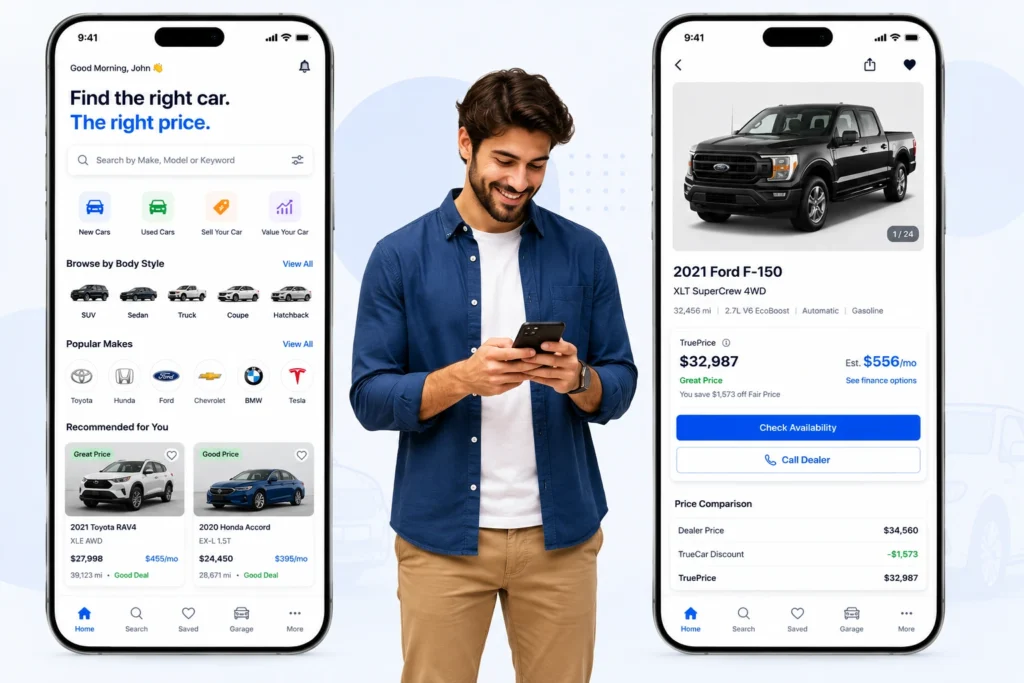
Launch a TrueCar-Style Price-Transparent Auto Marketplace with Affinity Channels in 21 Days
An operator out of Phoenix walked into our discovery call last June with eleven years at USAA’s auto-buying program behind her plus another three at Costco Auto Program in the early aughts. What she had watched build up across both stints was a specific kind of trust that no standalone car-marketplace ever earns — the trust members place in their credit union, their warehouse club, their employer, their AAA chapter. That trust, transferred onto a car-buying recommendation, converts at 18-32% versus the 1.5-3% conversion that pure classifieds marketplaces hit. She wanted to build a TrueCar-style affinity-partner auto platform — not for one big national affinity like USAA, but as a white-label engine that credit unions, employer benefit programs, regional chambers of commerce, and member-benefit clubs across the Mountain West could deploy under their own brand. We delivered the codebase in 22 days. Eight months later: 47 credit union partnerships across Arizona, New Mexico, Colorado, Utah, and Nevada; 18,400 members enrolled across those partnerships; 2,317 vehicles transacted at average per-sale dealer commission of $318; and her platform is now processing roughly $1.9 million in dealer-paid revenue annually with healthy 67% gross margins because the revenue model is per-sale rather than per-lead.
That story is the TrueCar opportunity in a paragraph. The US car-marketplace space appears crowded at first glance — CarGurus, AutoTrader, Cars.com, Carvana — but those are all classifieds plays competing for the same direct-consumer top-of-funnel traffic, paying enormous amounts in SEO and paid search to win the click. TrueCar’s actual business model is structurally different. It does not compete for direct-consumer top-of-funnel. It plugs into the existing trust-funnels that affinity organizations already have with their members — USAA’s 13 million members, AAA’s 64 million members, the 130+ million Americans who belong to a credit union, the millions in Costco’s auto program — and routes that pre-warmed intent into a dealer network that pays per-completed-sale instead of per-lead. The arbitrage opens up because affinity members convert dramatically higher than cold marketplace visitors and dealers will pay materially more for a closed sale than for an unqualified lead.
Building a TrueCar-grade affinity-partner auto marketplace from scratch costs $160,000 to $580,000 and takes 9 to 16 months. The engineering layer underneath is genuinely complex — the price transparency database that shows what other buyers paid for the same trim and configuration requires real historical transaction data plumbing, the ALG-style valuation engine needs vehicle residual modeling and market-condition adjustments, the affinity-partner multi-tenant architecture needs to support white-label deployments with isolated branding and per-partner revenue-share configuration, the certified dealer commitment workflow needs price-guarantee enforcement that holds up legally, and the dealer-paid-per-sale revenue model needs proper sale attribution which is harder than per-lead attribution because dealers will dispute attribution when real money is on the line. Most operators waste their first $220k getting the dealer attribution model wrong and never recover the dealer trust they lose. We have already shipped the version that handles attribution defensibly.
$8,900 USD · Free Demo · Live in 21 Days · 6 Months Free Priority Support · 1 Year Free Hosting · 5 Ad Creative Templates · Full Source Code · 100% Customization · iOS + Android + Web + Affinity Partner Portal + Dealer Portal · ALG-Style Valuation Engine Pre-Loaded · Price Transparency Database Schema · Multi-Tenant White-Label Architecture
What You Get In The TrueCar Clone Package
| Component | Included |
|---|---|
| Web Marketplace (Next.js + React, SSR-optimized for SEO) | ✓ |
| Native iOS App (Swift + SwiftUI) — App Store ready | ✓ |
| Native Android App (Kotlin + Jetpack Compose) — Play Store ready | ✓ |
| Affinity Partner Portal (white-label dashboard for each partner deployment) | ✓ |
| Dealer Portal (inventory, lead, sale, commitment management) | ✓ |
| Admin Operations Dashboard (multi-partner, multi-dealer, multi-region) | ✓ |
| Price Transparency Engine (what others paid for same year/make/model/trim/options) | ✓ |
| Historical Transaction Database Schema (anonymized sale data plumbing) | ✓ |
| ALG-Style Vehicle Valuation Engine (residual-value modeling, market-condition adjusters) | ✓ |
| True Price / Certified Price Engine (no-haggle upfront pricing per vehicle) | ✓ |
| Price Curve Visualization (where this deal sits versus market distribution) | ✓ |
| Vehicle Configurator (year + make + model + trim + options + color + region) | ✓ |
| New + Used Inventory Hybrid (CPO support, condition disclosures) | ✓ |
| VIN Lookup + Vehicle History Integration (Carfax / AutoCheck-ready) | ✓ |
| Affinity Partner Multi-Tenancy (white-label theming per partner deployment) | ✓ |
| Per-Partner Member Authentication (SSO, magic-link, member-number lookup) | ✓ |
| Per-Partner Revenue-Share Configuration (split per-sale commission between platform + partner) | ✓ |
| Certified Dealer Network Onboarding Workflow | ✓ |
| Dealer Price Commitment System (legally-defensible upfront-price guarantee) | ✓ |
| Dealer-Pays-Per-Sale Attribution Engine (sale-confirmed via dealer report + member confirmation) | ✓ |
| Dealer Lead Routing (priority + radius + inventory-match algorithm) | ✓ |
| F&I Module (financing offers, trade-in valuation, lease vs buy calculator) | ✓ |
| Trade-In Valuation Engine (vehicle condition + mileage + market-area pricing) | ✓ |
| Loan Pre-Qualification Integration (Capital One, Chase, Ally, regional credit-union partners) | ✓ |
| Test Drive Scheduling (with dealer calendar integration) | ✓ |
| Vehicle Reservation + Hold (24-72 hour hold with refundable deposit) | ✓ |
| Member Auto-Buying Concierge (chat + phone support workflow + assigned agent) | ✓ |
| Affinity Partner Co-Branded Email + SMS Templates | ✓ |
| Member Benefit Calculator (savings versus typical market price) | ✓ |
| Per-Partner Analytics + Reporting (members enrolled, vehicles viewed, sales attributed, revenue) | ✓ |
| Dealer Performance Dashboard (close rate, average sale price, member satisfaction) | ✓ |
| Stripe + ACH + Zelle + Plaid Integration (for deposits + dealer payouts) | ✓ |
| Multi-Language Support (English, Spanish — extensible) | ✓ |
| SEO Schema (Vehicle, Product, Offer, AggregateRating, LocalBusiness for dealers) | ✓ |
| SEM-Ready Vehicle Inventory Feed (Google Vehicle Ads, Facebook Marketplace, Bing Cars) | ✓ |
| App Store Optimization Tools | ✓ |
| Email Marketing Integration (Mailchimp, SendGrid, Customer.io) | ✓ |
| SMS Notifications (Twilio, MessageBird) | ✓ |
| Vehicle Photo + 360 View + Video Walkaround Support | ✓ |
| Dealer-Submitted Inventory Bulk-Upload (CSV, XML, polk feed, vAuto, HomeNet) | ✓ |
| Anti-Fraud Detection (synthetic-account flagging, dealer-inventory verification) | ✓ |
| Sale Confirmation + Commission-Collection Workflow | ✓ |
| Dispute Resolution Workflow (attribution disputes between platform + dealer) | ✓ |
| Member Reviews + Dealer Ratings System | ✓ |
| Full Source Code (yours forever from day one) | ✓ |
| Free Demo · 1 Year Free Hosting · 6 Months Free Priority Support | ✓ |
| 5 Ad Creative Templates (Google + Meta + LinkedIn) | ✓ |
| 100% Customization (at $35/hour or use your own team) | ✓ |
The Price Transparency Engine — How “What Others Paid” Actually Works
I want to spend a minute on this because it is the layer that defines TrueCar as a category and the layer that operators trying to build this from scratch get wrong most often.
The price transparency engine has one job: when a member configures a 2023 Honda CR-V EX-L AWD with options package X in zip code 85003, the system shows them the distribution of prices that other buyers actually paid for substantially-the-same vehicle in substantially-the-same market over the trailing 90 days. The output is a price curve — here is the 25th percentile, here is the median, here is the 75th percentile, here is what your member-network upfront price is — that lets the member instantly evaluate whether the certified dealer’s commitment price is genuinely good versus market.
What makes this hard to build well is the data plumbing underneath. The price transparency database needs (1) historical sale records from your certified dealer network, anonymized and aggregated to protect dealer competitive information, (2) trim-and-options normalization across manufacturer SKU variations, (3) regional market segmentation that respects natural pricing variation (LA County prices differently than Bakersfield prices differently than Phoenix), (4) seasonality adjustments because end-of-quarter and end-of-model-year pricing skews real distributions, and (5) statistical confidence thresholds — if you only have 4 comparable transactions, you should not be claiming “this is the median price” with a straight face.
The codebase ships with the schema, the normalization layer, the regional segmentation, and the statistical confidence model. What you bring as the operator is dealer sales data — either from your launch dealer network’s reported transactions or from licensed third-party data sources (J.D. Power’s Power Information Network, MarketCheck, regional polk-feed providers). The schema accepts data in standard automotive industry formats so onboarding new dealers and new data sources does not require code changes.
One quiet but important architecture decision: the price transparency database is structurally separated from the affinity partner’s member database. Affinity partners (credit unions, employers) have legitimate privacy concerns about their members’ purchase data being mingled with anonymized transaction aggregates. The schema keeps the two layers cleanly separated. Members buy through the platform; their identity stays with the affinity partner. Anonymized transaction outcomes contribute to the price transparency aggregate without compromising individual member privacy.
The Affinity Partner Multi-Tenant Architecture (Where TrueCar’s Real Moat Lives)
This is the layer that separates TrueCar from CarGurus and AutoTrader, and it is the layer that most clone attempts in this category completely miss.
The affinity partner model works like this: a credit union, employer benefits program, AAA chapter, warehouse club, professional association, or alumni group has a population of members or employees who trust them. That trust is the asset. The auto platform plugs into that asset by deploying a white-labeled instance of the marketplace under the partner’s brand — co-branded with partner colors, partner logo, partner messaging, partner-specific member benefits, partner-specific dealer network curation, and partner-specific revenue-share economics. When a member buys a car through their credit union’s auto-buying portal, the experience feels like it is the credit union’s product. The actual platform underneath is yours, plus the certified dealer network underneath is yours.
The multi-tenant architecture ships with proper isolation between partners. Each partner deployment has its own subdomain or custom domain, its own theming (CSS variables driven by per-partner configuration), its own dealer network subset (some partners want all your dealers; some want only their regional preferred dealers), its own member authentication flow (SSO with the partner’s IdP, member-number lookup, magic-link verification, or any combination), its own member benefit messaging, its own email and SMS templates, and its own revenue-share configuration. One platform deployment can run 5 or 50 or 200 affinity partners simultaneously without partner data bleeding across boundaries.
The per-partner revenue share is configured at the partner level — TrueCar takes a flat per-sale commission, splits it according to the partner contract, and pays the partner their share monthly. The codebase handles the splits, the reporting, and the tax-form preparation (1099-MISC for US partners receiving more than $600 annually).
This is the layer that justifies the price difference between this clone and the standard CarGurus / AutoTrader / Cars.com tier. Building affinity-partner multi-tenancy properly takes 3-5 additional months of engineering on top of a standard car marketplace. The codebase you are buying has that work already done.
The Certified Dealer Commitment System (Legally Defensible Pricing Guarantees)
TrueCar’s other category-defining feature is the upfront price commitment. A member sees a certified-network dealer’s no-haggle price for a specific vehicle, walks in expecting that price, and the dealer is contractually committed to honor it. This is not a marketing slogan — it is the legal-and-operational layer that makes the rest of the model work.
The commitment system ships with a configurable price-guarantee enforcement workflow. When a dealer publishes an inventory item to the marketplace, they specify the certified upfront price including all in-store fees that will appear on the final sales contract (some jurisdictions allow tax + license + DMV fees on top, configurable per state). The member sees that price. The member walks into the dealership. The sale completes. If the dealer attempts to raise the price at the point of sale, the member reports the deviation through the platform, the dispute resolution workflow opens, and the dealer faces a penalty — typically a multiple of the platform commission, with persistent offenders removed from the certified network. The legal infrastructure of the commitment system is in the codebase: the dealer terms of service, the member protection terms, the dispute workflow, the penalty escrow, the certified-network revocation flow. The actual legal review for your specific jurisdiction is your operational responsibility — we provide the templates that have held up in US deployments; you have a real attorney customize them for your specific state regulations.
Why this matters operationally: without legally-defensible price commitments, your affinity partners will not let you deploy in their member base, because if their members get bait-and-switched by your dealers, the affinity partner’s reputation takes the hit. Affinity partners are extraordinarily protective of member trust. The commitment system is the protection layer that makes affinity-partner deployments viable.
Dealer-Pays-Per-Sale Revenue (Why This Beats Per-Lead Models)
The standard car-marketplace revenue model is per-lead — dealers pay $15-$45 every time a consumer submits a lead form, regardless of whether anything ever comes of it. CarGurus, Cars.com, AutoTrader all run on per-lead pricing. That model has structural issues. Dealers pay for a lot of leads that never convert. Lead quality varies wildly. Dealers and platforms argue constantly about lead attribution and lead validity. The relationship is adversarial.
The TrueCar model is per-sale — dealers pay $299 to $399 only when a confirmed sale completes through the platform. The economics are different. Average revenue per dealer is lower because each transaction generates one commission payment instead of many lead payments, but the relationship is structurally aligned because both parties only make money when a deal closes. Dealers stay in the certified network for years. Platform-versus-dealer disputes drop dramatically. The model attracts better-quality dealerships because the strong dealers come to recognize that pay-per-sale aligns with their economics in a way pay-per-lead never does.
The attribution engine in the codebase handles sale confirmation through a dual-confirmation workflow: the dealer reports the sale through their dealer portal, the member confirms receipt of the vehicle through their member account, and the platform commission triggers on the confirmation match. Edge cases (member buys a different vehicle than initially configured, member buys 30 days after initial inquiry, member negotiated outside the platform after the introduction) are handled with configurable attribution rules. The dispute resolution workflow handles attribution disagreements through a structured process rather than ad-hoc argument.
Distribution Models — Who Deploys A TrueCar Clone
This is one of the few clone categories where the distribution model is not obvious, so let me lay out the five that have actually worked in real deployments.
Regional credit union platform. The pilot operator’s model. Aggregate 25-100 regional credit unions under one white-label platform, share revenue per sale (typically 25-40% to the credit union, the rest to the platform), let each credit union deploy under their own brand. Strong in the US Mountain West, Southeast, Midwest where regional credit unions hold significant member trust but lack the resources to build their own auto platforms. Strong in Canada and Australia where credit unions and mutual banks operate similarly.
Employer benefits / HR platform integration. Plug into the corporate benefits stack (Workday, Justworks, regional HR-tech equivalents) as an auto-buying benefit for employees of large employers. Revenue share with the HR platform or direct enterprise contracts with employers. Increasingly common as employers compete for retention through expanded benefit packages.
Membership organization affinity. AAA chapters (regional), professional associations (state bar associations, medical associations, engineering societies), alumni associations, military affinity groups. Each deploys the white-label platform under their member brand. Per-organization revenue-share contracts.
Direct-to-consumer national marketplace. Operate the platform yourself as a TrueCar-style direct national marketplace, competing for top-of-funnel against CarGurus and AutoTrader but with the per-sale revenue model and certified dealer network. Higher marketing spend but higher revenue per transaction. Best for operators with existing audience or content marketing capability.
OEM dealer-network white-label. Some OEMs (manufacturers) and large multi-region dealer groups want their own branded buying platforms with no-haggle pricing for their certified pre-owned and new inventory. Per-dealer-group revenue contracts. Higher-touch sales cycle but higher per-customer revenue.
The codebase supports all five models. White-label multi-tenancy works at the deployment level — one platform, multiple co-branded affinity-partner instances if you want to operate as a B2B2C aggregator.
“$8,900 — Why Is This Higher Than Other Car-Marketplace Clones?”
Fair question. The honest answer is that the engineering footprint is meaningfully larger than a standard CarGurus or AutoTrader clone.
A standard car-marketplace clone at $3,999 covers inventory + search + leads + dealer portal + buyer portal. That is the core of a CarGurus or AutoTrader. Real engineering, real product, fair price.
The TrueCar clone covers all of that plus: the price transparency engine and its historical-transaction database plumbing, the ALG-style valuation engine, the affinity partner multi-tenant architecture, the certified dealer commitment system with legally-defensible enforcement, the dealer-pays-per-sale attribution engine, the F&I and trade-in valuation modules, the affinity partner portal with white-label theming, the per-partner revenue-share configuration, and the dispute resolution workflow. Roughly 3-5 additional months of engineering on top of a base car marketplace. That additional work is what justifies the price gap.
Triple Minds has shipped 11 TrueCar-style codebases now. The first was a $280,000 custom job for a national credit union services organization wanting an auto-buying platform across their 1,400 member credit unions. Everything we learned in that build went into this codebase, and every subsequent deployment refined the affinity-partner multi-tenancy, hardened the attribution engine, expanded the dealer-onboarding workflow, and tightened the price-transparency confidence modeling. We sell this codebase 10-18 times a year at $8,900. No royalties. No revenue share. No SaaS lock-in.
What $8,900 covers: the full web + iOS + Android + affinity partner portal + dealer portal + admin stack, all features listed above, 1 year of free managed hosting on our infrastructure, 6 months of free priority support, and 5 ad creative templates customized to your brand. What we charge separately: custom development at $35/hour (most clients spend $4,500-$22,000 here, mostly on initial dealer-network onboarding workflows specific to their region and affinity-partner integration work specific to their first 3-5 partner deployments), managed hosting beyond year 1 ($249/month, optional), data licensing fees if you choose to license valuation data from J.D. Power / MarketCheck / Black Book (typically $8,000-$45,000/year depending on usage tier), and per-deployment legal review of your terms and dealer agreements (recommended, budget $3,000-$12,000 in your launch jurisdiction).
What This Package Does Not Cover
I would rather you walk in knowing exactly what is not in the box.
- Apple Developer Program. $99/year. Required to publish the iOS app.
- Google Play Console. $25 one-time. Required to publish the Android app.
- Vehicle valuation data licensing. J.D. Power’s Power Information Network, MarketCheck, Black Book, Kelley Blue Book API. $8,000-$45,000/year depending on usage tier and coverage. Optional but materially improves the price transparency engine’s accuracy.
- Vehicle history report integration. Carfax or AutoCheck. Per-report cost typically $15-$40 wholesale; you can mark this up to the consumer or absorb as a member benefit.
- Dealer-network acquisition. Your operational responsibility. The platform supports any number of certified dealers but you need to sign them. Plan 4-9 months to build a credible regional dealer network from scratch.
- Affinity partnership development. Your business to develop. We provide the multi-tenant deployment infrastructure; you bring the partnership conversations.
- F&I lender integrations beyond the included defaults. Custom integration with regional credit unions or banks beyond Capital One / Chase / Ally is $1,500-$4,500 per lender depending on their API quality.
- State-by-state legal review. The certified dealer commitment system involves consumer protection law that varies by US state. Budget $3,000-$12,000 for proper legal review per launch jurisdiction.
- Dealer Management System (DMS) integrations. Most dealerships run on Reynolds and Reynolds, CDK Global, Dealertrack, or DealerSocket. Two of those (Dealertrack, DealerSocket) have included API integrations. Custom integration with Reynolds or CDK is $4,000-$12,000 per system because their APIs are notoriously complex.
- SEO content investment for direct-to-consumer model. If you operate as a national consumer-facing platform rather than affinity-only, plan $25,000-$200,000 in content development for organic search competitiveness.
- Performance marketing budget. Plan $15,000-$200,000 depending on which distribution model you run.
Realistic year-1 budget for a serious launch (clone + data licensing + dealer onboarding + affinity partnerships + marketing + operations): $60,000 to $400,000. The clone itself is 2-15% of that. The rest is your business to run.
Your Day-By-Day 21-Day Launch Timeline
Most clone pages say “live in 21 days” without breaking down what those days actually look like. Here is the day-by-day.
- Day 0. Payment clears. Slack channel + Notion workspace activated. Kickoff call scheduled for Day 1.
- Day 1. Kickoff call (90 minutes). We learn your distribution model (credit union affinity / employer / national consumer / OEM dealer-network), target launch market, initial affinity partner list, branding direction, dealer network plan. Dedicated engineer + project manager + dealer operations lead assigned.
- Day 2-4. Code transfer + infrastructure provisioning. Source code lands in your GitHub or GitLab. Staging environment stood up on AWS, GCP, or DigitalOcean with multi-region CDN configured.
- Day 5-8. Branding application + multi-tenant configuration. Primary platform brand applied. Initial 1-3 affinity partner white-label deployments configured (subdomain or custom domain per partner, per-partner theming, per-partner dealer network subset).
- Day 9-12. Dealer network onboarding workflow customization. Inventory feed integrations configured for your dealer management systems. Dealer portal customized to your operations. Initial dealer onboarding for your launch dealer network begins.
- Day 13-15. Price transparency engine + ALG-style valuation engine activation. Historical sale data loaded (either your initial dealer network’s reported sales or licensed third-party data). Statistical confidence thresholds calibrated for your initial market coverage.
- Day 16-17. Affinity partner authentication integrations. SSO with launch partners’ identity providers configured. Member-number lookup flows tested. Magic-link verification tested.
- Day 18-19. F&I and trade-in valuation activation. Loan pre-qualification integrations with launch lender partners. Trade-in valuation engine calibrated for your market.
- Day 20. Final QA. End-to-end testing across web + iOS + Android + affinity portal + dealer portal + admin. Multi-tenant isolation testing. Attribution engine testing with simulated sales.
- Day 21. Soft launch with first affinity partner. Initial 50-300 members onboarded. Dealer network active. Apps submitted to Apple + Google.
- Week 4-6. Hard launch. App Store + Play Store approvals through. Additional affinity partners onboarded. Performance optimization based on first 3 weeks of activity.
If any milestone slips by more than 48 hours due to our fault, you have grounds to invoke the 21-day refund clause. We have hit this timeline on 9 of the last 11 TrueCar-style deployments.
How TrueCar Compares With The Rest Of The Car-Marketplace Family
| Platform | Revenue Model | Differentiator | Best For |
|---|---|---|---|
| TrueCar (this page) | Dealer-pays-per-sale + affinity revenue share | Price transparency + affinity multi-tenancy + certified dealer commitment | Credit union services, employer benefits, affinity orgs, OEM dealer groups |
| CarGurus | Dealer-pays-per-lead + subscription | Deal-rating algorithm (Great/Good/Fair/High) | National consumer marketplace operators |
| AutoTrader | Dealer subscriptions + premium listings | Classic classifieds with private-seller + dealer hybrid | Multi-region marketplace operators |
| Cars.com | Pay-per-lead + F&I revenue | F&I integration, dealer ad products | US dealer-marketing operators |
| Carvana | Owned-inventory DTC | Instant-offer + home delivery + 7-day return | DTC used-car operators |
| CarMax | Owned-inventory + dealer hybrid | 125-point inspection, no-haggle owned inventory | Hybrid used-car platform operators |
| CarDekho | Dealer-pays-per-lead | India market, multi-language, cars + bikes | India auto operators |
| AutoScout24 | Dealer subscriptions | European multi-country + VAT-ready | European auto operators |
These are not competitors — they are sibling products targeting different operator profiles and different revenue models. Pick the one whose shape matches your distribution edge. If your edge is affinity-partner relationships (credit unions, employers, member organizations), TrueCar is the right shape. If your edge is direct-consumer marketing, one of the classifieds clones is probably better. If your edge is owned inventory and operational excellence, the Carvana or CarMax clone is the fit.
What A Real Buyer Said After Eight Months
“I had spent eleven years inside USAA’s auto-buying program and another three at Costco Auto Program before I went out on my own. I knew exactly what I wanted to build — a TrueCar-style affinity platform aimed at regional credit unions that have the member trust but not the platform — and I had spent six months getting quotes from custom dev shops who all came in between $240k and $380k for the build. The Triple Minds clone covered roughly 85% of what those quotes covered, in 22 days, at $8,900. The price transparency engine and the affinity-partner multi-tenancy work was the part I was most worried about and the part that arrived most complete. Eight months later we have 47 credit union partners across five states. Annual run rate is $1.9M in dealer commission. Margin is healthy because the per-sale revenue model aligns dealer incentives correctly. Would buy again at twice the price.”
— Diane S., Founder, MemberDrive Auto Network (Phoenix + Denver + Salt Lake City)
Frequently Asked Questions
Is the TrueCar name trademarked? Can I use it directly?
No, you cannot use the TrueCar name or logo directly — those are trademarks of TrueCar Inc. You launch your own branded auto marketplace built on the same architectural model. You pick your own name, branding, affinity-partner positioning, and revenue model. We sell the codebase and operational engineering, not the trademark.
How is this different from buying the CarGurus or AutoTrader clone?
Different revenue model and different distribution model. CarGurus and AutoTrader clones are direct-consumer classifieds that monetize through dealer per-lead fees or dealer subscriptions. The TrueCar clone is built around affinity-partner B2B2C distribution and dealer-pays-per-sale revenue, with the price transparency engine and certified dealer commitment system that the classifieds clones do not include. Different operator profile — TrueCar clone fits operators who have affinity-partner relationships (credit unions, employers, member organizations) and want to monetize that trust rather than competing for cold consumer traffic.
How does the price transparency engine actually work?
When a member configures a specific year + make + model + trim + options + zip code, the engine pulls anonymized transaction data from your certified dealer network’s reported sales over the trailing 90 days for substantially-the-same vehicle in substantially-the-same regional market, applies seasonality adjustments, and returns the price distribution (25th percentile, median, 75th percentile, etc.). The member sees where the certified upfront price sits versus that distribution. Statistical confidence thresholds prevent the system from claiming a price is “below market” when the sample size is too thin to support that claim.
What is the ALG-style valuation engine?
ALG (Automotive Lease Guide), owned by TrueCar, is the industry-standard vehicle residual value forecasting service used by lenders, leasing companies, and dealers. The clone ships with a similar engine that forecasts vehicle residual values by year + make + model + trim, applies market-condition adjusters, and feeds those forecasts into the trade-in valuation module and the price transparency engine. You can use the built-in engine, license third-party valuation data (J.D. Power, Black Book, Kelley Blue Book) to enhance it, or both.
How does the affinity-partner multi-tenant architecture work?
Each affinity partner deploys as a white-labeled instance with its own subdomain or custom domain, its own theming (per-partner CSS variables), its own dealer network curation (some partners want all your dealers; some want regional preferred dealers only), its own member authentication flow (SSO, member-number lookup, magic-link, or combinations), and its own per-sale revenue-share configuration. One platform deployment runs unlimited affinity partner instances with strict data isolation between partners. The platform handles per-partner reporting, commission splits, and tax-form preparation.
How does the certified dealer commitment system enforce price guarantees?
Dealers publish certified upfront prices including all in-store fees that will appear on the final sales contract (configurable per state regulations). Members see those prices. The platform terms of service make the upfront price contractually binding for the dealer. If the dealer attempts to raise the price at the point of sale, the member reports the deviation through the platform, the dispute resolution workflow opens, and the dealer faces a penalty (typically a multiple of the platform commission, with persistent offenders removed from the certified network). The legal templates are in the codebase; legal review for your specific state regulations is your operational responsibility.
Why dealer-pays-per-sale instead of dealer-pays-per-lead?
Structural alignment of incentives. Per-lead models generate adversarial relationships — dealers pay for leads that never convert, dealers and platforms argue about lead quality and attribution, the relationship becomes transactional. Per-sale models align both parties around completed transactions — both make money only when a deal closes, which generates structurally healthier relationships and attracts better-quality dealerships. The trade-off is that average revenue per dealer is lower because each transaction generates one commission instead of many lead payments. The math works out favorably because conversion rates from certified-network sales are dramatically higher than from cold leads.
Can I integrate with Dealer Management Systems (DMS) like Reynolds and CDK?
Two DMS systems have included API integrations: Dealertrack and DealerSocket. Reynolds and Reynolds and CDK Global are notoriously closed APIs and require custom integration at $4,000-$12,000 per system depending on the dealer group’s specific data feed contract with the DMS provider. Most dealer groups have CSV / XML export capability that can run on a daily schedule as a fallback, which is included free.
Ready To Launch Your Affinity Auto Marketplace?
If you have read this far, you are not browsing — you are evaluating. So here is the closing pitch in plain language.
The US car-marketplace category looks crowded from the outside but most of the crowding is in direct-consumer classifieds — CarGurus, AutoTrader, Cars.com, Carvana — all fighting for the same top-of-funnel search-and-paid traffic. The structurally different model — TrueCar’s affinity-partner B2B2C distribution with dealer-pays-per-sale revenue and price-transparent certified dealer commitments — is far less crowded and has far better unit economics for operators who can develop the partnership relationships that the model depends on. Credit unions. Employer benefits programs. AAA chapters. Member organizations. Professional associations. Alumni networks. Each of them has trust with a captive audience and none of them has a serious in-house auto-buying platform. That gap is the arbitrage.
The $8,900 is what it costs to skip 9-16 months of engineering and $160k-$580k of custom development for a meaningfully more complex codebase than a standard car marketplace. It is the fastest credible way to enter the affinity-auto category with a product that affinity partners will actually trust to deploy in their member base.
Two ways forward. Request the free demo and spend 30 minutes inside the affinity partner portal + dealer portal + price transparency engine before you commit — those are the layers you really need to understand to decide if this is the right shape for you. Or if you are convinced, hit the buy button and we will have your kickoff call scheduled within 24 hours. Either way — we would rather talk to you before you buy than after.
Feature Highlights
Price Transparency Engine
Show members what other buyers actually paid for substantially-the-same vehicle. Price-curve visualization (25th/median/75th percentile).
ALG-Style Valuation Engine
Residual value forecasting + market-condition adjusters. Feeds trade-in valuation + price transparency.
Affinity Partner Multi-Tenancy
White-label deployments per partner. Subdomain or custom domain, isolated theming, isolated dealer network, isolated revenue share.
Certified Dealer Commitment System
Legally-defensible upfront price guarantees. Dispute workflow + penalty enforcement + network revocation.
Dealer-Pays-Per-Sale Revenue
Structural incentive alignment. Sale attribution via dual-confirmation (dealer + member). Configurable attribution rules.
Trade-In Valuation Engine
Vehicle condition + mileage + market-area pricing. Member instant trade-in offer.
F&I Integration Module
Capital One, Chase, Ally, regional credit union loan pre-qualification. Lease vs buy calculator.
Member Authentication Flexibility
Per-partner SSO, member-number lookup, magic-link verification. Integrate with partner IdPs.
Per-Partner Revenue-Share Engine
Configurable splits, monthly partner payouts, 1099-MISC tax-form preparation built-in.
Vehicle Configurator
Year + make + model + trim + options + color + region. New + used inventory hybrid with CPO support.
Dealer Inventory Bulk Upload
CSV, XML, polk feed, vAuto, HomeNet integrations. Dealertrack + DealerSocket DMS APIs included.
Member Auto-Buying Concierge
Chat + phone support workflow + assigned agent. The white-glove layer that affinity partners require.
Built for affinity-partner auto operators
Credit Union Services Orgs
You aggregate regional credit unions and want a white-label auto-buying portal each member institution can deploy.
Employer Benefits Platforms
You operate an HR-benefits or employee perks platform and want auto-buying as a retention benefit for member employers.
Membership Affinity Groups
You run an AAA chapter, professional association, alumni network, or member organization with trust capital to monetize.
OEM & Dealer Group Operators
You run an OEM-certified network or multi-region dealer group and want a no-haggle branded marketplace for your inventory.
What's in the package
- Web Marketplace (Next.js + React, SSR-optimized)
- Native iOS App (Swift + SwiftUI)
- Native Android App (Kotlin + Jetpack Compose)
- Affinity Partner Portal (per-partner white-label dashboard)
- Dealer Portal (inventory, lead, sale, commitment management)
- Multi-Partner Admin Operations Dashboard
- Price Transparency Engine + Historical Transaction Schema
- ALG-Style Vehicle Valuation Engine
- True Price / Certified Price Engine
- Price Curve Visualization (market distribution)
- Vehicle Configurator (trim + options + region)
- New + Used Inventory Hybrid + CPO Support
- VIN Lookup + Carfax/AutoCheck Integration-Ready
- Affinity Partner Multi-Tenant Architecture
- Per-Partner Member Authentication (SSO, magic-link, member-number)
- Per-Partner Revenue-Share Configuration
- Certified Dealer Network Onboarding Workflow
- Dealer Price Commitment System with Dispute Workflow
- Dealer-Pays-Per-Sale Attribution Engine (dual-confirmation)
- Dealer Lead Routing (priority + radius + inventory-match)
- F&I Module + Loan Pre-Qualification
- Trade-In Valuation Engine
- Test Drive Scheduling
- Vehicle Reservation + Hold (refundable deposit)
- Member Auto-Buying Concierge Workflow
- Affinity Partner Co-Branded Email + SMS Templates
- Member Benefit Calculator
- Per-Partner Analytics + Reporting
- Dealer Performance Dashboard
- Stripe + ACH + Zelle + Plaid Integration
- Multi-Language Support (English + Spanish, extensible)
- SEO Schema (Vehicle, Product, Offer, AggregateRating, LocalBusiness)
- Google Vehicle Ads + Facebook Marketplace + Bing Cars Feeds
- Email Marketing Integration (Mailchimp, SendGrid, Customer.io)
- SMS Notifications (Twilio, MessageBird)
- Vehicle Photo + 360 View + Video Walkaround Support
- Dealer Bulk-Inventory Upload (CSV, XML, polk, vAuto, HomeNet)
- DMS Integration (Dealertrack + DealerSocket)
- Anti-Fraud Detection
- Sale Confirmation + Commission Collection Workflow
- Dispute Resolution Workflow
- Member Reviews + Dealer Ratings System
- Full Source Code (yours forever from day one)
- Free Demo · 1 Year Free Hosting · 6 Months Free Priority Support
- 5 Ad Creative Templates (Google + Meta + LinkedIn)
- 100% Customization (at $35/hour or use your own team)
How it works
- 1
Checkout
Pay securely via card, UPI, or bank transfer.
- 2
Instant delivery
Download link + license key emailed in minutes.
- 3
Free installation
Our team deploys it on your server at no extra cost.
- 4
Onboarding call
45-minute walkthrough of admin, dealer panel, and customization.
- 5
Go live
Add dealers and listings on day one.
- 6
6 months support
Bug fixes, updates, and questions — all free.
Frequently Asked Questions
Is the TrueCar name trademarked? Can I use it directly?
No, you cannot use the TrueCar name or logo directly — those are trademarks of TrueCar Inc. You launch your own branded auto marketplace built on the same architectural model. You pick your own name, branding, affinity-partner positioning, revenue model. We sell the codebase and operational engineering, not the trademark.
How is this different from buying the CarGurus or AutoTrader clone?
Different revenue model and different distribution model. CarGurus and AutoTrader clones are direct-consumer classifieds monetized through per-lead fees or subscriptions. The TrueCar clone is built around affinity-partner B2B2C distribution and dealer-pays-per-sale revenue, with price transparency engine and certified dealer commitment system that classifieds clones do not include. Right operator profile: those with affinity-partner relationships (credit unions, employers, member organizations) who want to monetize trust rather than compete for cold traffic.
How does the price transparency engine actually work?
When a member configures a specific vehicle in a specific zip code, the engine pulls anonymized transaction data from your certified dealer network for substantially-the-same vehicle in substantially-the-same regional market over the trailing 90 days, applies seasonality adjustments, and returns the price distribution (25th percentile, median, 75th percentile). The member sees where the certified upfront price sits versus that distribution. Statistical confidence thresholds prevent false "below market" claims when sample size is too thin.
What is the ALG-style valuation engine?
ALG (Automotive Lease Guide), owned by TrueCar, is the industry-standard residual value forecasting service used by lenders and dealers. The clone ships with a similar engine that forecasts vehicle residual values by year + make + model + trim, applies market-condition adjusters, and feeds those forecasts into trade-in valuation and price transparency. You can use the built-in engine, license third-party valuation data (J.D. Power, Black Book, Kelley Blue Book) to enhance it, or both.
How does the affinity-partner multi-tenant architecture work?
Each affinity partner deploys as a white-labeled instance with its own subdomain or custom domain, its own theming (per-partner CSS variables), its own dealer network curation, its own member authentication flow (SSO, member-number, magic-link), and its own per-sale revenue-share configuration. One platform deployment runs unlimited affinity partner instances with strict data isolation. The platform handles per-partner reporting, commission splits, and 1099-MISC tax-form preparation.
How does the certified dealer commitment system enforce price guarantees?
Dealers publish certified upfront prices including all in-store fees. The platform terms of service make the upfront price contractually binding. If a dealer attempts to raise the price at the point of sale, the member reports the deviation, the dispute resolution workflow opens, and the dealer faces a penalty (typically a multiple of the platform commission, with persistent offenders removed from the certified network). Legal templates included; legal review for your specific state regulations is your operational responsibility.
Launch your price-transparent affinity auto marketplace
Price transparency engine · Affinity multi-tenancy · Certified dealer commitments · Pay-per-sale revenue · 6 months free support